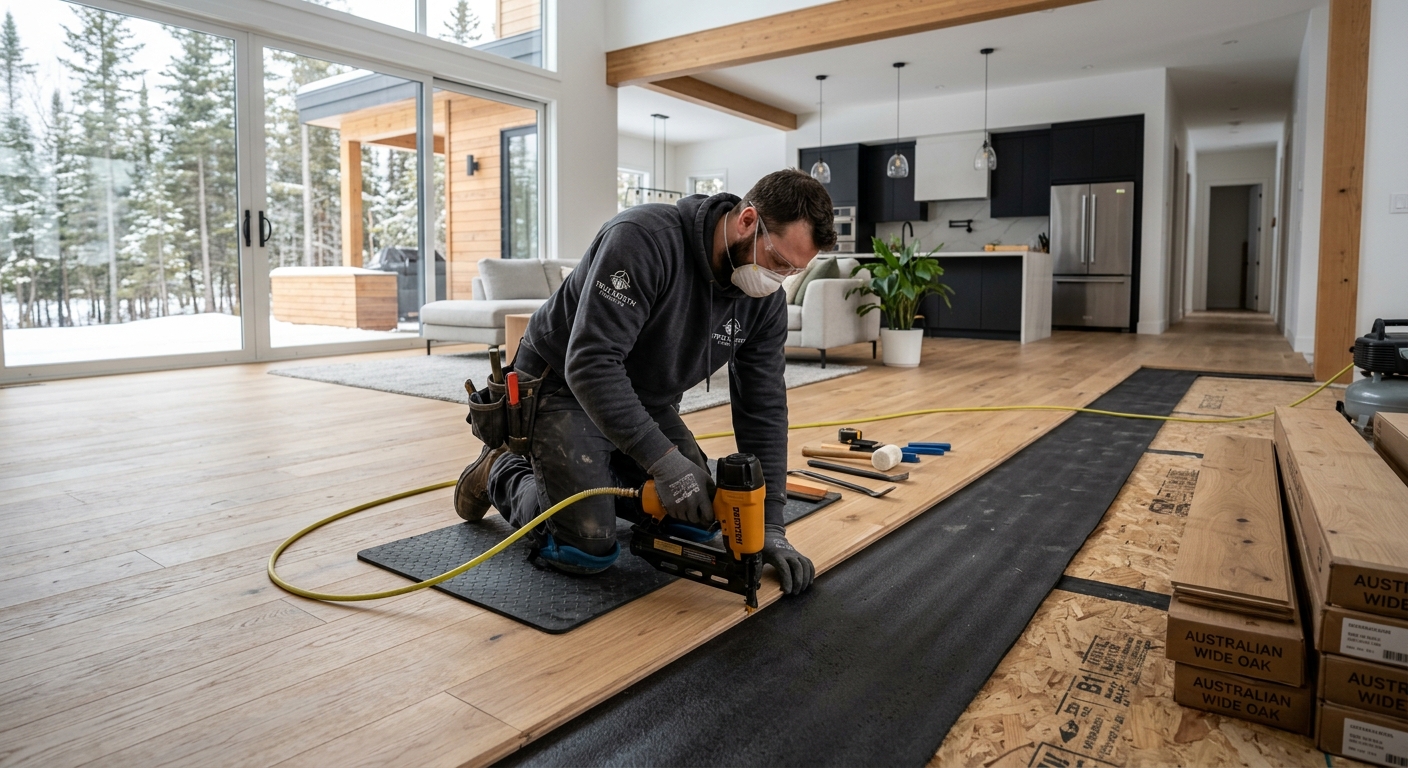
Flooring options and costs in South Parkdale
South Parkdale is a lively, renovation-heavy neighbourhood inside Toronto, and that shows up in how quickly flooring projects get scheduled—and how detailed your quote should be. With a population of 21,849 in the area (Statistics Canada, 2021 Census), contractor availability is generally good, but demand also pushes labour pricing up during peak months. Just as important: much of the housing stock around Toronto dates back decades, and older basements and subfloors often need levelling, plywood replacement, or moisture mitigation before any finish floor goes down. In practice, that prep can add a meaningful line item even when the selected floor is mid-range.
Toronto’s seasonal swings bring wide indoor humidity changes, and that’s why we steer most clients toward engineered hardwood or luxury vinyl plank rather than solid hardwood for the majority of homes. Basements and concrete slabs are common in South Parkdale, and solid hardwood is risky in those conditions because it expands/contracts with moisture and generally isn’t appropriate over concrete. If you’re in a newer infill or custom home with radiant floor heating, that also changes the shortlist—engineered wood, tile, and many LVP systems are more compatible than traditional solid hardwood.
In South Parkdale, especially around the Roncesvalles and Queen West corridor, flooring installs are in steady demand because lots of homeowners are refreshing older interiors and updating rental-ready finishes. Below is a practical comparison of the main options so you can see typical budget ranges, then we’ll break down what drives the differences between quotes.
| Type |
Best Room |
Moisture Resistance |
Lifespan |
Price per sq ft |
| Solid hardwood (nail-down, above grade only) |
Living room, dining room (above grade) |
Low to moderate; moves with humidity |
25–50 years |
$9,00 – $18,00 |
| Engineered hardwood (float or glue, above + on-grade) |
Main floor, bedrooms (above grade) |
Good; more dimensionally stable |
20–35 years |
$8,00 – $16,00 |
| Laminate (click-lock, above-grade) |
Bedrooms, hallways (above grade) |
Moderate; vulnerable at seams to standing water |
10–25 years |
$4,00 – $9,00 |
| Luxury vinyl plank / LVP (waterproof, any level) |
Kitchen, basement (finished) |
Very high; withstands moisture well |
15–25 years |
$5,00 – $10,00 |
| Porcelain / ceramic tile |
Kitchen, bathrooms, mudrooms |
Very high; grout maintenance required |
25–50 years |
$12,00 – $25,00 |
| Carpet (broadloom or modular tile) |
Bedrooms, stairs (comfort) |
Low; can hold odours if damp |
7–15 years |
$5,00 – $11,00 |
Prices are estimates only and vary by project scope, site access and material selection.
What affects the price of flooring in South Parkdale
In South Parkdale and across the Toronto economic region, it’s common to see quotes for the same room run 30–50% apart. The biggest reason isn’t just the floor material—it’s what the installer needs to fix (or avoid) before laying it, plus how your project interacts with Toronto’s indoor humidity swings and common below-grade conditions. Solid hardwood is sensitive to moisture and can’t be installed over concrete or used reliably in basements. Engineered hardwood and luxury vinyl plank are designed for higher-humidity installs and are the safer choices when you’re dealing with concrete slabs or finished basements.
Cold-weather and radiant heat compatibility also affects pricing and product selection. If you’re installing over in-floor heating, many homeowners choose engineered wood or tile because the heating cycles and expansion requirements are better matched than traditional solid hardwood. Older regional housing stock frequently needs subfloor levelling or repair; that prep can add roughly $1–$4 per sq ft depending on what’s wrong—bubbles, delamination, squeaks, or damaged plywood.
Concrete examples: (1) a 600 sq ft living/dining area with a “flat enough” subfloor can come in near the mid-band (for example, engineered hardwood often aligns with the $8,00–$16,00 range per sq ft), but if the same home needs plywood replacement and a feather-finish leveler, labour rises quickly. (2) a basement project where LVP is chosen may stay closer to the laminate/LVP budget band, while attempting solid hardwood in a below-grade situation often triggers extra moisture mitigation and risk—meaning you’ll pay more to do it right, or you’ll redo it sooner. That’s why we often recommend LVP for basements and only use solid where moisture conditions and installation method match.
| Price Factor |
Why It Matters |
Cost Impact |
| Room area in sq ft |
More square footage increases material, underlay, and labour time. |
Higher total cost; per-sq-ft tends to be more stable on larger jobs. |
| Subfloor condition |
Levelling compounds, plywood replacement, and fixing squeaks must happen before install. |
Often adds $1–$4 per sq ft in older Toronto-area homes. |
| Moisture / below-grade install |
Solid hardwood is not a basement-friendly choice; below-grade needs vapour-aware systems. |
Can shift you to engineered wood or LVP; may reduce future remediation costs. |
| Material choice |
Hardwood, engineered wood, LVP, tile, and laminate differ greatly in material pricing. |
Big swing: LVP often in the $5,00–$10,00 range vs tile $12,00–$25,00. |
| Removal and disposal of existing flooring |
Tearing out old layers and hauling debris adds labour and disposal fees. |
Can add a meaningful add-on, especially with thick underlay or glued-down products. |
| Stair nosing / transitions |
Transitions and stair finishes require custom pieces and additional time. |
Charged per step or per linear foot; adds visible cost quickly. |
| Radiant heat compatibility |
Heat cycling affects expansion; some products are restricted on heated floors. |
May require a specific engineered/tile/LVP system, slightly raising material costs. |
| Installation method |
Float, glue-down, or nail-down changes labour steps and subfloor prep demands. |
Glue-down and nail-down generally require stricter flatness and prep. |
Permits & regulations in Ontario
In Ontario, the flooring installation itself usually does not require a building permit. However, related work can trigger permits—especially when you’re altering electrical systems for radiant in-floor heating, or performing structural subfloor repairs that involve significant modifications. If your project includes electrical work (for example, installing or modifying in-floor heating circuits), that part typically falls under electrical permitting requirements.
For condominiums in the South Parkdale area, the bigger “rule” is often the condo corporation’s documentation: you must follow the declaration/by-laws and any sound-transmission requirements. Hard flooring can affect impact noise, so you may be required to use a specific underlay or a system rated for STC/IIC performance. Always request approval in writing before installation, particularly for tile and hardwood on upper floors.
Step-by-step for homeowners: (1) ask the contractor for their Ontario licence information and confirm they’re properly registered for the work they’re performing; (2) request a certificate of insurance naming you (where applicable) and ensure general liability is active for the project period; (3) verify WSIB/WCB coverage for workers—ask for confirmation letters or clearance details rather than a verbal promise. Then, compare quotes only after you’re sure the scope includes the same prep, underlay/vapour barrier approach, transitions, and disposal. If the contractor won’t provide documentation upfront, that’s a red flag.
Best flooring for each room in your South Parkdale home
Choosing flooring in South Parkdale comes down to moisture exposure, traffic level, and comfort—then matching the product to Toronto’s humidity swings. For living and dining areas, engineered hardwood or high-quality laminate is a strong balance: it delivers warmth and an upscale look while handling the region’s seasonal changes better than solid hardwood. If you want the most comfortable option upstairs, carpeting is still a favourite for bedrooms because it reduces sound and adds warmth in winter.
In kitchens, we typically move homeowners toward luxury vinyl plank (LVP) or large-format porcelain tile. LVP performs well because it’s waterproof and tolerates splashes without swelling, which matters when the seasons bring unpredictable moisture tracking from entrances. Porcelain tile is also an excellent “set-and-forget” finish—just plan on grout maintenance.
Basements in Toronto are where the decision becomes critical. LVP is usually the clear winner for finished basements because it’s designed for below-grade installs and fully waterproof performance. Traditional solid hardwood and most laminate products are more likely to react to moisture vapour and can fail or buckle over time if conditions aren’t perfectly controlled. Bathrooms should be porcelain or ceramic tile only.
If you’re upgrading in a home with radiant floor heating, engineered wood, tile, and many LVP systems generally pair better than solid hardwood due to heat and expansion considerations. For a concrete budgeting example: if engineered hardwood is near the $8,00–$16,00 per sq ft range but LVP is closer to $5,00–$10,00, it can be worth spending toward engineered in living spaces while using waterproof LVP in the basement—so you’re paying for performance where it’s actually needed.
| Room |
Best Material |
Why |
Moisture Risk |
Price Band per sq ft |
| Living / dining room |
Engineered hardwood |
Warm look with better dimensional stability for Toronto’s humidity swings. |
Low to moderate |
$8,00 – $16,00 |
| Master bedroom |
Carpet or engineered hardwood |
Carpet adds comfort and quiet; engineered holds up well to seasonal change. |
Low |
$5,00 – $16,00 |
| Secondary bedrooms |
Carpet (comfort) or laminate (budget) |
Laminate is economical; carpet helps with sound in multi-room households. |
Low |
$4,00 – $11,00 |
| Kitchen |
Luxury vinyl plank (LVP) or porcelain tile |
LVP handles spills; tile is durable and easy to clean. |
Moderate to high |
$5,00 – $25,00 |
| Basement (finished) |
Luxury vinyl plank (LVP) |
Waterproof and better suited to below-grade moisture vapour than hardwood/laminate. |
High |
$5,00 – $10,00 |
| Bathroom |
Porcelain / ceramic tile |
Maximum water resistance; durable under frequent wet conditions. |
Very high |
$12,00 – $25,00 |
How to choose a flooring contractor in South Parkdale
Start by verifying Ontario coverage and credentials the same way you would for any trade. Ask for their liability insurance certificate (active for the project dates) and proof of WSIB/WCB coverage for workers. How to check: look for an insurance certificate from the insurer showing the effective dates and coverage limits, then request WSIB/WCB clearance evidence rather than a one-page claim summary. If they can’t provide documentation, slow down—your cost risk increases fast if something goes wrong under renovation conditions.
Next, get 2–3 itemised written quotes. You want a breakdown that separates labour, removal/disposal, subfloor prep/levelling, underlay or vapour barrier, transitions, and any stair nosing work. Avoid lump sums that don’t explain exclusions—quotes that don’t mention disposal or transitions can end up charging you later when they “discover” stair pieces or edge cases. Also confirm whether any permit-related work is included where it applies (for example, electrical work for radiant systems).
Warranty matters, too: confirm the workmanship warranty length and what’s covered, plus the product/manufacturer warranty (and whether it’s transferable if you sell your home). Agree on a payment schedule—never more than 10–15% upfront, and keep a holdback until the job is complete and cleaned up. Finally, request a start date and completion estimate in writing, including contingency for drying/curing time if levelling compounds or glue-down systems are used.
- Confirm they carry active general liability insurance for the job period.
- Verify WSIB/WCB coverage using clearance or confirmation documentation.
- Ask for proof of Ontario registration/licence relevant to their scope.
- Get at least 2–3 itemised quotes (labour + materials + prep separated).
- Ensure removal and disposal are clearly included or priced separately.
- Confirm underlay/vapour barrier type and who supplies it.
- Ask how they handle subfloor moisture concerns (tests and remediation steps).
- Confirm transitions and stair nosing are itemised per step/linear foot.
- Check the flatness/levelness standard they’ll meet before glue/nail installs.
- Review warranty details: workmanship coverage and product warranty terms.
- Set a payment schedule with only 10–15% upfront and a final holdback.
- Get the schedule in writing, including curing/drying time for any prep.
Red flags we see in South Parkdale: contractors who won’t provide insurance/WSIB documentation, quotes that omit disposal or transitions yet assume “standard trim,” vague scope language like “prep as needed” without a price cap, refusal to put timeline and start date in writing, and crews who install over questionable subfloors without discussing moisture and levelling first.
Frequently asked questions — flooring in South Parkdale
Do I need to level my subfloor first?
In most South Parkdale homes—especially those with older subfloors—levelling is less of a “nice-to-have” and more of a requirement for long-term performance. If your subfloor has dips, high spots, or damaged plywood, the new floor won’t sit correctly, which can cause gaps, squeaks, or premature wear. Solid hardwood is particularly unforgiving because it needs a stable, consistent surface; engineered and LVP can be more forgiving, but they still need flatness for locking joints and proper support. Many regional upgrades also uncover areas that require repair before finish flooring can be installed. If you’re budgeting, remember that subfloor repair and levelling commonly add roughly $1–$4 per sq ft in older Toronto-area properties (scope dependent), and it’s a major reason quotes can differ by 30–50%.
What's the most durable flooring for pets and kids?
For pets and kids in Ontario, durability means impact resistance plus moisture tolerance. In South Parkdale, luxury vinyl plank (LVP) is usually the top pick because it handles everyday spills and has waterproof construction—so accidents don’t turn into swelling or cupping. It also stands up well to high-traffic wear better than carpet, and it’s easier to clean than many fibre-based options. If you want a wood look, engineered hardwood is a close second for above-grade areas, but we still recommend careful mat placement near entry points and quick cleanup for liquids. As a budget guide, LVP often falls around the $5,00–$10,00 per sq ft range, while engineered hardwood commonly sits higher (for example $8,00–$16,00). The “most durable” choice is the one that matches where moisture actually shows up in your home—especially basements.
How do I choose flooring for humidity in South Parkdale?
Toronto-area homes see wide indoor humidity swings across seasons, and South Parkdale is no exception. That climate reality affects how materials move. Solid hardwood expands and contracts with humidity, and it performs poorly in basements and is not the right choice over concrete in most cases. Engineered hardwood and luxury vinyl plank handle humidity far better because they’re built to be more dimensionally stable. If your installation includes a basement, that’s where humidity risk becomes a deal-breaker: we typically steer homeowners toward waterproof LVP designed for below-grade installs. For bathrooms and laundry-adjacent spaces, tile is still the best moisture-controlled finish. If you’re considering laminate, it can work above grade, but it’s vulnerable at seams if water sits for long periods. Your best humidity strategy is pairing the correct product with proper vapour barrier/underlay and fast cleanup habits.
Do condos restrict hard flooring?
Yes, South Parkdale condo rules often restrict or specify hard flooring requirements, mainly to manage sound transmission. The condo corporation’s documentation may require an approved underlay, installation method, or a product that achieves certain STC/IIC ratings. The specific requirement can vary by building, so the homeowner should request board approval (often in writing) before installation—especially for hardwood and tile on upper floors. This isn’t only about permits; it’s about compliance with the condo’s standard for noise control. Practically, it can also affect your quote because some underlay systems are required and can raise material costs slightly. Plan the process early so you’re not delaying installation while waiting for approval.
How do I compare flooring quotes?
To compare quotes fairly in South Parkdale, insist on itemised breakdowns rather than lump sums. Ask each contractor to separate labour from materials, clearly list removal/disposal, identify subfloor prep/levelling scope, and state the underlay/vapour barrier they’ll use. Check whether transitions and stair nosing are included or charged separately per linear foot or per step. Make sure the quote specifies the exact product tier (not just “engineered hardwood” generally), since one brand’s wear layer and thickness can change both lifespan and price. Also confirm warranty details: workmanship coverage length and manufacturer warranty terms. As a quick reality check, LVP commonly lands in the $5,00–$10,00 per sq ft band, while tile is often $12,00–$25,00; if a quote’s numbers are out of band without explanation, ask why. Once the scopes match, you can judge the true value.
Can I install flooring over existing tile in South Parkdale?
Sometimes, but it depends on the tile condition and what floor you’re installing over it. For many South Parkdale jobs, contractors can install over existing tile if the surface is sound, properly level, and clean—however, tile’s high rigidity and grout ridges can create an uneven base for click-lock laminate or certain vinyl systems if not addressed. In some cases, we recommend grinding high spots, patching low areas, or using an appropriate underlayment system designed for that substrate type. If the existing tile is loose, cracked, or uneven, it may need removal rather than being treated as a “free base,” which affects both cost and long-term performance. Also consider height transitions at doorways and stair edges. If you’re aiming to avoid demolition, ask the contractor to assess flatness and explain the method they’ll use before you commit.