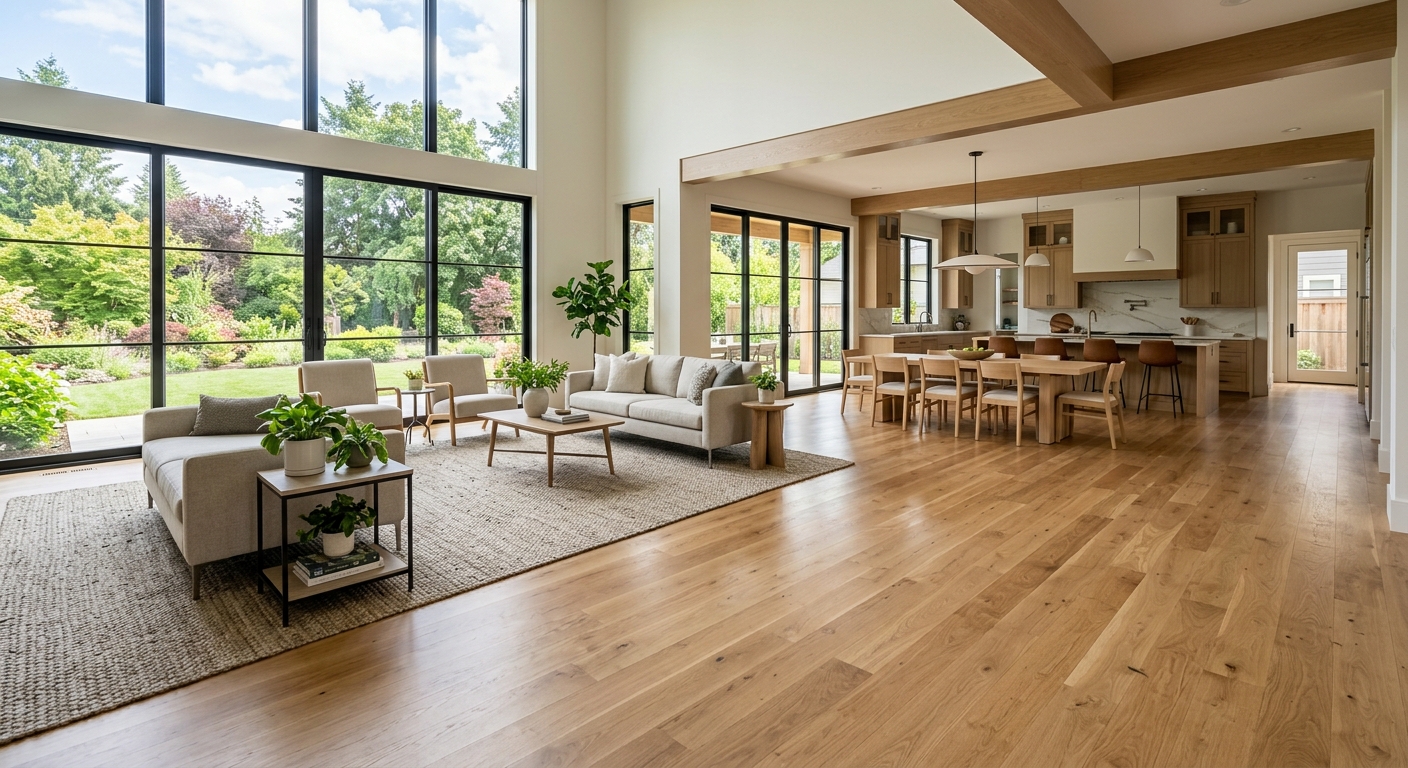
Flooring options and costs in Midland
Flooring choices in Midland typically come down to how your home handles Midland’s seasonal humidity swings and any basement moisture. With 17,817 residents (Statistics Canada, 2021 Census) and a housing stock where 61.6% of homes were built before 1981 (Statistics Canada, 2021 Census), many projects start with uneven or older subfloors that need flattening and localized repair before the new surface can perform as intended. That prep work is one of the biggest reasons the same “average-sized” room can price out differently between households. It also explains why levelling, patching, and sometimes an OSB overlay are common extras—especially in living areas and bedrooms over older joist systems.
In the Kitchener–Waterloo–Barrie economic region, contractors see winters that are drier indoors paired with humid summer stretches. Solid hardwood expands and contracts with those changes, and it’s not a basement-friendly option. Engineered hardwood and luxury vinyl plank (LVP) are more dimensionally stable, so they generally handle the reality of above-grade living spaces and below-grade installations more reliably. Where Midland homeowners are also adding or upgrading radiant heat, that can further limit material options and increase the spec requirements (underlayment, acclimation, and floor-surface temperature testing).
Demand stays especially strong in areas with older, bungalow-style homes and active renovation markets, such as parts of Waubaushene and the nearby Highway 93 corridor. Next, you can compare the core product types and the typical price bands contractors use for budgeting, before we get into the cost drivers that move those numbers up or down.
| Type |
Best Room |
Moisture Resistance |
Lifespan |
Price per sq ft |
| Solid hardwood (nail-down, above grade only) |
Living / dining (main level) |
Low to moderate (not for basements) |
25–50 years |
$9 – $18 |
| Engineered hardwood (float or glue, above + on-grade) |
Living / dining, bedrooms |
Moderate (better with seasonal swings) |
15–30 years |
$7 – $14 |
| Laminate (click-lock, above-grade) |
Secondary bedrooms, hallways |
Moderate (surface water only if sealed well) |
10–25 years |
$4 – $8 |
| Luxury vinyl plank / LVP (waterproof, any level) |
Kitchen, finished basement |
High (waterproof surface) |
15–25 years |
$4 – $10 |
| Porcelain / ceramic tile |
Bathrooms, kitchens, foyers |
Very high (with proper underlayment) |
25–50 years |
$8 – $20 |
| Carpet (broadloom or modular tile) |
Master bedroom, stairs |
Low to moderate (responds to moisture) |
8–15 years |
$4 – $7 |
Prices are estimates only and vary by project scope, site access and material selection.
What affects the price of flooring in Midland
It’s common for flooring quotes in the Kitchener–Waterloo–Barrie economic region to swing by about 30% to 50% for the “same” surface area, even when homeowners pick the same product grade. The reasons aren’t just material cost—labour, site prep, and subfloor reality drive the difference. Across Ontario, combined material-and-install averages tend to run higher in populated corridors, and hardwood sits at the top end of typical budgets, while laminate and vinyl are more price-accessible options.
Technically, Midland’s indoor humidity swings and below-grade moisture conditions are the key drivers. In a home where the basement has intermittent dampness (even if it’s not actively leaking), solid hardwood expands and contracts and cannot be glued or floated over concrete. That’s why contractors either remove moisture risks first or steer you toward engineered hardwood and LVP. LVP is often the go-to for basements because it tolerates moisture and can be installed with a proper vapour barrier and subfloor system. On top of that, colder-climate radiant heating has become more common in Ontario, and many radiant-compatible products still require strict installation specs—solid hardwood often isn’t recommended with aggressive radiant systems.
Older housing stock also matters. In homes built before 1981 (61.6% of local dwellings; Statistics Canada, 2021 Census), you’ll frequently see uneven subfloors or older underlay that need levelling. That prep can add roughly $1 to $4 per sq ft depending on how far out-of-flat the floor is and whether localized repairs are needed. For example, choosing LVP at a mid-band price can look “cheaper,” but if self-levelling and patching are extensive, the total gap versus laminate or engineered hardwood can narrow quickly. Meanwhile, projects that need detailed stair transitions and multiple rooms tied into one continuous floor often climb closer to the higher end of the hardwood and tile bands (roughly $9 – $18 for hardwood and $8 – $20 for tile) because of the extra labour and precision work.
| Price Factor |
Why It Matters |
Cost Impact |
| Room area in sq ft |
Material and labour scale with coverage |
Direct; usually the largest driver for totals |
| Subfloor condition |
Unevenness can force levelling or repairs |
Commonly adds $1 – $4 per sq ft |
| Moisture / below-grade install |
Rules out solid hardwood in basements |
May add vapour barrier, sealers, or LVP/tile spec |
| Material choice |
Solid vs engineered vs LVP vs tile changes labour complexity |
Shifts project into different band ranges |
| Removal and disposal of existing flooring |
More demo time, hauling, and disposal fees |
Often a notable add-on for glue-down and tile |
| Stair nosing / transitions |
Charged per step or per linear foot |
Can raise totals disproportionately |
| Radiant heat compatibility |
Limits what can be installed over active systems |
May add extra underlay and acclimation steps |
| Installation method |
Float vs glue-down vs nail-down changes prep and labour |
Glue-down and tile generally cost more than float |
Permits & regulations in Ontario
In Ontario, the act of installing a typical floor covering usually does not require a building permit. Where things get more regulated is the associated work around the floor. For example, electrical permits may be triggered if you’re installing, modifying, or connecting in-floor radiant heating systems, upgrading electrical circuits to support heated floors, or making other electrical changes tied to the flooring project. If a job includes structural subfloor repair that involves significant structural changes, or if moisture remediation requires specific regulated systems, you may be asked for additional documentation depending on the scope.
In condominiums, separate from Ontario permits, the building itself often controls what you can install. Corporation rules on sound transmission (often discussed in STC/IIC terms) can require specific underlay, restrict certain nail-down hardwood details, or mandate approved installation methods. Always review the condo declaration and ask for board approval in writing before installing hard flooring (hardwood or tile) on upper floors.
For Midland homeowners verifying a contractor, do it in three steps. First, check the contractor’s Ontario licensing status through the appropriate online registry for the type of work they’re performing. Second, request a Certificate of Insurance (liability) and confirm coverage is active for the project period. Third, verify WSIB/WCB clearance or equivalent proof of coverage. Then ask for it again in writing on the quote package so the scope is tied to the documentation.
Best flooring for each room in your Midland home
Midland homes see the same pattern we see across the Kitchener–Waterloo–Barrie region: humidity swings above grade and basement moisture risk below grade. That means the “best” flooring is the one that matches each room’s exposure and daily traffic, not the one that simply looks good in a showroom. In living and dining areas, engineered hardwood or high-quality laminate is usually the sweet spot—warm underfoot, attractive, and less prone to movement than solid hardwood when indoor conditions shift. For master bedrooms, carpet remains popular because it cushions sound and feels comfortable on cold mornings.
Kitchens are where LVP or large-format porcelain tile often wins. Spills, standing water from mopping, and tracked-in melt water demand a moisture-tolerant surface. In finished basements, the clear winner is typically LVP: it’s waterproof on the surface and can be detailed with vapour barriers and a subfloor approach suited to below-grade conditions. Bathrooms should be porcelain or ceramic tile only, because the combination of water exposure and durability needs an installed system that can handle wetting and drying.
Radiant heat compatibility is increasingly relevant in Ontario. Many engineered products, quality laminate, LVP and many tiles are rated as compatible, but solid hardwood usually requires tighter installation specifications and isn’t the first choice over aggressive radiant systems.
To show how prices can justify themselves: if you’re choosing between laminate in the price band of $4 – $8 per sq ft and LVP in the mid-range of $4 – $10 per sq ft, LVP can be worth the uplift in a basement because you reduce the risk of edge swelling from moisture vapour and you avoid the “solid wood isn’t recommended” limitation.
| Room |
Best Material |
Why |
Moisture Risk |
Price Band per sq ft |
| Living / dining room |
Engineered hardwood |
Warm look with better stability through humidity swings |
Low to moderate (mostly above grade) |
$7 – $14 |
| Master bedroom |
Carpet (broadloom) |
Comfort and sound absorption; forgiving underfoot |
Low (keep humidity controlled) |
$4 – $7 |
| Secondary bedrooms |
Laminate (click-lock) |
Budget-friendly, durable for everyday traffic |
Low to moderate if spills are cleaned quickly |
$4 – $8 |
| Kitchen |
Luxury vinyl plank (LVP) |
Waterproof surface and easy cleanup for spills |
High (water and melt tracking risk) |
$4 – $10 |
| Basement (finished) |
Luxury vinyl plank (LVP) |
Moisture-tolerant for below-grade conditions |
High (vapour and damp cycles possible) |
$4 – $10 |
| Bathroom |
Porcelain / ceramic tile |
Designed for wet areas when installed as a proper system |
Very high |
$8 – $20 |
How to choose a flooring contractor in Midland
Start by confirming Ontario coverage and credibility—then move to the quote details. In Midland, I advise homeowners to verify three things before you sign: (1) the contractor’s Ontario licence/qualification for the type of work they’re doing, (2) liability insurance with your project named/covered for the job period, and (3) WSIB/WCB coverage proof. To check, ask for the insurer’s Certificate of Insurance (not just a broker’s letter), confirm the coverage is active, and ensure the certificate includes the right business name. For WSIB/WCB, request clearance documentation or proof of coverage that matches the legal entity on the quote.
Next, get 2–3 itemised written quotes. You want labour and materials separated—underlayment, vapour barrier, levelling compound, transitions, stair work, and disposal. Avoid lump-sum only quotes unless the scope is extremely detailed. Read what’s excluded: does the price include subfloor flattening, mould/mildew remediation if found, permit fees if electrical work is needed, and furniture move and reinstall?
Warranty matters for both sides. Ask for the workmanship warranty length and what it covers (installation issues only, or also product-related failures). Confirm whether the manufacturer warranty is transferable and what installation conditions are required. Payment schedules should be cautious: never pay more than 10% to 15% upfront for a typical flooring job, and hold back a final portion until the flooring is complete and cleaned. Finally, require a start date and a realistic completion estimate in writing so you can plan around deliveries and drying/curing times.
- Ask for proof of Ontario licensing/qualification for the flooring contractor’s scope.
- Request Certificate of Insurance (liability) and verify effective dates cover your start and finish.
- Get WSIB/WCB clearance or proof of coverage in writing.
- Require itemised labour + materials (including underlay, vapour barrier, levelling, and transitions).
- Confirm whether removal and disposal of existing flooring is included.
- Ask what happens if the subfloor is more out-of-flat than expected (change-order rules).
- Verify acclimation and humidity control steps for hardwood or engineered wood installs.
- For basements, ask specifically about vapour barrier and subfloor prep details before pricing.
- Confirm radiant heat compatibility requirements (underlay, temperature cycling, and product ratings).
- Check warranty terms in the contract: workmanship length, exclusions, and dispute process.
- Use a payment schedule with a small deposit (10–15% max) and a holdback until completion.
- Get a written timeline with start date, expected install days, and curing/drying allowances.
Red flags in Midland include contractors who won’t provide insurance/WSIB documentation, quotes that don’t break down labour vs materials, vague scope language (no mention of levelling, vapour barrier, or transitions), asking for large deposits upfront, and promising “one-size-fits-all” installs over basements without assessing moisture conditions or subfloor flatness.
Frequently asked questions — flooring in Midland
What flooring works with radiant heat?
In Midland and across Ontario, the safest approach is to use products specifically rated as radiant-compatible by the manufacturer, and to follow their surface-temperature limits. Many engineered hardwoods, quality laminate, luxury vinyl plank (LVP), and many porcelain/ceramic tiles can be radiant-compatible when installed with the correct underlayment and acclimation steps. Solid hardwood is the most common “problem child” because it can react more to temperature cycling and requires tighter installation specs than most homeowners expect. If your home has (or will have) in-floor heating, ask your contractor to confirm the product rating in writing before installation. Budget-wise, many homeowners compare LVP in the $4 – $10 band to tile in the $8 – $20 band, then choose based on heat response and moisture tolerance for that room.
Engineered vs solid hardwood — what's the difference?
Solid hardwood is one single piece of wood thickness and is typically installed nail-down over properly prepared above-grade subfloors. Because it expands and contracts more with indoor humidity, it’s usually not recommended for basements in Midland where below-grade moisture vapour can be present. Engineered hardwood is layered (a real wood veneer on top with a stable core), which makes it more dimensionally stable through Midland’s humid summer conditions and indoor dryness in winter. That stability is why engineered hardwood is commonly installed as a floating or glue-down floor in above-grade rooms, and sometimes even on-grade where conditions are managed. Both can look similar, but they behave differently. If you’re budgeting, solid hardwood often sits in the top end around $9 – $18 per sq ft, while engineered hardwood more often lands lower, roughly $7 – $14 per sq ft depending on grade.
Do I need to level my subfloor first?
In most Midland projects, yes—at least some level of flattening or repair is common. Homes built before 1981 (Statistics Canada, 2021 Census; 61.6% locally) are frequently older and less perfectly flat. Even small dips and high spots can telegraph through click-lock laminate, cause LVP seams to flex, or create tile lippage that looks worse after the floor is finished. Leveling also supports warranty defensibility because many manufacturers require a flatness tolerance. Contractors usually assess flatness with straightedges and then decide between localized patching, replacing damaged sections, or self-levelling compound. Cost impact varies, but it often adds around $1 to $4 per sq ft when levelling or repairs are required. If a quote doesn’t mention subfloor testing, ask for it before you commit.
What's the most durable flooring for pets and kids?
For pets and kids in Midland, the top contenders are usually LVP and porcelain/ceramic tile, because they tolerate the daily realities of water splashes, mud tracking, and accidental impacts. LVP is waterproof on the surface, so it handles spill cleanup better than laminate, and it’s a practical choice for basements where moisture vapour is more of a concern. Tile is also extremely durable and resistant to scratches, but it’s harder and colder to stand on unless you use radiant heat or a suitable mat. Carpet can work in bedrooms for comfort, but it’s not the easiest option for frequent messes. If you’re comparing price bands, LVP typically sits around $4 – $10 per sq ft, while tile is more often $8 – $20 per sq ft. The “best” choice depends on whether you prioritize comfort (carpet) or moisture/impact tolerance (LVP/tile).
How do I choose flooring for humidity in Midland?
Midland humidity is seasonal: winters are generally drier indoors, then summers bring higher moisture. That cycling matters most for wood products. Solid hardwood can cup or gap if the installation and indoor humidity aren’t managed, and it’s particularly risky for basements where below-grade moisture vapour can be present. Engineered hardwood handles humidity better than solid, but it still requires proper acclimation and a well-prepared subfloor. For basements and rooms with higher moisture exposure, LVP is often the most forgiving choice because it’s waterproof at the surface and can be installed with the right vapour barrier details. If you’re working on a home built pre-1981 (61.6% of local dwellings; Statistics Canada, 2021 Census), plan for subfloor prep and flatness work, because unevenness can worsen the effect of movement. When comparing quotes, ask how each product type will be protected from moisture and what steps the installer takes before laying planks or boards.
Do condos restrict hard flooring?
Yes—many condos in Ontario restrict hard flooring details because of sound transmission concerns between units. Even when the flooring installation itself typically doesn’t require a building permit, the condominium corporation’s rules can require approved underlay, limit nail-down methods, or mandate specific installation systems to meet sound performance expectations (often discussed in STC/IIC terms). In Midland, condo owners commonly run into these requirements when they want hardwood, tile, or LVP on upper floors. The correct process is to review the condo declaration and request board approval in writing before starting, especially for hard-surface floors. If you don’t get approval first, you can be asked to modify or remove the installation. Ask your contractor to provide underlay specifications and installation details that align with the building’s requirements—this can also affect your material choice and total cost band.