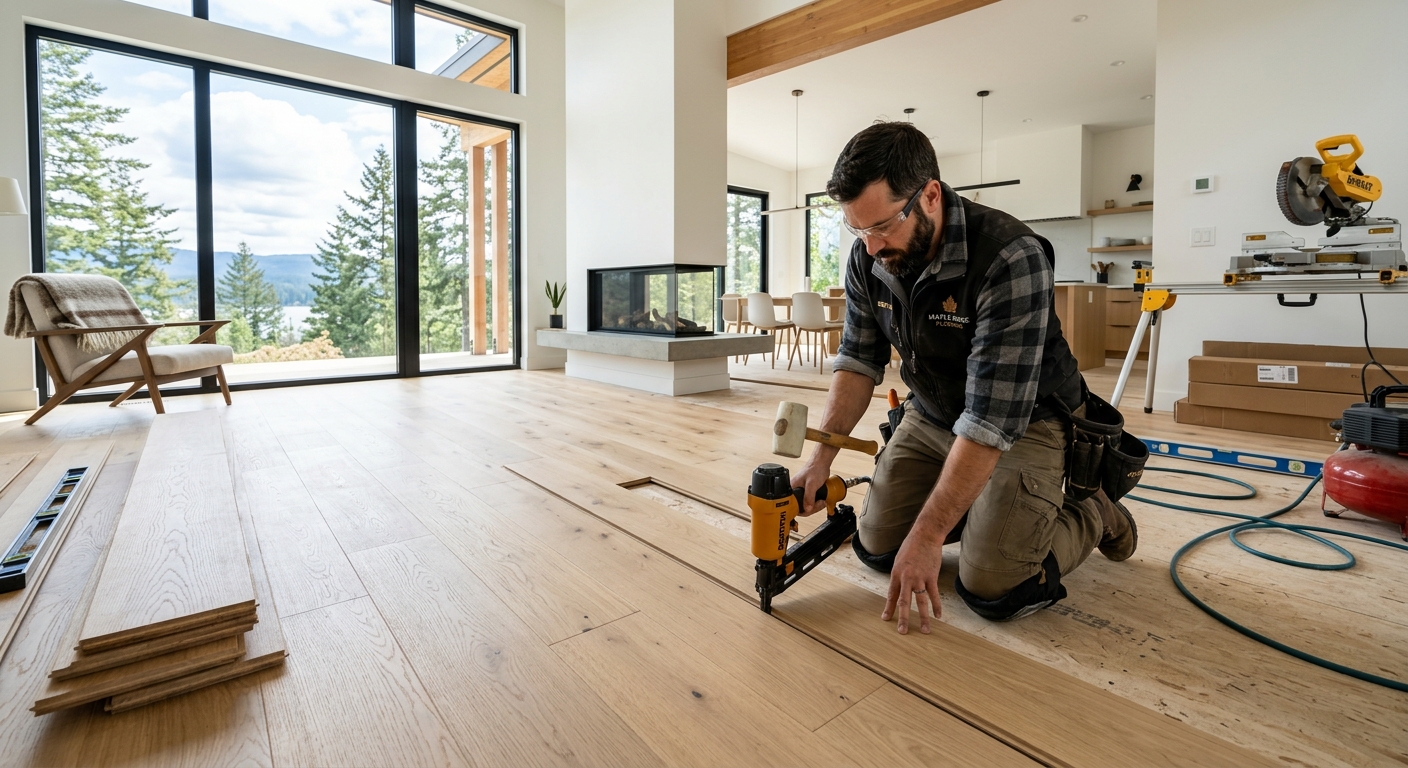
Flooring options and costs in Bluewater
Bluewater homeowners are often balancing style with practicality, especially because local homes sit through wide indoor humidity swings from winter to summer. With 60.5% of area dwellings built before 1981, it’s common to run into older subfloors that need levelling, repair, or an OSB/underlayment update before new finishes go down—these prep steps can add roughly $1–$4 per sq ft to your overall install. (Statistics Canada, 2021 Census). On top of that, the Stratford–Bruce Peninsula market has significant basement moisture, so the “cheapest” option on paper may cost more later if the material isn’t stable under damp conditions. That’s why contractors in Bluewater typically steer people toward engineered hardwood or luxury vinyl plank (LVP) where moisture risk is higher, and toward radiant-compatible products when renovations include in-floor heat.
You’ll also see pricing reflect local job realities: many basements and main floors aren’t perfectly level, and labour is spent on moisture control, levelling and proper underlayment—not just laying product. In neighbourhoods around the older core of Bluewater (including parts of the former Bayfield area), flooring replacement demand is steady because many homes are older and are being refreshed for resale or comfort. Once you’ve narrowed your material choice, the next step is understanding expected cost ranges—so you can compare quotes apples-to-apples in your table below.
| Type |
Best Room |
Moisture Resistance |
Lifespan |
Price per sq ft |
| Solid hardwood (nail-down, above grade only) |
Main living areas where humidity can be controlled |
Low (can gap/cup/warp if humidity swings; poor below grade) |
30–60 years |
$10–$18 |
| Engineered hardwood (float or glue, above + on-grade) |
Living/dining, hallways, and bedrooms (including on-grade) |
Medium to high (more dimensionally stable) |
20–40 years |
$11–$20 |
| Laminate (click-lock, above-grade) |
Living rooms and bedrooms (dry areas) |
Low to medium (water can swell edges if it penetrates) |
10–25 years |
$4–$10 |
| Luxury vinyl plank / LVP (waterproof, any level) |
Basements, kitchens, and mudrooms |
High (waterproof surface; handles vapour better) |
15–30 years |
$6–$14 |
| Porcelain / ceramic tile |
Bathrooms, kitchens, entryways |
High (surface impervious; grout maintenance matters) |
25–50 years |
$12–$22 |
| Carpet (broadloom or modular tile) |
Bedrooms and stairs |
Medium (needs prompt drying after any water event) |
8–15 years |
$5–$11 |
Prices are estimates only and vary by project scope, site access and material selection.
What affects the price of flooring in Bluewater
Even when homeowners in Bluewater choose the “same” flooring brand or thickness, quotes can differ by 30–50% across Stratford–Bruce Peninsula and Ontario because the hidden costs are usually in prep and compatibility—not in the sticker price. The big technical drivers here are indoor humidity swings and below-grade moisture. In this region, solid hardwood expands and contracts with humidity, so it can gap or cup if conditions drift; it also performs poorly in basements and can’t be installed the same way over typical concrete slabs. Engineered hardwood and luxury vinyl plank (LVP) are more dimensionally stable and are far better suited to on-grade and basement work. On top of that, the colder climate makes radiant floor heating a common renovation feature, which favours radiant-compatible engineered wood, LVP, many tiles, and some higher-density laminates—while ruling out certain solid hardwood selections and low-end laminate products that can’t handle temperature cycling.
Older housing stock is another pricing lever. With 60.5% of homes built before 1981, expect more frequent subfloor repairs and levelling before install, which can add about $1–$4 per sq ft to labour/materials for prep. For example, if you compare a laminate option in the $4–$10 per sq ft band to tile in the $12–$22 per sq ft band, the tile may still look “expensive”—until you factor in durability in wet zones and the fact that tile often avoids replacement after moisture-related laminate edge swelling. Likewise, upgrading to engineered hardwood from solid in the $10–$18 band can be justified where humidity control isn’t consistent, because it reduces callbacks related to movement. These are exactly the reasons local pricing reflects moisture control, levelling, underlayments and radiant compatibility as much as it reflects the surface material.
| Price Factor |
Why It Matters |
Cost Impact |
| Room area in sq ft |
More square footage increases both material consumption and install labour time |
Direct driver; small rooms still have higher per-sq-ft labour |
| Subfloor condition |
Levelling/repair is often required in older Stratford–Bruce Peninsula homes |
Commonly +$1–$4 per sq ft for levelling/repairs |
| Moisture / below-grade install |
Rules out solid hardwood; requires vapour management for basements |
May add underlayment/primer prep +$0.50–$2 per sq ft |
| Material choice |
Solid vs engineered vs LVP vs tile changes stability, labour and warranty terms |
Typically shifts total budget across the $4–$22 per sq ft bands |
| Removal and disposal of existing flooring |
Old flooring, tack strips, and damaged underlayments add demolition labour |
Often +$1–$3 per sq ft depending on what’s removed |
| Stair nosing / transitions |
Trim pieces and custom transitions are charged per step or per linear foot |
Can noticeably increase cost in hallways and multi-level homes |
| Radiant heat compatibility |
Limits materials; reduces risk of gapping or movement under temperature cycling |
May add cost if you select “radiant-ready” products |
| Installation method |
Float, glue-down, or nail-down changes labour time and subfloor requirements |
Glue-down and nail-down often increase labour versus basic click-lock |
Permits & regulations in Ontario
In Ontario, installing new flooring typically does not require a building permit by itself. Flooring is generally considered a finish upgrade. However, some related work can trigger permit or inspection requirements—especially when you’re touching electrical systems or structural elements. For example, if your renovation includes in-floor heating electrical work, you may need electrical permits (and the work must be done by a licensed electrical contractor). If you’re doing structural subfloor repairs—like replacing rotted joists, sistering, or major framing corrections—permits and inspections can be required depending on scope and code impact.
For condominiums, the rules are often less about permits and more about building policies. Upper-floor hard-surface flooring frequently must meet sound transmission requirements, and your condo corporation may restrict underlay or require a specific acoustical underlay to meet STC/IIC expectations. Always review your condo declaration and get written board approval if you’re installing hardwood or tile on an above-grade unit.
Step-by-step, Bluewater homeowners can protect themselves by verifying three items before signing: (1) contractor licensing status using Ontario’s public listings (where applicable) and ask for the contractor’s business information; (2) liability insurance—request a current Certificate of Insurance naming you as interested party where possible; and (3) WSIB/WCB coverage confirmation—ask for proof directly. If the contractor can’t provide clear documentation, it’s a signal to slow down and get another quote from someone who can.
Best flooring for each room in your Bluewater home
Choosing the right flooring in Bluewater is less about trends and more about moisture, traffic, sound, and comfort in a climate with cold winters and humidity swings. In living and dining areas, homeowners usually want warmth and a finished look without overreacting to seasonal movement—engineered hardwood or high-quality laminate are the usual balance. For the master bedroom, carpet remains a favourite for comfort and sound absorption, but engineered hardwood also works well when you can maintain indoor humidity within the product’s acceptable range. Kitchens in Stratford–Bruce Peninsula homes need everyday cleanability and splash tolerance; luxury vinyl plank (LVP) or large-format porcelain tile is a strong match because spills are easier to wipe up and the surface is stable under minor water exposure.
Basements are where Bluewater decisions matter most. The clear winner for most finished basements is LVP: it’s waterproof at the surface and handles vapour and below-grade conditions far better than solid hardwood and most laminate. For bathrooms, porcelain or ceramic tile is the safe, long-term choice because it resists moisture and withstands frequent cleaning.
Radiant floor heating is increasingly popular in Ontario renovations, and it shapes material selection. Engineered wood, LVP, tile and many radiant-compatible laminate products can work well, but solid hardwood options are more limited and low-end laminates can struggle with temperature cycling. As a price reality check: upgrading from laminate in the $4–$10 band to LVP in the $6–$14 band may feel like a jump, but the difference is often justified in basements and splash zones where moisture-related failures would otherwise force costly replacement.
| Room |
Best Material |
Why |
Moisture Risk |
Price Band per sq ft |
| Living / dining room |
Engineered hardwood |
Warm look with better stability during seasonal humidity changes |
Low to medium (tolerates typical seasonal swings) |
$11–$20 |
| Master bedroom |
Carpet or engineered hardwood |
Carpet adds comfort and sound dampening; engineered wood stays more stable than solid |
Low (assuming good ventilation) |
$5–$11 |
| Secondary bedrooms |
Laminate (higher-density) or carpet |
Easy maintenance for families; carpet is practical for stairs and playrooms |
Low |
$4–$10 |
| Kitchen |
Luxury vinyl plank (LVP) or porcelain tile |
Excellent spill tolerance and easy cleaning; stable under daily mess |
Medium (spills and leaks possible) |
$6–$22 |
| Basement (finished) |
LVP (waterproof) |
Handles below-grade moisture and vapour better than solid wood and most laminate |
High (vapour and seasonal dampness) |
$6–$14 |
| Bathroom |
Porcelain / ceramic tile |
Moisture-resistant surface and long service life |
High |
$12–$22 |
How to choose a flooring contractor in Bluewater
Start with verification. In Ontario, ask for proof of liability insurance and WSIB/WCB coverage before work begins—request the documents and confirm the policy is active. For licensing, use Ontario’s public resources to check the contractor’s status where applicable, and insist on a clear business name, address, and contact details that match their quote and invoices. A reputable Bluewater flooring contractor should be comfortable answering directly and providing paperwork.
Next, get 2–3 itemised written quotes that break labour and materials separately. Avoid lump-sum numbers that don’t show what’s included. Read the scope carefully: is subfloor levelling included if your floor is out of level? Is moisture testing and vapour management included for basements? Is removal and disposal of old flooring included? Are transitions, stair nosing, quarter-round/trim, and the right underlayment for your product included? Also confirm permit-related scope (if any) and whether electrical work is handled by the correct trade.
Warranty matters for both workmanship and product. Ask for the workmanship warranty length, whether it covers labour only or also materials, and if it’s transferable to future owners. Payment should be sensible: never pay more than 10–15% upfront; hold back the balance until the job is complete and you’ve walked the work with the contractor.
- Ask for a written start date and completion estimate
- Confirm subfloor prep plan in writing (level/repair, not just “install over existing”)
- Require the exact underlayment specified for your LVP/laminate
- Check whether moisture testing or vapour barrier prep is included for basements
- Ensure transitions and stair details are priced per step/linear foot when applicable
- Verify removal and disposal is included (or priced as an add-on)
- Confirm trim/under-cutting strategy around vents, door jambs and baseboards
- Request product model numbers and grade (not just “engineered hardwood”)
- Ask about acclimation time for materials before install
- Get the workmanship warranty in writing
- Review payment schedule and holdback terms before signing
- Look for a contract with change-order rules and start/finish coverage
Red flags in Bluewater include: (1) refusing to show WSIB/WCB or insurance documents; (2) quoting “solid hardwood in a basement” without a moisture plan; (3) dismissing subfloor levelling as unnecessary; (4) offering only vague scopes like “remove and install” without disposal/transition details; and (5) pushing high upfront payments (beyond 10–15%) before any materials are delivered or prep is verified.
Frequently asked questions — flooring in Bluewater
What is luxury vinyl plank and is it worth it in Bluewater?
Luxury vinyl plank (LVP) is a layered vinyl floor designed to look like wood while staying more dimensionally stable than solid hardwood in humidity swings. In Bluewater and the Stratford–Bruce Peninsula region, it’s often worth it because basements can have higher moisture vapour and because indoor humidity can fluctuate a lot from winter to summer. Solid hardwood can gap, cup or warp when conditions drift, while waterproof LVP handles that better. For pricing, typical LVP-installed budgets often land in the $6–$14 per sq ft range, versus laminate in the $4–$10 band. The “value” comes from fewer replacement risks in damp zones and better practicality for kitchens and mudrooms. If your subfloor is severely damaged, though, prep costs still matter—choose LVP, but still fix the substrate.
How much does flooring cost in Bluewater?
Flooring cost in Bluewater depends on the surface material and how much prep your home needs, not just the product price. In older housing stock—60.5% built before 1981—it’s common to require subfloor levelling or repair, which can add around $1–$4 per sq ft before the new floor is installed. Material and install pricing commonly follows local bands: hardwood tends to run about $10–$18 per sq ft, laminate or vinyl plank like LVP around $4–$14 depending on quality, and tile often sits in $12–$22 per sq ft. Carpet installation is usually $5–$11 per sq ft. For an apples-to-apples comparison, make sure your quote includes removal/disposal, underlayment/vapour barrier where required, transitions/stair work, and whether your contractor has included radiant-compatible products if you have in-floor heat.
Hardwood vs laminate vs vinyl plank — which is best?
There isn’t one “best” option across every Bluewater room, but there are clear winners by moisture and heating needs. Solid hardwood is beautiful and long-lasting above grade, yet it’s the most sensitive to humidity swings and should not be treated as a basement floor. Laminate is budget-friendly (often $4–$10), but its edges can swell if water gets underneath, and temperature cycling from radiant heat may limit product choices. Vinyl plank (especially waterproof LVP) is usually the most forgiving where moisture vapour or splash risk is higher—often within the $6–$14 per sq ft range—and it tolerates any level installation better. For radiant floor heating in Ontario, engineered wood, LVP, tile and compatible laminates are generally safer than solid hardwood in many cases. If your home’s subfloor is uneven or older, all options need proper prep—quote comparisons should include levelling and moisture control.
What flooring is best for a Bluewater basement?
For a Bluewater basement, the most reliable choice for most homeowners is waterproof luxury vinyl plank (LVP) because it’s designed to handle moisture vapour and below-grade conditions better than solid hardwood and most laminate. In the Stratford–Bruce Peninsula region, this matters because basements often face seasonal dampness and humidity variation. Carpet can be uncomfortable in damp spaces and tile grout can be fine but still requires correct subfloor prep and waterproofing considerations. LVP typically installs in the $6–$14 per sq ft range, and the added cost is often justified by reduced risk of swelling or movement problems that can lead to replacement. The “best” basement floor also depends on your substrate: if you have active water issues or major subfloor damage, you’ll need moisture remediation and repairs before installing any finish.
Can I install hardwood over concrete?
In many Bluewater renovations, installing solid hardwood directly over concrete is a problem. Solid hardwood needs an above-grade style environment and is sensitive to moisture; it also can’t be reliably glued or floated over typical concrete slab conditions unless the system is specifically designed for that moisture profile and climate. In practical terms, most contractors steer homeowners toward engineered hardwood over concrete, because engineered products are more dimensionally stable. If you’re dealing with a slab and there’s radiant floor heat, you’ll also need radiant-compatible product and proper underlayment/thickness requirements. If you want solid hardwood, the safest route is usually above grade only (and installed using the right method for your subfloor type). For any concrete installation, ask your contractor to describe the moisture plan: surface prep, moisture testing approach, and underlayment/adhesive compatibility.
How long does flooring installation take?
Installation time varies based on square footage, floor condition, and whether prep is included. In Bluewater homes—especially those with older subfloors—levelling, patching, and moisture/vapour prep can add days before any planks or tiles go down. As a general expectation for typical residential jobs: a single small room may take a day, but multi-room projects commonly take several days of active installation plus time for acclimation, layout, and curing (for glue-down systems). Tile and any work involving underlayment, waterproofing considerations, or detailed transitions can take longer. Your timeline should be spelled out in writing in the contract: start date, completion date, and how many days are reserved for substrate prep. If radiant heating is involved, that can also affect sequencing and curing/temperature cycling rules for the floor system.