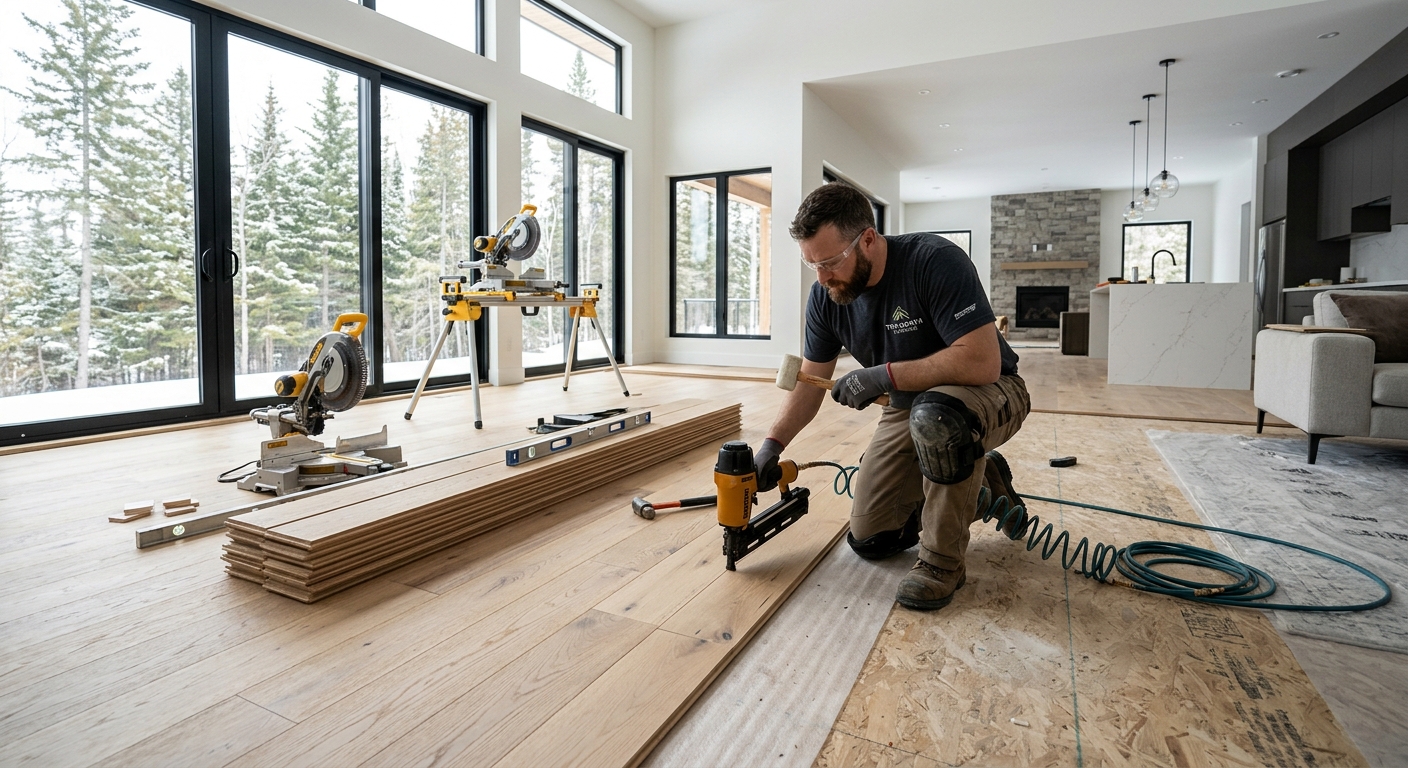
Flooring options and costs in North Perth
North Perth homeowners usually have three big realities to plan for: older housing, moisture swings, and the cost of prep. With 51.3% of local homes built before 1981, many projects start with subfloor patches, levelling, and moisture-control upgrades before a new floor can go down. That prep time can be the difference between a “simple install” and a full rework of damaged OSB, underlay, or concrete surfaces. At the same time, North Perth sits in a Stratford–Bruce Peninsula housing mix where winter-to-summer humidity swings and basement moisture are common, so the material you choose can materially change your installed cost and long-term performance. Solid hardwood is beautiful, but it can cup, gap, or swell when humidity swings are large—especially below grade—so contractors often recommend engineered wood or luxury vinyl plank (LVP) for basements and other higher-humidity spaces.
In practice, labour availability and site conditions also affect the price. Older single-detached homes (70.2% of local dwellings) often need more floor evaluation and levelling to get to a flat, manufacturer-ready surface. This is particularly in demand in older pockets near Listowel and the rural edges where basements are frequent and sometimes unfinished or prone to dampness. With that in mind, here’s a clear baseline comparison of the main flooring types you’ll see in North Perth quotes, followed by the local cost drivers that move your final number.
| Type |
Best Room |
Moisture Resistance |
Lifespan |
Price per sq ft |
| Solid hardwood (nail-down, above grade only) |
Living / dining (above grade) |
Low (gapping/cupping risk in humidity swings) |
25–60 years |
$10–$18 |
| Engineered hardwood (float or glue, above + on-grade) |
Living / dining and master |
Medium–high (more stable across humidity) |
20–40 years |
$12–$20 |
| Laminate (click-lock, above-grade) |
Bedrooms, hallways (above grade) |
Low–medium (water can damage core) |
10–25 years |
$4–$10 |
| Luxury vinyl plank / LVP (waterproof, any level) |
Basement (finished) and main level |
High (waterproof surface) |
15–25 years |
$5–$12 |
| Porcelain / ceramic tile |
Kitchen and bathroom |
Very high (tile + grout surface) |
25–50 years |
$12–$22 |
| Carpet (broadloom or modular tile) |
Bedrooms and stairs |
Medium (avoid prolonged dampness) |
7–15 years |
$4–$12 |
Prices are estimates only and vary by project scope, site access and material selection.
What affects the price of flooring in North Perth
In North Perth and across the Stratford–Bruce Peninsula region, it’s common to see quotes for the “same-looking” floor come in 30–50% apart once you factor in prep, moisture control, and compatibility with colder-climate heating. A home built before 1981 (51.3% locally) often has out-of-level subfloors, older underlay, and occasional patchwork. If levelling or subfloor repair is required, the job shifts from “install” to “restore first,” and that can add roughly $1–$4 per sq ft to the total, depending on how much rebuild is needed.
Technically, the key driver is moisture. Stratford–Bruce Peninsula homes can swing from dry forced-air in winter to higher humidity in summer, and basements can add persistent dampness. Solid hardwood expands and contracts with humidity and generally shouldn’t be glued or floated over concrete; it also performs poorly in basements where moisture vapour can move through slabs. That’s why engineered hardwood and LVP typically price into a wider range of conditions. If radiant floor heating is part of your renovation, colder-region compatibility matters too: many solid hardwood options are limited with temperature cycling, and low-end laminates can’t handle the change as well—so your “best value” may shift to engineered wood, LVP, many tiles, or higher-density laminates designed for radiant.
Two examples that often change cost in North Perth: (1) installing LVP in a finished basement may avoid expensive subfloor rebuild that solid wood would require, keeping you closer to the LVP band (roughly $5–$12 per sq ft for many typical installs). (2) if you choose porcelain tile (often $12–$22 per sq ft), you may still pay for underlayment and prep, but you’ll get the water-resistance that laminate and carpet can’t match in kitchens and bathrooms. Material choice and prep scope are why labour-heavy jobs cost more even when the square footage looks similar.
| Price Factor |
Why It Matters |
Cost Impact |
| Room area in sq ft |
Drives material quantities and labour hours |
Direct—larger areas reduce per-sq-ft setup costs |
| Subfloor condition |
Levelling, patching, or replacing damaged OSB/underlayment |
Commonly adds about $1–$4 per sq ft for repairs/levelling |
| Moisture / below-grade install |
Determines whether solid hardwood is feasible and what vapour control is needed |
Can shift you toward LVP/engineered; may reduce long-term failure costs |
| Material choice |
Solid vs engineered vs LVP vs tile each has different prep and tolerances |
Moves you within the local bands ($10–$18 hardwood; $12–$22 tile; $4–$10 laminate) |
| Removal and disposal of existing flooring |
Impacts disposal fees and labour time |
Often adds a noticeable labour line item; can increase total by several hundred dollars |
| Stair nosing / transitions |
Custom pieces, sanding, and extra measuring per step |
Charged per step or per linear foot; increases total unpredictably if not planned |
| Radiant heat compatibility |
Some products must be rated for temperature cycling and specific underlay systems |
May rule out certain solid hardwoods/low-end laminates, steering cost up or down |
| Installation method |
Float vs glue-down vs nail-down changes substrate prep and labour |
Glue-down and specialized prep can add cost versus floating installs |
Permits & regulations in Ontario
In Ontario, installing new flooring by itself usually does not require a building permit. Flooring is typically treated as a finish upgrade, not structural work. Where permits can come into play is when your scope expands into related building systems. For example, if you’re doing structural subfloor repair (joist changes, engineered load modifications), or moisture remediation that involves drainage or major building envelope changes, that work may require permitting depending on what’s being altered. If you’re adding or modifying in-floor heating circuits (electrical connections, thermostats, wiring), electrical permits can be required for the electrical portion.
In condominiums, the corporation’s rules often restrict or require specific underlay for hard flooring on upper floors due to sound transmission. That doesn’t mean you always need a permit, but you should obtain board approval (in writing) and confirm the recommended underlay and installation method for engineered wood or tile.
To verify a contractor in North Perth, start with Ontario licensing and compliance: (1) check their business listing and any trade qualifications where applicable, (2) request a current certificate of insurance (liability) showing the policy is active, and (3) ask for proof they carry WSIB/WCB coverage where required for their work. If they can’t provide clearance documents or certificates, pause and ask before signing.
Best flooring for each room in your North Perth home
Choosing the right floor for each room in North Perth comes down to moisture risk, day-to-day traffic, and comfort—then matching it to our local humidity swings and the common older home build style. For living and dining areas, engineered hardwood and higher-quality laminate are popular because they keep a warm, natural feel while handling humidity shifts better than many solid hardwood installs. In a master bedroom, carpet is a strong choice for comfort and sound absorption, especially if you want quieter footsteps, but it should be kept dry and properly installed away from dampness sources.
Kitchens are where waterproof performance pays off. Luxury vinyl plank (LVP) is a top option because it tolerates spills and day-to-day splashes, and it’s also a practical fit for homes with basements where moisture is a recurring concern. If you prefer a “forever” look, large-format porcelain tile ($12–$22 per sq ft) is excellent for water resistance and cleaning. Basements (finished) are where many North Perth homeowners make a smart upgrade: LVP is the clear winner for below-grade applications because it’s waterproof at the surface and supports a more reliable installation when vapour conditions vary. Bathrooms should be porcelain or ceramic tile only, because the water exposure is continuous and grout needs correct sealing and installation.
Radiant floor heating is increasingly common in Ontario renovations, and it steers product selection. Many tile products and radiant-compatible engineered floors perform well under temperature cycling, while most solid hardwoods are limited to specific installation conditions. As a budget example, upgrading from laminate (roughly $4–$10 per sq ft) to LVP can be “worth it” in humid areas because it reduces the risk of core swelling from accidental moisture—often preventing the much higher cost of redoing a basement floor later.
| Room |
Best Material |
Why |
Moisture Risk |
Price Band per sq ft |
| Living / dining room |
Engineered hardwood |
Warm look with better dimensional stability than many solid hardwood installs |
Low–medium (manage indoor humidity seasonally) |
$12–$20 |
| Master bedroom |
Carpet or engineered hardwood |
Carpet adds comfort and quiet; engineered adds easier maintenance |
Low (keep away from basement moisture transfer) |
$4–$12 |
| Secondary bedrooms |
Carpet or laminate (above grade) |
Balances comfort and budget; laminate is tidy for everyday use |
Low (above-grade installations only) |
$4–$10 |
| Kitchen |
Luxury vinyl plank or porcelain tile |
Water and spill tolerance; tile offers longer “wear for the look” |
Medium (spills and wet mopping) |
$5–$22 |
| Basement (finished) |
Luxury vinyl plank (waterproof) |
More tolerant of below-grade moisture conditions than solid wood/most laminate |
High (vapour and seasonal swings) |
$5–$12 |
| Bathroom |
Porcelain / ceramic tile |
Built for wet areas and easier to clean; long service life |
Very high (direct water exposure) |
$12–$22 |
How to choose a flooring contractor in North Perth
When you hire a flooring contractor in North Perth, you want proof of coverage and clear, itemised pricing that matches the prep your older homes often need. Start by verifying Ontario compliance: ask for their liability insurance certificate and confirm it’s current; request WSIB/WCB coverage proof for their workers where required; and check their business details and credentials so you know who will actually be on site. A reputable crew won’t resist providing paperwork—if they do, that’s your first red flag.
Next, get 2–3 itemised written quotes rather than one lump sum. Look for a labour-and-materials breakdown that lists: underlay/vapour control, levelling/patching, subfloor repair scope, removal and disposal, transitions, and stair work. Confirm whether a permit is required for your specific scope (for example, electrical permits if radiant wiring changes are involved) and whether the contractor will handle anything permit-related. Ask about the warranty: workmanship (how long and what’s covered), product warranty (what the manufacturer covers), and whether coverage is transferable if you sell your home.
For payment schedule, keep it controlled: never pay more than about 10–15% upfront, and hold back payment until the job is complete and cleaned. Also get a start date and an estimated completion timeline in writing so you can plan around moisture control, deliveries, and curing/setting times for levelling products or adhesives.
- Ask for a site visit or subfloor evaluation before pricing.
- Request itemised labour and materials (not a single total).
- Confirm what underlay/vapour barrier is included and for what floor type.
- Get their plan for levelling out-of-level subfloors.
- Ask whether removal and disposal of old flooring is included.
- Clarify stair nosing and transition pricing (per step/linear foot).
- Confirm product compatibility with radiant heating if applicable.
- Ask for the workmanship warranty length and terms in writing.
- Confirm the manufacturer warranty start date and any registration steps.
- Verify liability insurance certificate and coverage limits.
- Verify WSIB/WCB clearance or coverage proof where required.
- Set a payment schedule with a holdback until completion.
Red flags in North Perth include quotes that skip subfloor evaluation but assume a “standard” install, vague scopes that omit disposal and levelling, contractors who can’t provide insurance/WSIB proof, unrealistic timelines that ignore curing/setting for patching or adhesive, and offers to bypass manufacturer installation requirements for underlay or moisture barriers.
Frequently asked questions — flooring in North Perth
What's the most durable flooring for pets and kids?
For most North Perth families with pets and kids, waterproof LVP is the practical winner because it handles accidents and frequent cleanups without the swelling risk you can get with laminate cores. In many local installs, LVP pricing commonly falls around $5–$12 per sq ft depending on thickness and wear layer, while laminate often lands closer to $4–$10 per sq ft but is less forgiving if liquid sits on the surface. If you want a “hard but comfortable” feel, porcelain tile is also very durable, but it’s harder underfoot and can add cost (often $12–$22 per sq ft). In bedrooms, carpet can be fine if you control moisture—however, basement moisture vapour and humidity swings mean carpet needs extra caution in below-grade areas.
How do I choose flooring for humidity in North Perth?
Humidity is the deciding factor in Stratford–Bruce Peninsula homes, and North Perth is no exception: indoor conditions swing between winter dryness and summer humidity, and basements can be more variable. Solid hardwood is the most sensitive option and generally shouldn’t be installed in basements. Engineered hardwood and luxury vinyl plank are the better choices because they tolerate moisture conditions more reliably. If your home has a basement, plan on LVP for finished spaces rather than relying on laminate or solid wood—solid can gap, cup, or swell. If you’re on the fence, start with a moisture assessment of the subfloor and ask your contractor what vapour control they’ll use. Your quote should reflect any levelling or moisture prep; older homes built before 1981 often need more of it, and that can shift the budget.
Do condos restrict hard flooring?
Yes, often. In Ontario condominiums, the corporation’s rules commonly restrict hard flooring because of sound transmission requirements between units. That usually means you’ll need board approval and specific underlay systems designed to meet the building’s sound expectations (commonly discussed in terms like STC/IIC). Even when a permit isn’t required for flooring itself, you must follow the condo’s declaration and installation requirements—especially for engineered hardwood and tile on upper floors. Before you buy, ask the building office or property manager what underlay is approved and whether your installation method must be glue-down or floating. If radiant heat or special subfloor prep is involved, confirm that too, because cold-climate temperature cycling can affect product selection.
How do I compare flooring quotes?
Compare quotes line-by-line, not by the final total. Ask each contractor to provide itemised labour and materials so you can see what’s included: subfloor levelling/repair, underlay or vapour barrier, adhesive (if glue-down), removal and disposal, and transitions/stair nosing. In North Perth, older home subfloors often require extra prep—so a quote that doesn’t mention levelling or moisture control may look cheaper but cost more later when issues surface. Confirm warranty terms: workmanship coverage and product warranty details, plus whether the warranty is transferable. Finally, check payment terms—good contractors keep upfront payment modest (around 10–15%) and hold back until completion. As a benchmark, if one quote has engineered hardwood near $12–$20 but another has laminate at $4–$10, make sure you’re comparing the same room scope and prep level, not just the headline price.
Can I install flooring over existing tile in North Perth?
Sometimes, but it depends on the condition of the existing tile and what your new floor manufacturer requires. Over-tile installations can work if the surface is solid, flat, and clean, and if you can meet the required height and substrate preparation steps. Many homeowners choose this to avoid removal and disposal costs; however, if the tile is cracked, uneven, or not well bonded, it may telegraph movement into the new floor. For LVP, engineered wood, and laminate, you typically need an appropriate substrate (often a flat surface with minimal variation), and in some cases tile removal is still the safest long-term solution. In a North Perth climate with humidity swings and basement moisture considerations, skipping proper prep can create edge lifting or uneven transitions. Ask your contractor to measure flatness and explain the specific underlayment plan in the written quote.
What is the best flooring for a high-traffic area in North Perth?
For high-traffic areas, the best choice is usually based on whether moisture risk is low or high. On the main floor, engineered hardwood with a strong wear layer is a common balance of durability and warmth, while LVP is often the most forgiving option if you expect spills, muddy shoes, or variable humidity. In terms of pricing, you’ll often see LVP installs around $5–$12 per sq ft and tile around $12–$22 per sq ft—tile lasts extremely well, but it’s harder underfoot. Carpet can handle traffic comfortably, but it can be harder to maintain if you have moisture events (especially near exterior doors or in basements). Whichever option you choose, ensure your contractor addresses subfloor flatness and uses the correct underlay system—older North Perth homes frequently need that prep to prevent premature wear or movement.