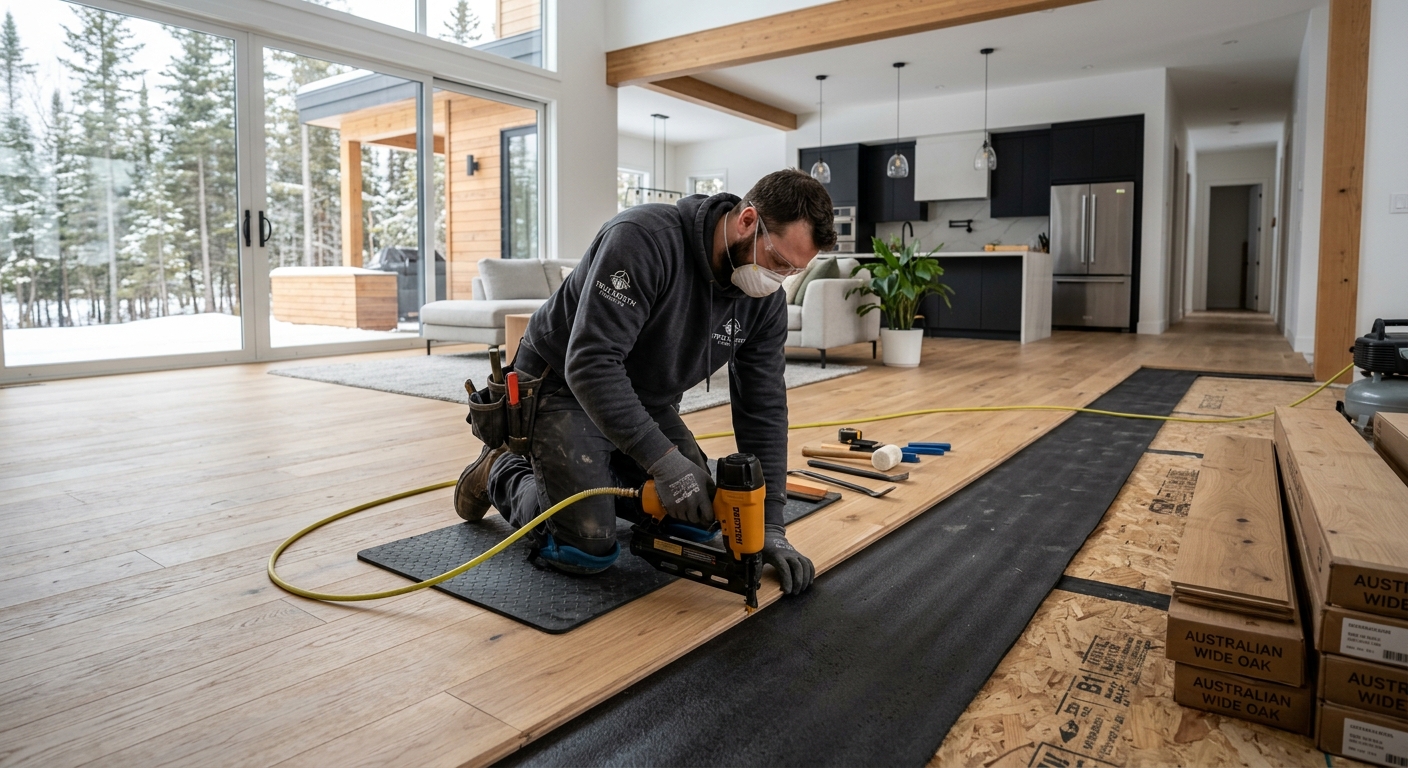
Flooring options and costs in Richmond Hill
In Richmond Hill, your choice of flooring has to handle real seasons: humid summers, dry winters, and frequent condensation around doors and windows. With a population of 202,022 and 78.2% of households owning, many homeowners are investing in long-term upgrades rather than short-lived covers (Statistics Canada, 2021 Census). Costs typically start with the material, then get adjusted once contractors price the prep work—especially in older neighbourhood pockets where dated subfloors are common. Richmond Hill also has a meaningful share of homes built before 1981 (15.1%), and that age band often means levelling, plywood patching, or moisture mitigation before installation. That prep can add a noticeable line item even when you choose a mid-range floor like laminate or LVP.
Toronto-area labour demand is strong, so install pricing can run higher than other parts of Ontario. At the same time, the market has lots of qualified installers for engineered wood, LVP, and tile, which helps keep turnaround times reasonable in areas like Oak Ridges and around Yonge Street corridors. From a performance standpoint, we steer many clients away from traditional solid hardwood for below-grade risk areas: moisture vapour and humidity swings can cause cupping and gapping. Engineered hardwood and waterproof luxury vinyl plank are generally the safer bets for on-grade and basement-adjacent projects.
Use the table below as a budgeting baseline, then we’ll refine based on room count, subfloor condition, and whether radiant floor heating is involved.
| Type |
Best Room |
Moisture Resistance |
Lifespan |
Price per sq ft |
| Solid hardwood (nail-down, above grade only) |
Living/dining, bedrooms |
Low to moderate (humidity sensitive) |
25–50 years |
$9,00 – $18,00 |
| Engineered hardwood (float or glue, above + on-grade) |
Main floor, bedrooms |
Moderate to high (more dimensionally stable) |
20–40 years |
$10,00 – $17,00 |
| Laminate (click-lock, above-grade) |
Bedrooms, hallways |
Low to moderate (not truly waterproof) |
10–25 years |
$4,00 – $9,00 |
| Luxury vinyl plank / LVP (waterproof, any level) |
Kitchen, main floor, finished basements |
High to very high (waterproof cores) |
15–25 years |
$4,50 – $11,00 |
| Porcelain / ceramic tile |
Kitchen, bathrooms, entry |
Very high (with proper underlayment/grout) |
30–50 years |
$12,00 – $25,00 |
| Carpet (broadloom or modular tile) |
Bedrooms, rec rooms |
Low (can trap moisture; needs good subfloor) |
8–15 years |
$5,00 – $11,00 |
Prices are estimates only and vary by project scope, site access and material selection.
What affects the price of flooring in Richmond Hill
In Richmond Hill and across the Toronto economic region, two quotes for the “same” flooring can differ by 30–50% because the scope is rarely identical. One proposal may include subfloor levelling, underlayment upgrades, stair work, and proper moisture prep; another may price a clean, flat-ready surface and then hit you with extras once they see the existing floor. In an older housing mix—where 15.1% of homes were built before 1981 (Statistics Canada, 2021 Census)—subfloor condition is often the biggest swing factor, not the finish plank or tile.
Technically, Toronto-area indoor humidity swings are the key driver. Solid hardwood expands and contracts with humidity and generally should stay above grade; it’s also risky over concrete slabs and in basements where moisture vapour can migrate upward. That’s why engineered hardwood and luxury vinyl plank (waterproof) usually handle Richmond Hill conditions better, especially for below-grade and high-humidity zones. Colder stretches of the region and many newer builds also include radiant floor heating, which typically pairs better with engineered wood, tile, and certain vinyl systems than with traditional solid hardwood. If your contractor finds you need levelling, plywood repair, or moisture mitigation, budgeting an extra $1–$4 per sq ft is common—on top of the base install. For example, a $9–$18/sq ft hardwood project can climb quickly once prep is added, while LVP at roughly $4–$11/sq ft may end up costing less overall when your subfloor needs remediation.
Local market pressure matters too: high renovation demand affects labour rates, and swift scheduling can reduce site overhead. Neighbourhoods with heavier infill and condo turnover—often near transit corridors—tend to have steady availability, which can keep labour more competitive than you’d see in less active areas.
| Price Factor |
Why It Matters |
Cost Impact |
| Room area in sq ft |
Materials and labour scale directly with square footage |
Low rooms can have higher per-sq ft due to minimum charges |
| Subfloor condition |
Levelling, patching, or replacement adds prep time and labour |
Often +$1 to $4 per sq ft |
| Moisture / below-grade install |
Determines whether you can use solid wood; affects underlayment/system choice |
Can add membranes/testing and +$0.50 to $3 per sq ft depending on condition |
| Material choice |
Solid hardwood, engineered, LVP, laminate, and tile differ in price and installer requirements |
Hardwood commonly costs roughly double LVP baseline |
| Removal and disposal of existing flooring |
Labour and disposal costs vary by flooring type and thickness |
Often +$0.50 to $3 per sq ft |
| Stair nosing / transitions |
Stairs and specialty transitions take time and custom cuts |
Frequently charged per step or per linear foot |
| Radiant heat compatibility |
Limits product selection (solid hardwood is riskier under heating cycles) |
May increase material cost to an engineered/tile/vinyl system |
| Installation method |
Float vs. glue-down vs. nail-down changes labour and subfloor prep needs |
Nail-down systems often require flatter, drier conditions; glue-down can add prep |
Permits & regulations in Ontario
In Ontario, installing new flooring itself usually does not require a building permit. If you’re replacing finished flooring (hardwood/engineered, laminate, LVP, tile, or carpet) without altering structural framing, electrical circuits, or plumbing, permits are typically not triggered. However, associated work can change the permit picture.
Work that may require permits includes: electrical permits for altering or adding components related to radiant floor heating (thermostat wiring, in-floor heating circuit changes), and any permitted structural subfloor remediation that involves engineering or significant structural repair. In condominiums around Richmond Hill, another practical “rule set” is the building’s own sound-transmission requirements. Even when permits aren’t needed, corporations often require specific underlayment for floating floors to meet STC/IIC expectations, particularly on upper levels—this can restrict underlay thickness or material type.
For a homeowner’s due diligence, verify three things before signing: the contractor’s Ontario licence (where applicable to their business/industry registration), liability insurance, and WSIB/WCB coverage (or proof of account status where required). Ask for certificates directly and confirm the coverage is current and matches the job site address. Then confirm clearance: a WSIB/WCB clearance letter is typically provided on request. Finally, in condos, request written board approval (or follow the corporation’s documented process) before starting—especially for tile and hard surface installs above-grade.
Best flooring for each room in your Richmond Hill home
In Richmond Hill’s climate, the best flooring by room comes down to moisture tolerance, day-to-day traffic, and temperature comfort. Living and dining rooms take the most visible wear, so engineered hardwood or high-quality laminate often delivers the look with better stability. Richmond Hill’s humidity swings can still cause problems if you install solid hardwood in sensitive areas, so engineered wood is the more dependable choice when you want warmth without the same movement risk. For master bedrooms, carpet is a comfortable option and can help with sound—just ensure the subfloor is dry and properly level to avoid future stretching or odour. If you prefer a hard surface, engineered hardwood is still the safer “comfort + stability” compromise.
In kitchens, we usually recommend luxury vinyl plank (LVP) or large-format porcelain tile. LVP’s waterproof construction helps with spills and wet-mop routines, and it’s easier on joints than tile. Basements are where flooring decisions become strict: finished basements are prone to moisture vapour, and solid hardwood and most standard laminate can fail without very specific conditions. Waterproof LVP is the clear winner because it’s designed for below-grade installs. Bathrooms should be porcelain or ceramic tile only—water resistance plus grout and proper waterproofing details are non-negotiable.
If you’re adding radiant floor heating (popular in Ontario new construction and custom builds in the region), engineered wood, tile, and certain vinyl systems typically perform best due to heat and expansion considerations. As a budgeting example, if you choose tile at roughly $12–$25/sq ft in a main bathroom, you’ll pay more than LVP at about $4–$11/sq ft in adjacent spaces—but that difference is justified because bathrooms demand water-ready assemblies.
| Room |
Best Material |
Why |
Moisture Risk |
Price Band per sq ft |
| Living / dining room |
Engineered hardwood |
Warm look with better dimensional stability through seasonal humidity |
Low to moderate (depends on relative humidity and air sealing) |
$10.00 – $17.00 |
| Master bedroom |
Carpet or engineered hardwood |
Carpet adds comfort and sound control; engineered wood stays stable |
Low (if subfloor is dry) |
$5.00 – $17.00 |
| Secondary bedrooms |
Laminate or engineered hardwood |
Laminate is a budget-friendly option; engineered better tolerates humidity swings |
Low to moderate |
$4.00 – $17.00 |
| Kitchen |
Luxury vinyl plank (LVP) or porcelain tile |
LVP handles spills; tile is ultra-durable and easy to clean |
Moderate to high (spills and wet cleaning) |
$4.50 – $25.00 |
| Basement (finished) |
Luxury vinyl plank (waterproof) |
Built for below-grade moisture and vapour management requirements |
High (vapour risk is typical) |
$4.50 – $11.00 |
| Bathroom |
Porcelain / ceramic tile |
Water-ready surface with long service life when properly installed |
Very high |
$12.00 – $25.00 |
How to choose a flooring contractor in Richmond Hill
Choosing the right contractor is where your budget either holds up—or quietly dissolves into change orders. Start by confirming coverage and accountability. Ask for the contractor’s liability insurance certificate and ensure the coverage is active for the job timeframe. In Ontario, request proof of WSIB/WCB coverage (or a clearance letter where applicable) before work begins; a reputable flooring contractor can provide these documents without hesitation. If you’re in a condominium, make sure they understand the building’s sound and installation requirements and can follow your corporation’s underlay rules.
Next, get 2–3 itemised written quotes—labour and materials separated, not a single lump sum. The scope should clearly state what’s included: subfloor levelling, underlayment/membranes, installation method, stair nosing, transitions, and the plan for removing and disposing of existing flooring. Clarify whether permit-related items are included (for example, radiant heating electrical work is a different scope than flooring) and whether any testing or moisture remediation is recommended or included. Confirm warranties: workmanship warranty length, manufacturer/product warranty terms, and whether the warranty is transferable to future owners (important in Richmond Hill where many homes are sold after upgrades).
For payment, never pay more than 10–15% upfront. Use a holdback until the job is complete and you’ve inspected transitions, edges, and any stair detailing. In addition, get the start date and completion estimate in writing so scheduling risk doesn’t become your problem.
- Provide a current certificate of insurance (liability) with your project address
- Show WSIB/WCB clearance/coverage documentation before installation
- Use a written, itemised quote (labour, materials, underlayment, prep work separated)
- Confirm subfloor moisture plan: levelling only vs. levelling plus mitigation
- State exactly which underlayment and vapour barrier (if any) you’ll receive
- List removal and disposal of existing flooring (and what isn’t included)
- Spell out stair work pricing (per step or per linear foot)
- Include transition strips/thresholds by room, not “as required”
- Verify radiant heat compatibility if you have in-floor heating
- Ask for the workmanship warranty period in writing
- Confirm payment schedule and that you’ll retain a holdback on completion
- Get a start date and a realistic completion timeline in the contract
Concrete red flags we commonly see around Richmond Hill include: refusing to provide insurance/WSIB documents, quotes that don’t mention subfloor prep but assume “flat and ready,” vague scope language like “disposal included” without details, and offering an unusually low price that doesn’t include transitions/stair nosing or required underlayment for floating floors.
Frequently asked questions — flooring in Richmond Hill
What flooring holds up best to pets in a Richmond Hill home?
For pets in Richmond Hill, the most forgiving options are typically waterproof luxury vinyl plank (LVP) and quality engineered hardwood with a properly prepared, stable subfloor. LVP is the easiest to live with for accidents and wet paw clean-ups because it’s designed to handle moisture—important in a region with humidity swings and occasional condensation near entryways. If you’re budgeting, LVP often lands in the $4–$11 per sq ft range, which can make sense for homes where wear happens quickly (Statistics Canada, 2021 Census). Engineered hardwood also holds up well, but we still recommend it over solid hardwood when there’s any basement exposure risk, since solid wood can be more humidity sensitive. If you have large claws, choose thicker wear layers and consider area rugs in high-scratch zones.
How do I fix squeaky floors in my Richmond Hill home?
Squeaks usually come from movement between subfloor layers, fasteners, or the subfloor and joists—not from the finish flooring itself. In Richmond Hill homes built before 1981 (15.1% of the local stock) (Statistics Canada, 2021 Census), older subfloor systems are more likely to have loose planks or gaps that show up as squeaks once weight changes with seasons. Before any new install, ask your contractor for an inspection: they should identify the squeak source, then either re-screw/secure subfloor panels or, if needed, repair localized subfloor damage and re-level. Trying to “cover it up” with soft underlayment often won’t correct the problem; it may mask it briefly and then noise returns. If you’re doing a basement reno, moisture testing and proper prep are especially important because a dry, stable base is what makes the final floor quieter.
What is luxury vinyl plank and is it worth it in Richmond Hill?
Luxury vinyl plank (LVP) is a layered flooring product with a wear surface on top and a waterproof core (in true waterproof lines). In Richmond Hill, it’s often worth it because it’s more tolerant of the indoor humidity swings and the occasional below-grade moisture conditions that can challenge solid hardwood and standard laminate. That’s why we often steer basement and main-floor spill zones toward LVP. Pricing tends to fall in the $4–$11 per sq ft range, which can be a strong value compared with tile ($12–$25 per sq ft) or hardwood ($9–$18 per sq ft). The best LVP installs also include good subfloor prep, correct underlayment (if manufacturer-approved), and proper transitions—those details are what prevent clicking sounds, edge lift, and cupping.
How much does flooring cost in Richmond Hill?
In Richmond Hill, total project cost depends on the material, how much subfloor prep is needed, and whether you’re removing existing flooring. As a quick budgeting guide, hardwood typically prices around $9–$18 per sq ft, while laminate or vinyl plank often sits in the $4–$9 per sq ft range. Tile commonly runs $12–$25 per sq ft, and carpet installation is frequently in the $5–$11 per sq ft band. Those ranges reflect Toronto-area labour demand and the fact that many homes need prep—subfloor levelling or patching is common in older housing stock. For example, if you choose LVP at roughly $4–$11 per sq ft, a poorly prepared base can still add levelling work that nudges your per-sq ft higher. For an accurate number, ask for an itemised quote that includes removal/disposal, underlayment, and any moisture mitigation.
Hardwood vs laminate vs vinyl plank — which is best?
There isn’t one universal winner—your “best” option depends on moisture risk and the room. Hardwood (solid) looks great but is more humidity sensitive; it’s also not a typical choice for basements or high-moisture areas. Laminate can be a cost-effective option for above-grade rooms, but it’s not waterproof and can suffer if spills seep to the seams. Vinyl plank—especially waterproof LVP—is usually the best all-round choice in Richmond Hill because it handles humidity swings better and can be used for kitchens and finished basements more safely. Budget-wise, hardwood often starts around $9–$18 per sq ft, laminate/vinyl plank often sits around $4–$9 per sq ft, and tile is higher at $12–$25 per sq ft. If you want the look of wood with less risk, engineered hardwood or waterproof LVP usually performs better than solid hardwood over concrete or in below-grade applications.
What flooring is best for a Richmond Hill basement?
For a Richmond Hill basement, waterproof luxury vinyl plank (LVP) is usually the top recommendation. Basements are exposed to moisture vapour and temperature variation, and in many older homes the subfloor may need additional levelling or moisture mitigation before any finish goes down. Waterproof LVP is designed for these below-grade conditions, while solid hardwood is typically a poor match because it can move with humidity and is risky over concrete. Most laminate products are also less forgiving when water reaches the seams. Tile can work in basements too, but it requires careful assembly choices and can be harder/colder underfoot unless you plan for warmth strategies (like radiant-compatible options). If your basement includes in-floor heating, tell your contractor so they can select a compatible system—this is where product compatibility matters as much as the material price band ($4–$11 per sq ft for LVP; tile often runs $12–$25 per sq ft).