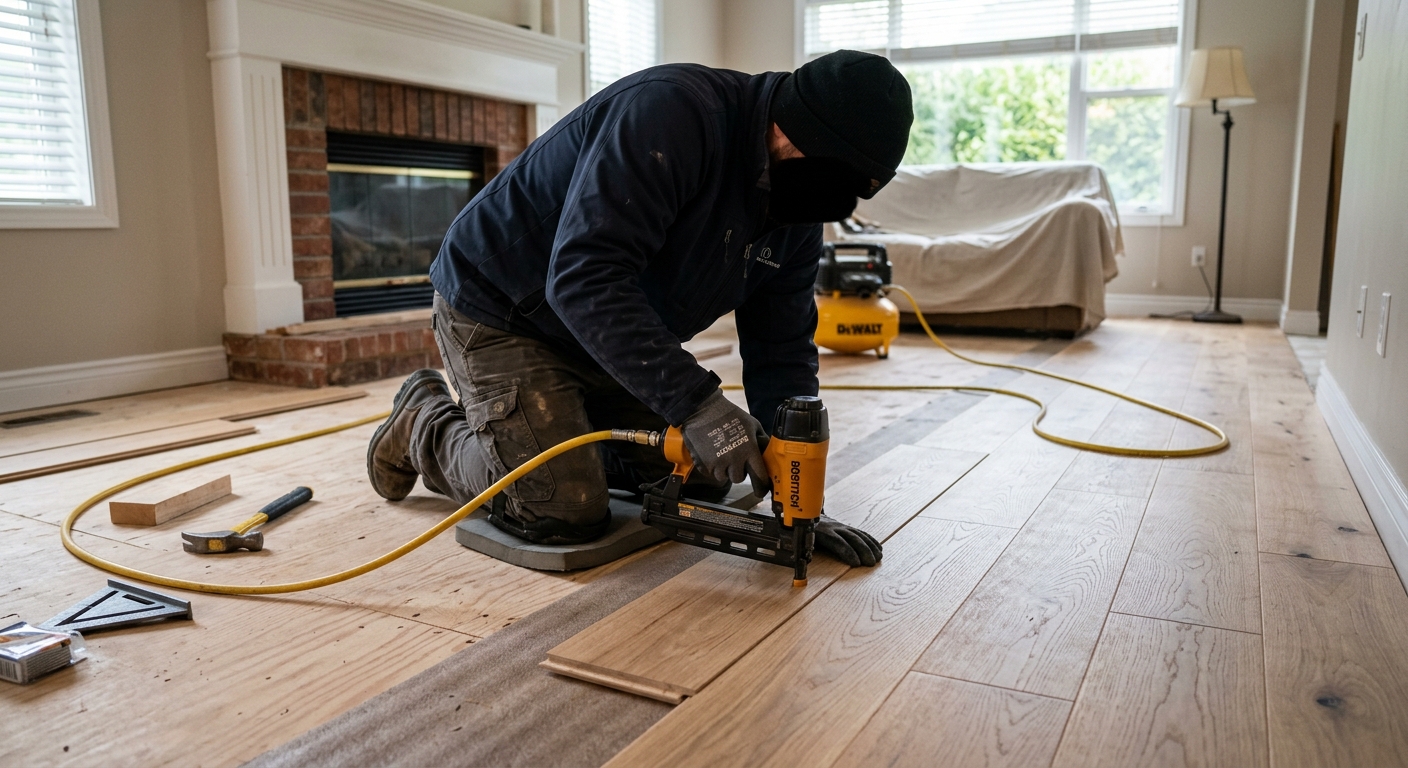
Flooring options and costs in Oakville
Oakville homeowners typically have plenty of flooring choices, but the best value comes from matching the material to Toronto-area indoor moisture swings and to how your subfloor has held up over time. With 27.0% of homes built before 1981 (Statistics Canada, 2021 Census), many projects start with levelling, plywood repair, or moisture mitigation before the “pretty” part begins—so even a mid-range floor can end up costing more once prep is included. That’s also why pricing in the Toronto economic region can feel inconsistent: contractors price risk, and older slabs or uneven subfloors increase labour and materials.
In Oakville—where you can get cool winters, humid summers, and fast seasonal changes—solid hardwood can look fantastic above grade, but it’s more sensitive to expansion and contraction indoors. Toronto-area humidity swings also make engineered hardwood and luxury vinyl plank (LVP) the default safer bets, especially when there’s any chance of installing on concrete, over an irregular subfloor, or in basements. Neighbourhoods like Bronte Creek and the East Oakville corridor see steady renovation demand, so you’ll often have more contractor capacity there, but higher labour rates still apply compared with smaller Ontario markets.
To compare options, use the ranges below as a backbone for Oakville quotes, then we’ll break down what commonly drives add-on costs in Section 2.
| Type |
Best Room |
Moisture Resistance |
Lifespan |
Price per sq ft |
| Solid hardwood (nail-down, above grade only) |
Living / dining rooms |
Low (avoid basements and concrete) |
20–35 years |
$9–$18 |
| Engineered hardwood (float or glue, above + on-grade) |
Living / dining, bedrooms |
Medium to high (better for Ontario humidity) |
15–30 years |
$10–$17 |
| Laminate (click-lock, above-grade) |
Bedrooms, hallways |
Low to medium (not for below-grade flooding) |
10–20 years |
$4–$9 |
| Luxury vinyl plank / LVP (waterproof, any level) |
Kitchen, finished basement |
High (waterproof core) |
15–25 years |
$5–$10 |
| Porcelain / ceramic tile |
Kitchen, bathrooms, entries |
Very high (surface water-ready) |
25–50 years |
$12–$25 |
| Carpet (broadloom or modular tile) |
Bedrooms, stairs |
Medium (avoid long-term wet areas) |
8–15 years |
$5–$11 |
Prices are estimates only and vary by project scope, site access and material selection.
What affects the price of flooring in Oakville
In Oakville and the wider Toronto area, two “similar” flooring jobs can land far apart—often by 30–50%—because the quote isn’t just the floor. It’s the risk of preparing the subfloor, handling moisture conditions, and dealing with older builds. For example, if your home is one of the homeowner households in Oakville (57,025; 77.5% of households own—Statistics Canada, 2021 Census), you’ll commonly see renovations where there’s existing flooring to remove, old adhesive residue, and sometimes uneven subfloors that need correction before installation.
Technically, the biggest drivers in our region are indoor humidity swings and below-grade moisture. Solid hardwood expands and contracts with humidity, so it can’t be glued or floated over concrete and it performs poorly in basements. Engineered hardwood and LVP are far more dimensionally stable and are specifically designed for above-grade and below-grade situations (when the product and prep match the system). Where radiant floor heating is present or planned, colder-region Ontario practices favour engineered wood, tile, and certain vinyl systems, while traditional solid hardwood is usually a mismatch.
Cost examples that routinely move the budget in Oakville: (1) a 1,200 sq ft main-floor install where the plywood is uneven may require levelling—commonly an add-on that can push the total by several dollars per sq ft; (2) basement installations over concrete often include moisture mitigation steps; and (3) stairs add labour and trim, and transitions can require extra materials. Those prep costs can make a project that starts near the laminate/vinyl band (about $4–$9 per sq ft) finish closer to engineered hardwood territory, while a tile job can rise from the lower end of $12–$25 once underlayment, backer board, and more labour are included.
| Price Factor |
Why It Matters |
Cost Impact |
| Room area in sq ft |
Material quantity and crew hours scale directly with square footage. |
Low to high (larger homes magnify every add-on) |
| Subfloor condition |
Levelling, patching, plywood replacement, or adhesive removal affects prep time. |
Often +$1–$4 per sq ft |
| Moisture / below-grade install |
Basements may need vapour control and stricter product system requirements. |
Can add several dollars per sq ft or change the product choice |
| Material choice |
Solid vs engineered vs LVP vs tile changes material cost and install method. |
Ranges from the laminate/vinyl band up through tile pricing |
| Removal and disposal of existing flooring |
Hauling, subfloor scraping, and dump fees vary by what’s there. |
Moderate; can be a meaningful line item in older homes |
| Stair nosing / transitions |
Steps and door transitions are labour-intensive and require matching trims. |
Often charged per step or per linear foot |
| Radiant heat compatibility |
Some materials and installation systems must be compatible with heating cycles. |
May add cost via upgraded products or different underlay |
| Installation method |
Float vs glue-down vs nail-down changes labour steps and surface requirements. |
Can shift the total by 10–30% depending on prep and method |
Permits & regulations in Ontario
In Ontario, the act of installing new floor coverings typically does not require a building permit. Flooring companies usually don’t pull permits for wood, laminate, LVP, carpet, or standard tile installs on a typical subfloor. However, related work can trigger permit or code requirements—especially when you’re changing electrical systems or structural assemblies.
Work that often does require permits includes: any electrical work to install or modify radiant floor heating circuits; modifications to power, junction boxes, or thermostats tied to in-floor heating; and structural or major subfloor work where building officials or engineering requirements may apply (for example, replacing a significantly compromised structural subfloor).
In condominiums, the bigger constraint is usually not “a permit,” but the condo corporation’s rules. Many condos regulate underlay and sound transmission to protect neighbours (STC/IIC expectations). Before installing hardwood or tile on upper floors, confirm the required underlay system and obtain any written board approval the building requires.
To verify your contractor in Oakville step-by-step: (1) ask for their Ontario business documentation and check the relevant public registry they use for contracting; (2) request a certificate of insurance for liability (and ensure the expiry date is current); (3) request proof of WSIB/WCB coverage (or an appropriate clearance letter, if applicable for their structure); and (4) keep copies with your quote so everyone is covered if something goes wrong on-site.
Best flooring for each room in your Oakville home
Choosing flooring room-by-room is the easiest way to avoid expensive mistakes in Oakville. Living and dining areas see daily traffic plus seasonal humidity movement, so engineered hardwood (or high-quality laminate) balances warmth with better dimensional stability than solid wood. Bedrooms usually benefit from comfort and sound control—carpet is still a strong pick for comfort underfoot and noise reduction, while engineered hardwood also works well if you’re managing humidity carefully.
In kitchens, the reality is water, grease, and wet shoes. Luxury vinyl plank (LVP) and large-format porcelain tile are both practical because they tolerate spills and are easier to clean. For basements, especially in homes built before 1981 (Statistics Canada, 2021 Census), the prep and moisture environment matter—finished basements are where LVP often shines. It’s waterproof and designed for below-grade installs, while solid hardwood and most laminate systems are higher risk over moisture vapour. Bathrooms should be porcelain or ceramic tile only, since they’re meant for wet areas.
If you have, or plan, radiant floor heating, favour materials that match heat cycling. Engineered wood, tile, and certain vinyl products are typically the best partners. As a budget example: upgrading from laminate in a 800 sq ft living space might look attractive in the $4–$9 band, but if your subfloor needs levelling anyway, the marginal difference to engineered wood can be justified because you’re buying stability for Oakville’s humidity—not just appearance.
| Room |
Best Material |
Why |
Moisture Risk |
Price Band per sq ft |
| Living / dining room |
Engineered hardwood |
Warm look with better stability during Toronto-area humidity swings. |
Low to medium (manage indoor RH) |
$10–$17 |
| Master bedroom |
Carpet or engineered hardwood |
Carpet adds comfort and sound absorption; engineered wood stays stable above grade. |
Low |
$5–$11 |
| Secondary bedrooms |
Carpet or laminate |
Laminate is cost-effective; carpet is quieter and softer for kids. |
Low |
$4–$9 |
| Kitchen |
Luxury vinyl plank (LVP) or porcelain tile |
Handles spills and cleanup; LVP is forgiving underfoot. |
Medium (occasional standing water risk) |
$5–$25 |
| Basement (finished) |
LVP |
Waterproof core suits below-grade moisture conditions and common concrete substrates. |
High |
$5–$10 |
| Bathroom |
Porcelain / ceramic tile |
Designed for wet zones; long service life if properly installed. |
Very high |
$12–$25 |
How to choose a contractor in Oakville
In Oakville, the safest way to protect yourself is to verify coverage before you sign. First, request proof of Ontario contracting compliance (where applicable), then confirm liability insurance with a current certificate of insurance—this should list your address as the job site (or at least match the contractor’s name). Next, ask for documentation showing WSIB/WCB coverage (or a clearance letter where appropriate for their business structure). Flooring is physical work: cuts, subfloor prep, moving furniture, and demolition all carry risk, and you don’t want to be the one holding the liability if something goes wrong.
Get 2–3 written, itemised quotes. A good quote breaks out labour and materials separately (and clearly lists what’s included): product type and thickness, underlay/vapour barrier, subfloor prep (levelling/patching), removal and disposal, transitions and stair work, and any trim. Carefully read exclusions: many “cheap” estimates omit subfloor replacement, moisture mitigation, or disposal fees. Also ask whether permits are needed for any electrical/radiant work and whether the contractor will coordinate with the electrician.
Warranty matters too: insist on workmanship warranty length and whether it’s tied to proper installation and maintenance. Confirm the manufacturer warranty on the product and whether it’s transferable to you. For payment, never pay more than 10–15% upfront; use a holdback until the job is complete and cleaned. Finally, get the start date and completion estimate in writing so scheduling doesn’t drift.
- Ask for and verify liability insurance before materials are ordered.
- Confirm WSIB/WCB coverage (or clearance letter) in writing.
- Require an itemised quote: labour, materials, underlay/vapour barrier, and disposal.
- Ensure subfloor prep is explicitly listed (levelling, plywood replacement, scraping).
- Confirm the moisture mitigation steps (especially for basements).
- Check what’s included for transitions and stair nosing.
- Ask whether the quote includes moving furniture and protecting fixtures.
- Get the floor flatness requirements and how they’ll measure before install.
- Confirm acclimation requirements for hardwood or engineered products.
- Clarify warranty terms: workmanship vs product warranty and what voids it.
- Use a payment schedule with a holdback after completion and punch list.
- Get a written start date and timeline for lead times and inspection/cleanup.
Common red flags in Oakville: vague “lump sum” quotes with no subfloor scope, no proof of WSIB/WCB or outdated insurance, pressure for large upfront payments, ignoring moisture testing/prep for basements, and warranties that don’t specify workmanship duration or coverage details.
Frequently asked questions — flooring in Oakville
Is cork or bamboo flooring a good choice in Oakville?
In Oakville, cork and bamboo can work, but they’re not the “safe default” for every room. Cork is dimensionally stable compared with some natural woods, and it’s comfortable and quiet, yet it can still be sensitive to sustained moisture if installed improperly or in a damp basement. Bamboo flooring is a wood product and generally carries similar humidity considerations—solid bamboo especially behaves like hardwood. In our climate with indoor humidity swings, I typically steer homeowners to engineered options (or carefully specified products) for main floors, and to LVP or tile for basements and wet zones. If you’re quoted around the laminate/vinyl band (about $4–$9 per sq ft), double-check the installation system and moisture protection layers before choosing any natural product.
What is the difference between floating and glued-down flooring?
Floating flooring “clicks” together and rests on an underlay, with the boards not mechanically attached to the subfloor. Glued-down flooring is bonded directly to the subfloor (or to an approved underlayment layer) to control movement. In Oakville’s Toronto-region humidity swings, floating floors can be easier to install over minor variation, and they’re common for laminate and many engineered products. Glued-down installations often require tighter subfloor flatness and careful moisture handling—especially over concrete. For basements or concrete slabs, the decision is less about preference and more about system design: vapour control, adhesive compatibility, and the product’s installation guidelines. A professional quote should specify which method you’re getting and what underlay or vapour barrier is included.
What flooring holds up best to pets in a Oakville home?
For pets in Oakville, the best-performing choices are usually waterproof and scratch-resilient surfaces that can handle accidents and paw traffic. Luxury vinyl plank (LVP) is often the top recommendation because many products are waterproof and tolerate spills better than laminate. Porcelain tile also holds up extremely well—though it’s harder underfoot and can be louder without proper sound control underlay. Carpet can work for comfort, but it requires faster cleaning if an accident occurs, and it can wear faster in high-traffic routes. If you’re comparing budgets, laminate and LVP often land in the $4–$9 and roughly $5–$10 bands, respectively, while tile usually starts higher (around $12–$25). The right fit depends on claw type, training, and whether the room has moisture risk.
How do I fix squeaky floors in my Oakville home?
Squeaks usually come from movement between subfloor layers, poorly secured joists, or loose fasteners—not from the finish flooring itself. In older Oakville homes (including a meaningful share built before 1981—Statistics Canada, 2021 Census), squeaks can be tied to ageing nail patterns, underlayment separation, or minor settlement. The first step is diagnosing: walk the area and note where the sound occurs, then check if it’s the underlay/subfloor or the surface boards. Sometimes the fix is from below (tightening fasteners or adding blocking), but if the problem is in the top layer, you may need to lift some flooring sections to re-secure. A contractor who does proper subfloor assessment can prevent you from tearing out the whole floor unnecessarily. Avoid “spray fixes” without inspection; they rarely address the root cause.
What is luxury vinyl plank and is it worth it in Oakville?
Luxury vinyl plank (LVP) is a layered flooring with a wear layer on top and a waterproof core. In Oakville, it’s often worth it because it handles Toronto-area humidity swings better than many wood-look alternatives and it’s a strong choice for basements and concrete installs. It can tolerate moisture vapour and minor spills more effectively than laminate or traditional hardwood. That said, not all LVP is equal: the wear layer quality, thickness, and the underlayment system (including vapour control where needed) matter for longevity. If your project is priced around the vinyl range (commonly about $5–$10 per sq ft), LVP can be a cost-effective way to get a durable floor without the higher risk of solid hardwood movement. For radiant heat homes, ask which LVP products are rated compatible with in-floor heating.
How much does flooring cost in Oakville?
In Oakville, flooring cost depends on the material, room size, subfloor condition, and how much prep is required before installation. As a quick guide based on typical price bands, laminate/vinyl plank often comes in around $4–$9 per sq ft, while engineered hardwood typically falls roughly between $9–$18 depending on quality and thickness. Tile is usually higher—commonly $12–$25 per sq ft—and carpet installation generally lands around $5–$11 per sq ft when labour is included. In many Toronto-area renovations, older homes can need levelling or plywood repair, which adds to the total even if the chosen floor is in a mid-range band. To get an accurate number, request an itemised quote that includes subfloor prep, removal/disposal, and transitions.