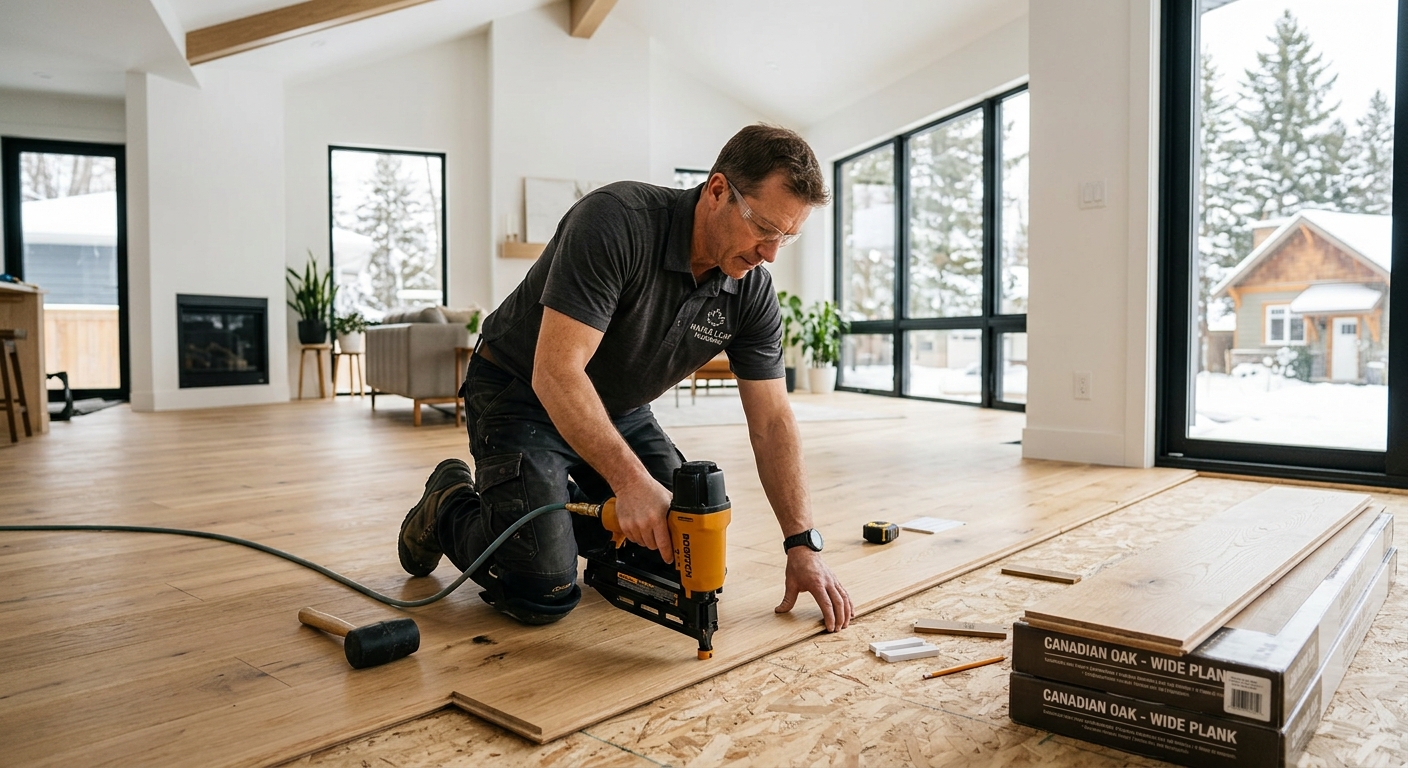
Flooring options and costs in The Beaches
The Beaches, Ontario is a wonderful place to live—but it also means real seasonal swings in indoor humidity, which can push labour and material choices in the Toronto area. With a local population of 21,567 (Statistics Canada, 2021 Census), there’s plenty of renovation demand, and that keeps contractor scheduling tight in peak months. Many nearby homes were built decades ago, and Toronto’s older housing stock often needs subfloor levelling, plywood replacement, or moisture mitigation before the “new floor” can be installed—especially if you’re covering tired OSB or uneven subfloor panels. In practice, that prep can add meaningful cost even when the finished product is mid-range.
Across The Beaches, we commonly steer homeowners toward engineered hardwood or luxury vinyl plank (LVP) because they’re more dimensionally stable in the face of Toronto’s humidity swings. That matters for the upper floors in townhouses as well as for basements and ground levels where moisture vapour can be a challenge. Solid hardwood is beautiful, but it moves more with humidity and is risky over concrete or in basements without a proper moisture-control assembly. If you’re adding or already have radiant floor heating (in newer infill builds and some custom homes), engineered wood and certain vinyl/tile systems pair better with the heat and expansion cycles than traditional solid.
Demand is especially consistent around Queen Street East and the Village core area, where homeowners often update main living spaces first and then move into kitchens and lower levels. Below is a practical cost comparison to help you translate “flooring type” into budgeting reality, then we’ll break down the specific pricing drivers.
| Type |
Best Room |
Moisture Resistance |
Lifespan |
Price per sq ft |
| Solid hardwood (nail-down, above grade only) |
Living / dining (above-grade) |
Low to moderate; sensitive to humidity |
25–50 years |
$9–$18 |
| Engineered hardwood (float or glue, above + on-grade) |
Living areas, main floor corridors |
Moderate; far more stable than solid |
15–30 years |
$9–$17 |
| Laminate (click-lock, above-grade) |
Bedrooms, living rooms |
Low to moderate; protect from standing water |
10–25 years |
$4–$9 |
| Luxury vinyl plank / LVP (waterproof, any level) |
Kitchen, finished basement |
High; waterproof core |
15–25 years |
$5–$12 |
| Porcelain / ceramic tile |
Kitchen, bathrooms, entries |
High; grout needs sealing as needed |
25–50 years |
$12–$25 |
| Carpet (broadloom or modular tile) |
Bedrooms, stairs (with proper padding) |
Low; moisture stains possible |
7–15 years |
$5–$11 |
Prices are estimates only and vary by project scope, site access and material selection.
What affects the price of flooring in The Beaches
Two homeowners can receive quotes for “the same flooring” in The Beaches and see a 30–50% difference, and it usually isn’t because contractors are guessing—it’s because the scope and site conditions are different. In Toronto-area renovations, labour is pushed up by strong demand and higher general construction wages, so any extra prep or complications show up quickly in your final number. Also, one quote might include moisture testing, levelling/plywood repair, and disposal, while another treats those as add-ons.
For The Beaches specifically, the key technical drivers are indoor humidity swings and below-grade moisture vapour. Solid hardwood expands and contracts with humidity, and it cannot be safely glued or floated over concrete; it’s also risky in basements. That’s why engineered hardwood and LVP—both designed with better dimensional stability—often come out as the better value over time. If you’re in a colder pocket of the region or using radiant floor heating, it can steer you away from traditional solid hardwood and some laminate assemblies because of heat and expansion considerations.
Older regional housing stock also frequently needs subfloor levelling or repair before any install, adding roughly $1–$4 per sq ft depending on how far out-of-level the substrate is and whether we need plywood replacement or additional moisture mitigation. On a 600 sq ft project, that alone can be the difference between a mid-band and a higher-band spend.
Concrete examples: (1) a main-floor upgrade with a straight run and flat subfloor may stay near the lower side of laminate/LVP pricing (for example, $4–$9 for laminate or $5–$12 for LVP), while (2) the same footprint with uneven plywood and moisture mitigation can add several dollars per sq ft before you even choose the finish. (3) Over concrete or in a finished basement, solid hardwood may be excluded—so engineered hardwood or waterproof LVP often becomes the justified, problem-solving choice rather than a cosmetic swap.
| Price Factor |
Why It Matters |
Cost Impact |
| Room area in sq ft |
Material quantities and hours scale directly with square footage |
Low to high; bigger rooms usually lower cost per sq ft |
| Subfloor condition |
Levelling, plywood replacement, and fastening add labour |
Often $1–$4 per sq ft in older homes |
| Moisture / below-grade install |
Rules out solid hardwood and some laminates over moisture-vulnerable slabs |
May add mitigation materials/testing; can shift you to engineered/LVP |
| Material choice |
Solid, engineered, LVP, and tile have different install systems and complexity |
Solid often highest ($9–$18); LVP typically mid ($5–$12) |
| Removal and disposal of existing flooring |
Demolition time, hauling, and disposal fees vary |
Can add noticeable cost on tile/underlay-heavy floors |
| Stair nosing / transitions |
Steps and transitions are charged separately per step or linear measurement |
Frequent add-on that increases total project cost |
| Radiant heat compatibility |
Limits products and can require specific installation methods |
May increase costs if you upgrade product type or prep |
| Installation method |
Float vs. glue-down vs. nail-down affects labour and required materials |
Glue-down can add prep/time; nail-down needs proper nailing surfaces |
Permits & regulations in Ontario
In Ontario, installing new floor coverings by itself typically does not require a building permit. If you’re only replacing flooring on existing framing and you’re not altering structural elements, you usually won’t need municipal permits. However, certain “associated work” can trigger permit requirements—particularly where electrical systems are involved, where structural subfloor repair crosses into regulated work, or where you’re modifying in-floor heating circuits.
Concrete examples of work that commonly does require permits or inspections: (1) connecting, modifying, or adding radiant floor heating circuits (electrical-related work), (2) making significant structural changes to the substrate that affect load-bearing components, and (3) specific moisture-control systems that require trades beyond simple surface treatments (depending on how the scope is defined). Work that typically does not require a building permit: replacing carpet, laminate, LVP, engineered hardwood, or tile over an existing subfloor, as long as you’re not changing wiring/plumbing or structural framing.
For condos in The Beaches, the bigger constraint is often the building’s rules on sound transmission. Even when permits aren’t required, the corporation may restrict underlay types or require specific underlayment to meet sound performance expectations. Always review the condo declaration and request board approval in writing before installing harder flooring like hardwood or tile on upper floors.
To verify your contractor in Ontario, check three areas: (1) Ontario licence/registrations applicable to the contractor’s trade scope (ask them to provide proof, and confirm on the relevant online registry), (2) liability insurance certificate naming you/your unit as required, and (3) WSIB/WCB coverage. Request documentation before work starts: the certificate of insurance, WSIB/WCB clearance letter (or equivalent proof), and a written scope that clarifies what’s included.
Best flooring for each room in your The Beaches home
In The Beaches, choosing flooring is about matching the material to how the room behaves seasonally—Toronto homes can see indoor humidity swings, and moisture vapour is often a bigger issue on ground levels and basements. For living and dining spaces, engineered hardwood or a high-quality laminate can provide warmth and a natural look while staying steadier than solid wood. In bedrooms, many homeowners like carpet for comfort and sound absorption, but engineered hardwood also works well when the subfloor is dry and properly prepared.
For kitchens, go with luxury vinyl plank (LVP) or large-format porcelain tile. Both handle splashes and easy cleaning better than solid hardwood, and LVP is also forgiving if you get minor subfloor movement over time. Basements (especially finished ones) are where waterproof performance matters most: LVP is usually the clear winner because it’s designed for below-grade installs and can tolerate moisture vapour that would shorten the life of laminate and can create problems for traditional solid hardwood.
Bathrooms should be porcelain or ceramic tile. If you have radiant floor heating, it’s increasingly common in Ontario’s newer custom builds; engineered wood and certain vinyl/tile systems pair better with heat and expansion than traditional solid hardwood.
A practical budget example: if you’re comparing LVP at roughly $5–$12 per sq ft versus engineered hardwood at about $9–$17 per sq ft, the extra spend can be justified in main living areas where you’ll enjoy the look daily. But for a basement in The Beaches, paying the difference often isn’t the best trade—waterproof LVP is typically the more reliable solution for the conditions.
| Room |
Best Material |
Why |
Moisture Risk |
Price Band per sq ft |
| Living / dining room |
Engineered hardwood |
Warm, realistic wood look with better dimensional stability for Toronto humidity swings |
Low (above-grade) |
$9–$17 |
| Master bedroom |
Carpet or engineered hardwood |
Carpet adds comfort and sound control; engineered wood keeps a cleaner, allergy-friendly option |
Low |
$5–$11 |
| Secondary bedrooms |
Laminate (good quality) or carpet |
Durable and easier to maintain; laminate is cost-effective if the subfloor is properly prepped |
Low to moderate (avoid spills and standing water) |
$4–$9 |
| Kitchen |
Luxury vinyl plank (LVP) or porcelain tile |
Handles splashes and frequent cleaning; tile resists water and lasts extremely long |
Moderate to high |
$5–$25 |
| Basement (finished) |
Luxury vinyl plank (waterproof) |
Designed for below-grade and moisture vapour conditions where solid wood and most laminate struggle |
High |
$5–$12 |
| Bathroom |
Porcelain / ceramic tile |
Best long-term water resistance; works well with proper underlayment and grout considerations |
High |
$12–$25 |
How to choose a flooring contractor in The Beaches
Choosing a flooring contractor in The Beaches is mostly about verification and clarity. Start by confirming Ontario compliance and coverage before you sign anything. Ask for (1) evidence of the right Ontario licence/registration for the scope they’re doing, (2) liability insurance certificate (so you’re protected if there’s property damage), and (3) WSIB/WCB clearance/proof of coverage for their workers. You should be able to receive these documents by email before work begins. Then, verify the information using the contractor’s documents and the appropriate online registry where applicable.
Next, request 2–3 itemised written quotes. “Itemised” matters: you want a line-by-line breakdown of labour, subfloor prep (levelling/repairs), underlay/vapour barrier where applicable, installation method (float/glue/nail), transitions and stair work, and removal/disposal. Avoid lump-sum quotes that don’t specify whether moisture mitigation is included or whether the contractor will repair an uneven substrate to a tolerable flatness standard.
Read scope exclusions carefully: what’s not included (baseboards, door trimming, plumbing knock-out adjustments), whether permits are handled if radiant heating electrical work is part of the job, and whether demolition/disposal are included. Confirm warranty terms: workmanship warranty length and how it’s delivered, plus product/manufacturer warranty details (and whether it’s transferable if you sell your home). Payment scheduling should be conservative: never pay more than 10–15% upfront, and use a holdback until the job is fully completed and cleaned up.
Finally, get the timeline in writing: proposed start date, time per phase, and completion estimate. In Toronto, weather and material lead times happen—good contractors plan for it instead of “hoping” the schedule holds.
- Verify Ontario licence/registration relevant to the scope and ask for proof in writing.
- Confirm liability insurance with a current certificate and correct insured parties.
- Request WSIB/WCB clearance/proof before work starts.
- Get 2–3 itemised quotes (labour + materials + prep + disposal), not a single lump sum.
- Ensure the quote states the installation method (floating, glue-down, nail-down) and product grade.
- Confirm subfloor prep scope: levelling, plywood replacement, fastening, and moisture mitigation details.
- Ask who handles transitions and stair nosing, and how those are measured/charged.
- Confirm removal and disposal: what gets hauled, and where it goes (and whether disposal fees are included).
- Clarify underlay/vapour barrier: included where required, and compatible with the flooring type.
- Check warranty specifics: workmanship duration, exclusions, and response process.
- Use a payment schedule with a maximum 10–15% upfront and a holdback until completion.
- Get start date and completion estimate in writing, including contingencies for material lead times.
Red flags in The Beaches: contractors who won’t provide insurance/WSIB proof, quotes that omit subfloor prep and then “discover” it mid-job, vague warranty language, pressure to pay more upfront than is reasonable, and mismatched flooring specifications (for example, describing “waterproof LVP” but quoting a cheaper non-waterproof core).
Frequently asked questions — flooring in The Beaches
How do I compare flooring quotes?
To compare quotes in The Beaches, line them up like-for-like. First, confirm the actual product: brand, model, thickness, wear layer (for LVP/engineered where relevant), and any underlay or vapour barrier the contractor includes. Second, check the install method: click-lock floating isn’t the same scope as glue-down or nail-down. Third, review subfloor prep. Toronto-area older homes often need levelling or plywood repair; one quote might include this and another might not, which can swing the price by 30–50% even with similar finish choices. Fourth, make sure disposal is included and that stair nosing/transitions are itemised. If you’re budgeting, use the local bands as a reality check—e.g., laminate/vinyl typically falls around $4–$9, while tile is commonly in the $12–$25 range.
Can I install flooring over existing tile in The Beaches?
Sometimes, yes—but it depends on the tile surface, height changes, and floor flatness. In The Beaches (and across the GTA), we often see tile over concrete, and you’ll need to confirm that the tile is firmly bonded and the surface is stable. If the tile is loose, cracked, or uneven, you’ll usually need removal or additional prep to reach a suitable flatness standard. Height is also a practical issue: adding underlay/levelling can raise door clearances and transitions, which can change the scope and cost. For vinyl or laminate, you also have to consider moisture and vapour control over concrete. If you’re planning tile-on-tile, make sure the quote specifies how they’ll address grout ridges and whether they’ll use an appropriate underlayment system. A good contractor should be able to explain why your specific tile is acceptable or not—no guesswork.
What is the best flooring for a high-traffic area in The Beaches?
For high-traffic zones in The Beaches—entries, hallways, and main living walkways—the best pick is usually LVP or engineered hardwood with a strong wear layer and good installation details. LVP is popular because it’s waterproof (helpful for wet boots in winter and accidental spills) and performs better with humidity swings than solid hardwood. Engineered hardwood can also be a great choice above grade when the subfloor is level and dry. Carpet can work, but it will show wear faster in heavy traffic, and it’s not ideal where moisture happens frequently. If your quote is comparing options, use local pricing bands to judge value: laminate/vinyl are commonly in the $4–$9 range, while engineered hardwood often lands higher (around $9–$17). The “best” option is the one that matches your room’s moisture risk and the quality of prep—especially subfloor flatness and underlayment compatibility.
How do I prepare my subfloor before new flooring?
In Toronto homes, subfloor preparation is often the difference between a floor that looks great for years and one that fails early. Preparation usually includes inspection, cleaning, and checking flatness. If the surface is uneven or damaged, contractors may need levelling compound and/or plywood replacement, then fastening/straightening to create a stable base. Moisture control is also key in The Beaches: basements and ground levels can have moisture vapour, which is one reason solid hardwood is risky and why engineered hardwood and LVP are preferred. Good contractors should explain what they’ll do for your specific situation—whether that’s moisture mitigation, vapour barrier planning, or underlayment selection. Ask your installer to describe the exact steps and which materials are included in the quote so you’re not surprised later.
Is cork or bamboo flooring a good choice in The Beaches?
Cork can be a good comfort option in above-grade rooms because it’s quieter and feels warmer underfoot, but it still requires proper subfloor prep and careful attention to moisture. In The Beaches, humidity swings mean cork needs stable indoor conditions and good installation details; any room with frequent moisture (kitchens/bathrooms and most basements) is where cork can be a tougher sell. Bamboo can be a durable-looking alternative, but its performance depends on whether you’re using a solid or engineered product and whether the install system fits Toronto’s moisture realities. In basements or over concrete, many homeowners are better served by engineered hardwood designed for stability or waterproof LVP. As a budgeting reference, if you’re trying to compare “natural” products to typical bands, you might find these materials land near the engineered hardwood tier (often around $9–$17) once prep is included—so it’s smart to ask how the moisture plan will be handled before committing.
What is the difference between floating and glued-down flooring?
Floating flooring is installed so the planks aren’t rigidly fixed to the subfloor. Click-lock systems “float” over an underlayment, which helps reduce some impact of minor subfloor movement. Glued-down flooring, by contrast, is adhered directly to the subfloor or through a specified underlayment system, creating a more rigid bond. In Ontario’s climate—with humidity swings and occasional subfloor movement—both methods can work, but they’re not interchangeable. Floating LVP and click laminate are common choices for many above-grade projects, provided the subfloor is properly prepared and flat. Glue-down engineered hardwood may be preferred for certain floors where stability is critical, but it requires strict substrate readiness and correct adhesive selection. If radiant floor heating is involved, the product’s installation instructions usually determine whether floating or glue-down is appropriate.