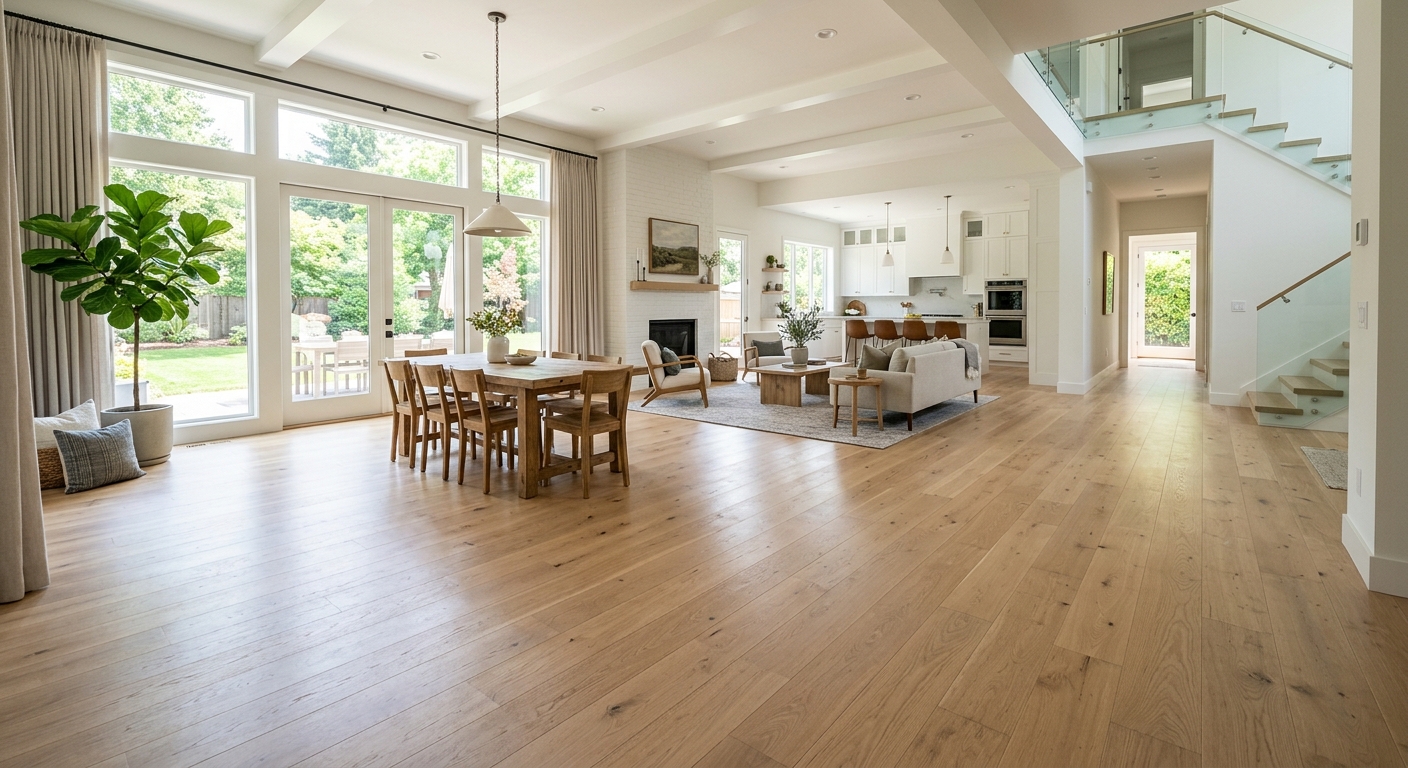
Flooring options and costs in Richmond
Richmond, Ontario sits in the Ottawa economic orbit, and that matters because local crews price jobs based on the same real-world constraints: weather-driven scheduling, material freight, and basement/prep needs tied to older housing. Richmond’s population is small (4,055 people in 2021, Statistics Canada, 2021 Census), so the same contractors can be booked out for longer when winter storms hit and when multiple nearby projects start at once. In this market, many homes reflect mid-20th-century layouts and transitions, and it’s common to find uneven subfloors or additions that require patching and levelling before flooring ever goes down.
Ottawa-region winters tend to be dry indoors, then summers bring humidity swings. That cycle is one reason solid hardwood is the most sensitive option: it expands and contracts with moisture, and it’s not a good match for basements or installs over concrete. Engineered hardwood and luxury vinyl plank (LVP) are typically more stable, and LVP is the safer choice when moisture vapour is a concern. Many homeowners also plan energy efficiency upgrades and are considering radiant floor heating; compatibility limits what you can choose, which can affect labour planning and material pricing.
In Richmond, trade demand is especially steady in established residential pockets where basements and remodels are common—near the older farmstead-style properties and the older neighbourhood streets close to the community core. If you’re budgeting, the “prep” work (removal, OSB/plywood fixes, levelling compound) can move the total cost by dollars per square foot before you even select the finish. Use the table below to compare typical installed price bands by flooring type.
| Type |
Best Room |
Moisture Resistance |
Lifespan |
Price per sq ft |
| Solid hardwood (nail-down, above grade only) |
Living/dining, bedrooms (above grade) |
Low to moderate; sensitive to humidity swings |
25–50 years with proper conditions |
$11 – $22 |
| Engineered hardwood (float or glue, above + on-grade) |
Living/dining, bedrooms (above + on-grade) |
Moderate to high; more dimensionally stable |
15–30 years |
$12 – $20 |
| Laminate (click-lock, above-grade) |
Living rooms, hallways (above grade) |
Moderate; seams can fail if repeatedly wet |
10–25 years |
$6 – $14 |
| Luxury vinyl plank / LVP (waterproof, any level) |
Kitchen, main floor, basement |
High; waterproof core with correct underlayment |
15–25 years (product-dependent) |
$8 – $16 |
| Porcelain / ceramic tile |
Kitchen, bathrooms, entryways |
High when installed to specs; grout needs care |
25–50 years |
$12 – $25 |
| Carpet (broadloom or modular tile) |
Bedrooms, stairs (comfort) |
Moderate; avoid long-term dampness |
7–15 years |
$5 – $11 |
Prices are estimates only and vary by project scope, site access and material selection.
What affects the price of flooring in Richmond
It’s common to see flooring quotes for the same square footage in the Ottawa region vary by 30–50%. In practice, two estimates can look similar until you compare what’s included: subfloor prep, how uneven the existing surface is, disposal, transitions to adjacent floors, and whether the installer is pricing for humidity-safe underlayment and vapour barriers. In Richmond, the biggest technical cost driver is Ottawa-region climate: large indoor humidity swings between dry winters and humid summers. That cycle makes solid hardwood prone to seasonal movement, so basements and concrete slabs often require alternatives (engineered wood, approved LVP systems, or tile).
Below-grade moisture is another recurring factor. In older local homes, hydrostatic pressure and moisture vapour are common in basements and crawlspaces, which is why true waterproof LVP (and properly detailed systems for tile) usually cost less to “do once” than solid hardwood. Also, colder local winters and more radiant floor heating planning can limit material choices; compatible systems often require specific underlayments or direct-install details.
Older regional housing stock frequently needs levelling or repair. For example, patching and levelling compounds or adding plywood/OSB can add about $1–$4 per square foot before the new floor is laid. As a budget example, moving from carpet at roughly $5–$11 per square foot to tile at $12–$25 can be justified in kitchens and bathrooms where water exposure is realistic and long-term durability matters. Conversely, if your subfloor is very uneven, you might spend more on prep than you expected regardless of whether you select laminate at $6–$14 or engineered hardwood.
| Price Factor |
Why It Matters |
Cost Impact |
| Room area in sq ft |
Materials and installation labour scale directly with square footage |
Low-to-high depending on complexity; small rooms often cost more per sq ft |
| Subfloor condition |
Uneven floors need levelling or panel repair before install |
Often adds $1–$4 per sq ft in older homes |
| Moisture / below-grade install |
Basements over concrete may rule out solid hardwood |
May increase prep and require vapour barrier or waterproof systems |
| Material choice |
Solid vs. engineered vs. LVP vs. tile have different installation requirements |
Can shift totals by several dollars per sq ft (e.g., carpet vs. tile) |
| Removal and disposal of existing flooring |
Demolition time, hauling, and dump fees can be significant |
Commonly adds a noticeable line item, especially with tile/underlay removal |
| Stair nosing / transitions |
Steps, door jamb work, and matching heights drive extra labour |
Charged per step or per linear foot; can add hundreds on larger jobs |
| Radiant heat compatibility |
Limits product selection and underlayment type |
May add cost for compatible materials and careful installation sequencing |
| Installation method |
Float vs. glue-down vs. nail-down changes labour time and prep |
Glue-down and nail-down generally require more detailed subfloor prep |
Permits & regulations in Ontario
In Ontario, installing new flooring itself usually does not require a building permit. If you’re simply removing existing material and installing new carpet, laminate, vinyl plank, engineered hardwood, or tile over a prepared subfloor, that’s typically a straightforward trade scope with no permit. However, associated work can trigger permitting, and that’s where homeowners need to be careful.
Work that may require a permit includes electrical modifications related to in-floor systems (for example, if you’re adding or altering a radiant floor heating circuit), and any structural or significant repairs that change building elements (such as engineered subfloor rebuilds that affect structural integrity). If moisture remediation involves more than surface-level corrections—especially anything that changes how the floor assembly manages water—your contractor should confirm whether additional approvals are needed.
For condominiums in Ontario, permits aren’t the only issue. Condo corporations often regulate sound transmission between units. That means you may need specific underlayments under hard flooring to meet building requirements. Before work begins, review the condo declaration and request board approval in writing, especially for hardwood or tile installed on upper floors.
To verify your contractor in Richmond, ask for three things and check them in advance: (1) Ontario licence/registration where applicable for your scope (ask the contractor what category they operate under), (2) liability insurance certificate of insurance (COI) listing you as a certificate holder where possible, and (3) WSIB/WCB clearance information for workers. You can request documentation directly and also verify clearance letters with the insurer/board process the contractor provides.
Best flooring for each room in your Richmond home
In Richmond, the “best” flooring is the one that fits your room’s moisture exposure, traffic level, and comfort needs—then tolerates Ottawa-region humidity swings. Living and dining areas typically benefit from warmth and the look of wood without the seasonal sensitivity of solid hardwood. In most cases, I recommend engineered hardwood or a quality laminate (click-lock) because they’re better at handling indoor movement. For bedrooms, comfort and sound matter: carpet still wins for softness and reduced echo, while engineered hardwood is a strong upgrade if you’re keeping moisture under control.
Kitchens are where waterproof performance pays off. Luxury vinyl plank (LVP) is usually the practical choice for spill-prone days and easy cleanup, and large-format porcelain tile is also excellent where you want maximum water resistance. Basements (finished) are different: fully waterproof LVP is typically the clear winner because it handles moisture vapour and below-grade conditions far better than solid wood and most laminate. Bathrooms should be porcelain or ceramic tile only—done right with proper underlayment and sealing where required.
Radiant floor heating is increasingly common in Ontario upgrades and new construction. Many LVP and engineered wood systems can be installed over compatible radiant setups, but not every product works over every heating type, so we match the flooring system to the radiant specs.
Price-wise, if you’re debating options, remember the difference between typical bands: for example, carpet around $5–$11 per square foot can be a good value for bedrooms, but in a basement where dampness is realistic, paying for waterproof LVP (often in the $8–$16 range installed depending on product) can prevent early failure—saving you from redoing the project sooner.
| Room |
Best Material |
Why |
Moisture Risk |
Price Band per sq ft |
| Living / dining room |
Engineered hardwood |
Warm look with improved stability for Ottawa humidity swings |
Low to moderate (depends on seasonality and ventilation) |
$12 – $20 |
| Master bedroom |
Carpet or engineered hardwood |
Comfort and sound control; hardwood if you want a cleaner feel |
Low (above grade, usually) |
$5 – $20 |
| Secondary bedrooms |
Laminate or carpet |
Good durability for family traffic; carpet adds softness |
Low |
$6 – $14 |
| Kitchen |
Luxury vinyl plank (LVP) or porcelain tile |
Water and spill tolerance, easier cleaning, strong daily performance |
Moderate to high |
$8 – $25 |
| Basement (finished) |
Luxury vinyl plank (waterproof) |
Designed for below-grade moisture vapour conditions |
High (vapour and occasional seepage risk) |
$8 – $16 |
| Bathroom |
Porcelain / ceramic tile |
Best match for wet areas; long service life when installed correctly |
High |
$12 – $25 |
How to choose a flooring contractor in Richmond
Choosing a flooring contractor in Richmond is mostly about proof, clarity, and risk control. Start with verification: confirm the contractor’s Ontario licensing/registration for their trade scope (ask them directly which category they’re operating under), request a current certificate of liability insurance, and ensure workers are covered under WSIB/WCB—then ask for a clearance letter or proof document rather than accepting a verbal promise. You can review the COI for effective dates and coverage limits, and you should be able to provide the clearance information within a reasonable timeframe before installation.
Next, get 2–3 itemised written quotes. Avoid “all-in” numbers that don’t break out labour, material, subfloor prep, underlayment/vapour barrier, stair work, and disposal. A proper quote will also state what’s excluded—things like removing old tile thinset completely, levelling if the floor is out of tolerance, or moving appliances. In Ontario, if radiant heat is part of the scope, the installer should clearly confirm compatibility and who is responsible for any electrical requirements.
Warranty matters: look for a workmanship warranty length and confirm the product warranty terms (and whether the warranty is transferable to you). Payment should be conservative—never more than 10–15% upfront, with a holdback until the job is complete and cleaned. Finally, insist on a start date and estimated completion timeline in writing so you can plan around weather and delivery schedules.
- Ask for written scope: what is removed, what is replaced, and what prep is included
- Confirm subfloor flatness target and how they’ll measure it
- Verify underlayment/vapour barrier details for your specific flooring type
- Require a line item for disposal and dump fees
- Confirm stair nosing and transition work (per step vs per linear foot)
- Request proof of liability insurance with correct project details
- Ask for WSIB/WCB clearance documentation in writing
- Check that the quote lists the exact product line/model (not just “engineered hardwood”)
- Clarify whether moulding installation and caulking are included
- Confirm return policy for unused materials (restocking and who pays freight)
- Get installation schedule dates in writing and material delivery timelines
- Make sure warranty start date aligns with completion and handover
Red flags I see in Richmond include contractors who refuse written scope details, won’t show insurance/WSIB/WCB documentation, price changes after site measurements without a documented reason, “per square foot” quotes that don’t include subfloor prep or disposal, and crews who promise basement installs of solid hardwood over concrete without discussing moisture/vapour barriers.
Frequently asked questions — flooring in Richmond
Do I need to level my subfloor first?
Most Richmond homes benefit from at least an assessment, because Ottawa-region housing stock often includes uneven subfloors and transitions between old additions. If the floor is out of tolerance, levelling is usually the difference between a long-lasting installation and one that squeaks, separates at seams, or fails early—especially with click-lock laminate and floating engineered floors. Solid hardwood can also be unforgiving when the subfloor isn’t flat. In practical terms, levelling compounds and/or plywood/OSB repair can add about $1–$4 per square foot depending on how much work is needed. Get your contractor to measure flatness, then confirm in the quote whether levelling/repair is included or treated as an add-on. (Statistics Canada, 2021 Census)
What's the most durable flooring for pets and kids?
For pets and kids in Richmond, durability means resisting scratches, dents, and daily spills—not just looking good. Luxury vinyl plank (LVP) is usually the safest overall choice because it’s waterproof and holds up better to accidents than laminate. If your basement is in the mix, LVP becomes even more attractive because it tolerates below-grade moisture vapour conditions that can shorten other floors. If you prefer a “wood look,” engineered hardwood is durable and warm, but it still needs good moisture control and careful cleaning—scratches will show with wear. As a rough budget comparison, carpet often comes in around $5–$11 per square foot and helps with comfort, but it can stain or trap odours if moisture or pet accidents aren’t treated quickly. LVP typically sits higher (often around $8–$16 installed depending on product and prep), but it frequently costs less over time due to fewer replacement triggers in humid Ontario conditions.
How do I choose flooring for humidity in Richmond?
Choose based on how the material handles humidity swings. In Richmond, you’ll see dry winter indoor air followed by humid summer conditions, and that movement can cause issues with solid hardwood—especially over concrete or in basements where moisture vapour is common. Solid hardwood is best limited to above-grade spaces with consistent indoor conditions. Engineered hardwood is more dimensionally stable and is often approved for many on-grade and above-grade installs when paired with the correct underlayment system. Luxury vinyl plank is the most forgiving option for humidity because many products are waterproof and can handle below-grade moisture vapour better than wood and most laminate. Tile is also stable long-term, though grout maintenance matters. If radiant floor heating is planned, match the flooring system to the heating type—some products require specific installation details to prevent movement or loss of performance.
Do condos restrict hard flooring?
Yes, often. In Ontario condos, the restriction usually isn’t about “a permit” for flooring—it’s about sound transmission. Many corporations require specific underlayments and may reference STC/IIC performance targets. That means you can’t assume you’ll be able to install hard flooring (engineered hardwood, tile, or LVP) the way you would in a standalone home. Before any work starts, review the condo declaration and request board approval in writing. Ask what underlayment thickness and type is allowed for the specific floor assembly you’re installing. On upper floors, failure to comply can lead to repair demands. For budgeting, note that the approved underlayment and prep details can affect installed cost; for example, upgrading to a moisture-safe LVP system versus a cheaper laminate can change the price outcome even if the square footage is identical. (Statistics Canada, 2021 Census)
How do I compare flooring quotes?
Compare quotes like-for-like by forcing an itemised breakdown: materials, labour, subfloor levelling/repair, underlayment/vapour barrier, removal and disposal, and transitions/stair nosing. Two quotes that both say “laminate installed” can differ by hundreds if one includes proper prep and the other doesn’t. Look for whether the quote states product model numbers and thickness, and whether it matches your moisture needs—especially if you have a basement or slab. Also compare the method: floating click-lock versus glue-down versus nail-down changes labour time and prep requirements. Pay attention to warranty terms (workmanship length and product warranty conditions) and the payment schedule. As a quick reality check, carpet installations commonly land around $5–$11 per square foot, while tile can be roughly $12–$25 per square foot installed. If a tile quote is close to carpet pricing, ask what’s missing before you sign.
Can I install flooring over existing tile in Richmond?
Sometimes, but it depends on the condition of the existing tile and the flatness of the surface you’re covering. In Richmond, I typically see two scenarios: (1) installers remove the tile when it’s cracked/heaving or when the room needs to be level for proper transitions, and (2) flooring goes over tile only when the tile is solid, well-adhered, and flat enough for the new system’s requirements. Click-lock floating floors often require a very stable, flat substrate; LVP may be more forgiving but still needs correct underlayment and height planning. If you’re going over tile with a thicker assembly (like some vinyl systems), you may run into door clearance and stair height mismatch that increases transition costs. For bathrooms or kitchens where moisture is expected, don’t treat “tile underneath” as a free pass—verify that the tile surface is clean, mechanically sound, and appropriate for your new flooring’s installation instructions. (Statistics Canada, 2021 Census)