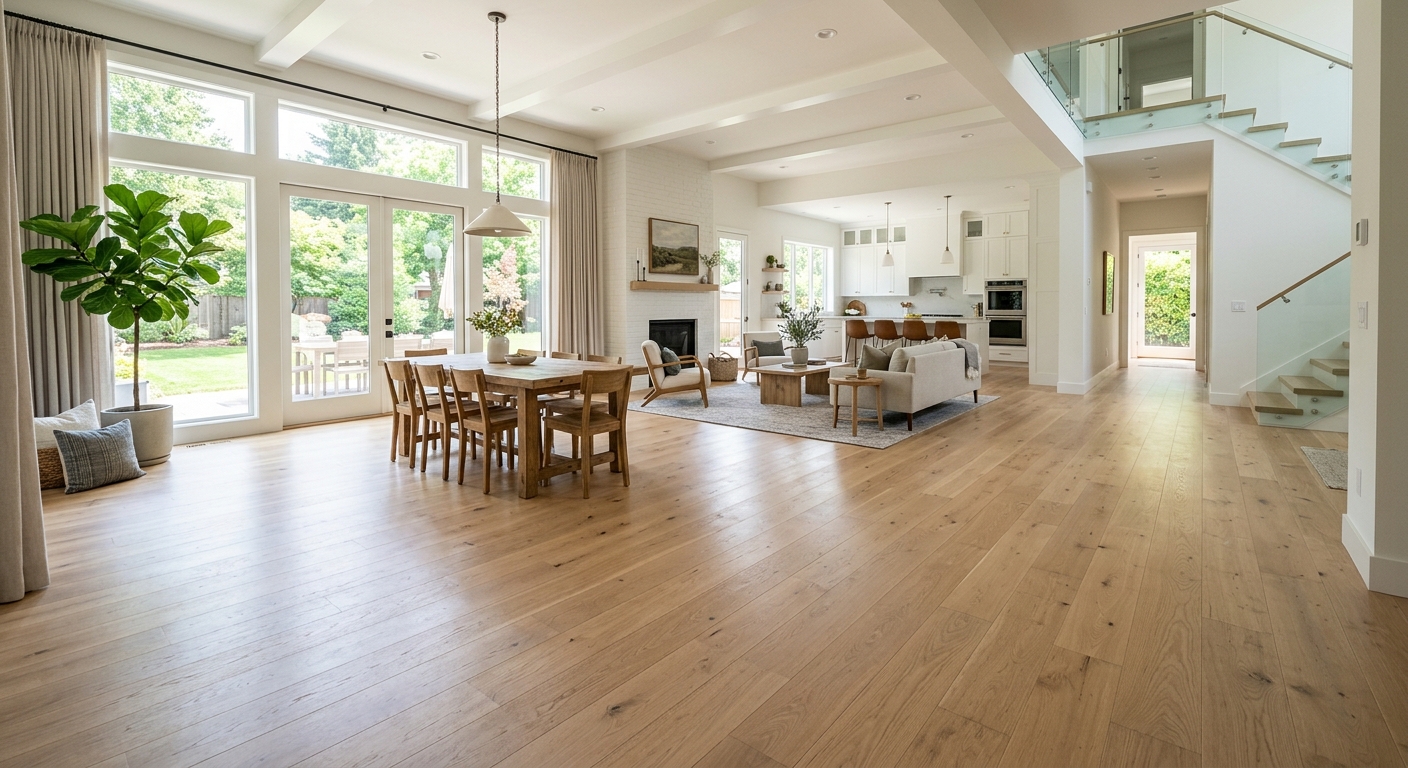
Flooring options and costs in Canyon Meadows
Canyon Meadows homeowners typically shop flooring options by how they’ll perform through Calgary’s dry, cold prairie winters and sudden seasonal humidity swings. With a population of 7,435 in 2021 (Statistics Canada, 2021 Census), there’s strong local competition among installers, so you can usually get multiple price quotes—but the cheapest bid isn’t always the best value once prep work is included. One big cost driver is older housing stock in the Calgary area: when subfloors are out of level, contractors often add levelling (and sometimes patch/skim repairs) before tile or new hardwood goes down. That prep step alone commonly lands around $1,000–$3,000 for a typical mid-size project, which is equivalent to roughly $1–$4 per sq ft depending on how uneven the concrete or aged plywood is.
Basements and on-grade slabs in the region also influence material choices. Because moisture can migrate through concrete, solid hardwood is often restricted to above-grade only, while engineered wood and waterproof LVP/SPC are selected more frequently. In homes with radiant heat (more common in newer builds), the material list tightens further.
Trade demand is especially steady in the Canyon Meadows / surrounding southeast Calgary corridor, where many projects involve replacing dated main-floor finishes and upgrading wet-area flooring. Once you know your moisture situation and whether you need levelling, you can compare realistic per-sq-ft pricing across the options below.
| Type |
Best Room |
Moisture Resistance |
Lifespan |
Price per sq ft |
| Solid hardwood (nail-down, above grade only) |
Living / dining (above grade) |
Low to moderate (humidity-sensitive; no concrete basements) |
25–40 years |
$8–$15 |
| Engineered hardwood (float or glue, above + on-grade) |
Living / dining, hallways |
Moderate to high (more stable in humidity swings) |
20–35 years |
$9–$14 |
| Laminate (click-lock, above-grade) |
Bedrooms, living rooms (dry areas) |
Low to moderate (stands up to spills briefly; not a true wet-area solution) |
12–25 years |
$3–$7 |
| Luxury vinyl plank / LVP (waterproof, any level) |
Basements, kitchens, main floor |
High (waterproof core; better for below-grade risk) |
15–30 years |
$4–$10 |
| Porcelain / ceramic tile |
Bathrooms, kitchens, entries |
Very high (if installed correctly with proper prep and grout) |
25–50 years |
$6–$12 |
| Carpet (broadloom or modular tile) |
Bedrooms, media rooms |
Low (can hold odours and moisture; needs quality underlay) |
8–15 years |
$3–$7 |
Prices are estimates only and vary by project scope, site access and material selection.
What affects the price of flooring in Canyon Meadows
In Canyon Meadows, it’s common to see quotes for the same floor type vary by 30% to 50% once you account for prep, subfloor condition, and the “stuff around the flooring.” Two installers can quote the same square footage but use different underlay, handle transitions differently, or include (or exclude) disposal, stair work, and levelling. That’s why a “per sq ft” number is only comparable when the scope is written the same way.
Technically, Calgary’s humidity swings are a major cost driver. Solid hardwood expands and contracts with indoor relative humidity, so it cannot be glued or floated over concrete and performs poorly in basements where moisture vapour risk is higher. Engineered hardwood and luxury vinyl plank (LVP) handle humidity better, and waterproof LVP/SPC is the safer bet for below-grade installations. If your home has radiant heat, colder regions like ours also reduce the best-fit material options—most solid hardwood is limited, and some laminate and adhesives need manufacturer approval.
Older regional housing stock often needs subfloor levelling or repair. Depending on how far out the surface is, that prep can realistically add $1–$4 per sq ft to the job. For example, if you budget at the lower end of $3,000–$7,000 (material-only) for a laminate-style approach, levelling can erase the savings quickly; whereas upgrading to LVP may still be cost-effective when moisture control is a concern.
In Canyon Meadows specifically, basements with slab moisture migration and main-floor transitions (different subfloor layers/older plywood patches) are frequent reasons costs land toward the upper end of the $8,000–$15,000 hardwood band after labour, prep, and stair/trim reinstallation are included.
| Price Factor |
Why It Matters |
Cost Impact |
| Room area in sq ft |
Material quantity and labour hours scale with coverage |
Higher area often lowers per-sq-ft labour rate but increases total cost |
| Subfloor condition |
Levelling/patching is required for proper locking, lippage control, and tile flatness |
Commonly adds $1–$4 per sq ft for repairs/skim/patch work |
| Moisture / below-grade install |
Moisture vapour through concrete can damage solid wood and some laminates |
May shift you to engineered wood or waterproof LVP/SPC; costs usually rise vs dry-only installs |
| Material choice |
Solid vs engineered vs LVP vs tile have different install systems and tolerances |
Material-only differences often range from budget to mid-range bands (e.g., laminate/vinyl vs hardwood/tile) |
| Removal and disposal of existing flooring |
Demo time, haul-away, and subfloor cleaning affect labour |
Can add several hundred to a few thousand depending on build-up and disposal |
| Stair nosing / transitions |
Complex cut-outs, nosings, and matching profiles are time-heavy |
Often charged per step or per linear foot; can meaningfully change totals |
| Radiant heat compatibility |
Some products are restricted or require specific underlay/adhesive systems |
May require different products and additional acclimation time |
| Installation method |
Float, glue-down, and nail-down each require different subfloor prep and labour technique |
Glue-down and nail-down tend to be higher labour cost than click-lock floors |
Permits & regulations in Alberta
In Alberta, installing flooring itself typically does not require a building permit. That said, associated work can trigger permits depending on what’s being changed. For example, if the project includes electrical modifications for in-floor heating components, new circuits, or panel/breaker work, electrical permitting can be required. If you’re repairing structural subfloors in a way that impacts load-bearing components (rare for flooring-only jobs, but possible in extreme rot situations), permits may be required—so it’s important to match the scope to the correct category.
For condominiums in Alberta, the bigger “rule” is usually the building’s own policies: sound transmission requirements often restrict hard flooring on upper floors. Many boards require specific underlay systems (or a minimum sound rating) before you install hardwood, tile, or hard-surface products.
Here’s a practical step-by-step way a homeowner in Canyon Meadows can verify your contractor before they start:
- Confirm the contractor’s Alberta licence/registration status as applicable and ask for their business number details.
- Request proof of liability insurance (certificate of insurance showing current coverage).
- Ask for WSIB/WCB clearance or coverage documentation (or proof of exemption if they truly qualify).
- Get the quote in writing with product names, installation method, and what prep work is included/excluded.
- For condos: ask for board approval steps and request it in writing before installation begins.
Best flooring for each room in your Canyon Meadows home
Choosing the right flooring for Canyon Meadows is less about “what looks best” and more about humidity risk, traffic, and comfort in our dry, cold prairie conditions. In living and dining areas, engineered hardwood or a high-quality laminate can balance warmth and durability without the same humidity sensitivity issues you’ll see with solid hardwood. For the master bedroom, carpet is still a strong comfort choice because it reduces noise and feels warm underfoot in winter; if you prefer a hard surface, engineered wood is the more stable option.
In kitchens, where water spills are realistic, luxury vinyl plank (LVP) or large-format porcelain tile is typically the most forgiving. Tile also suits entries well because it’s easy to clean after snow and slush. For basements, LVP is the clear winner in most Canyon Meadows homes: waterproof cores handle moisture vapour and below-grade risk far better than solid wood and many laminate products. Bathrooms should be porcelain or ceramic tile only, with proper substrate prep and crack isolation where needed.
If you have rooms over radiant heat, confirm compatibility before purchase. Radiant heat can affect product expansion and adhesive selection, so installers often steer you away from certain solid hardwood installations and toward approved engineered products, specific underlays, or tile assemblies.
A dollar example: if a tile upgrade is priced near the $6,000–$12,000 tile band for your bathroom/entry, that extra cost is often justified by long-term water resistance and lower maintenance versus flooring that struggles with repeated damp episodes.
| Room |
Best Material |
Why |
Moisture Risk |
Price Band per sq ft |
| Living / dining room |
Engineered hardwood |
Stable in humidity swings while still giving a hardwood look and feel |
Low to moderate (above grade) |
$8–$14 |
| Master bedroom |
Carpet or engineered hardwood |
Carpet adds comfort and sound control; engineered keeps a cleaner hard-surface option |
Low |
$3–$14 |
| Secondary bedrooms |
Laminate (click-lock) or carpet |
Budget-friendly coverage that holds up to everyday wear in dry spaces |
Low |
$3–$7 |
| Kitchen |
Waterproof LVP or porcelain tile |
LVP tolerates spills and cleaning; tile handles repeated wet mopping |
Moderate (spills, sink leaks) |
$4–$12 |
| Basement (finished) |
Luxury vinyl plank (waterproof) |
Best match for below-grade installs and moisture vapour conditions |
Higher (concrete moisture migration risk) |
$4–$10 |
| Bathroom |
Porcelain / ceramic tile |
Designed for wet zones with the right underlayment and grout practices |
Very high (constant wet environment) |
$6–$12 |
How to choose a flooring contractor in Canyon Meadows
To choose the right flooring contractor in Canyon Meadows, you want proof—not promises—especially given how much Calgary prep work can cost. Start by verifying Alberta coverage: request their liability insurance certificate of insurance, and ask for WSIB/WCB clearance (or a clear exemption explanation if applicable). Next, confirm licensing/registration where required and keep a copy for your records.
Then get 2–3 itemised written quotes that separate labour and materials. Avoid “lump sum” numbers that don’t say what underlay, adhesive type, levelling compound, stair nosings, and disposal are included. Pay attention to what’s excluded: for example, whether levelling is only a skim or includes full flattening, whether transitions and stair treads are included, and whether the contractor is responsible for floor preparation cleaning.
Warranty matters in Alberta’s seasonal conditions. Ask for a clear workmanship warranty length (often separate from product warranty), plus confirm whether the manufacturer warranty is transferable to the homeowner. Also ask how they handle acclimation—especially for engineered wood or laminate—because climate swings can cause installation failures if timelines are rushed.
On payment, never pay more than 10–15% upfront. Use a holdback until the job is complete and you’ve confirmed transitions, edges, and transitions match the scope. Require a start date and completion estimate in writing so you’re not stuck waiting through winter weather delays.
- They provide proof of liability insurance before signing.
- They show WSIB/WCB clearance (or written exemption details).
- Quotes list product brands/lines and grade (not just “LVP” or “hardwood”).
- They specify underlay and moisture barriers in the written scope.
- They state how levelling is measured and what “flat” means for your floor type.
- Removal and disposal are itemised, including underlay tack strips or old staples.
- Stair nosing, landings, and transitions are listed per step or per linear foot.
- They include trim reinstallation or clearly state who handles it.
- They address radiant heat compatibility in writing when applicable.
- They confirm acclimation timeframes for engineered wood/laminate.
- Workmanship warranty is written and matches the install scope.
- Payment schedule is staged and includes a completion holdback.
Concrete red flags I see with some Canyon Meadows flooring contractors: (1) refusal to provide a certificate of insurance or WSIB/WCB documentation, (2) “flat-fee” quotes that don’t mention levelling or moisture barrier assumptions, (3) no written scope for stair work and transitions, (4) pressure to pay more than 15% upfront, and (5) vague product listings like “same style” without exact model numbers.
Frequently asked questions — flooring in Canyon Meadows
Do condos restrict hard flooring?
Yes, many condo corporations in Alberta restrict or regulate hard flooring on upper floors due to sound transmission (often referencing STC/IIC-style performance targets). In practical terms for Canyon Meadows homeowners, this usually means you’ll be required to use an approved underlay system, limit certain installation methods, or request board approval before work starts. Always check your condo declaration and ask the board (or property manager) what underlay thickness/type and installation details are acceptable.
If you’re choosing hardwood or tile for a unit, plan for documentation before you order materials. Hard surfaces can also amplify noise in dry winter conditions when gaps shrink/expand, so the “how” of installation matters. If your board-approved option lands you around the lower end of laminate or engineered pricing (for example, similar budget ranges to $3,000–$7,000 for laminate-style projects), you may want to compare comfort and sound insulation alongside the look.
How do I compare flooring quotes?
To compare flooring quotes fairly in Canyon Meadows, ask for itemised pricing that breaks out labour, materials, and prep. Focus on whether they include levelling/patching, moisture barrier/underlay, stair nosing, transitions, trim removal and reinstallation, and disposal. Quotes that only state “labour + materials” without naming the product line or underlay type can hide major cost differences—especially in Calgary, where subfloor condition and moisture vapour risk often change the scope.
Next, compare installation method: click-lock laminate will price differently than glue-down engineered or nail-down solid. Ask how they’ll achieve flatness for tile (ceramic and porcelain are particularly sensitive). Finally, make sure start dates and warranty terms are the same in both quotes.
Can I install flooring over existing tile in Canyon Meadows?
Sometimes, but it depends on the tile surface condition and floor height. In Canyon Meadows, existing tile can be installed over if the tile is well-bonded, stable (not rocking), and you can meet flatness requirements without creating an excessive step at doorways. However, tile “over tile” often requires careful prep: grinding high spots, checking for lippage, and using an appropriate underlayment or patch system compatible with your new flooring type.
For floating floors like laminate or some LVP systems, contractors may use specific underlay strategies to handle minor irregularities. For tile installation on top of tile, you must also consider substrate flatness and crack management. If moisture is a concern (common over slabs or in basements), installing a waterproof LVP directly may be easier than trying to build on top of an unknown tile condition. Discuss your existing tile age, grout integrity, and any loose tiles before deciding.
What is the best flooring for a high-traffic area in Canyon Meadows?
For high-traffic zones like entryways and main corridors in Canyon Meadows, waterproof LVP/SPC or porcelain tile is usually the most reliable. They handle heavy foot traffic, winter slush, and frequent cleaning better than carpet, laminate, or solid hardwood—particularly where moisture migration through concrete could be a factor near basements or slab areas. Engineered hardwood can also work well in dry, above-grade areas, but it’s not the first choice for repeated wet exposure.
Cost-wise, it’s worth weighing durability against upfront price. If porcelain tile is near the $6–$12 per-sq-ft band, you’re paying more than a laminate-style option (often closer to $3–$7), but tile can outperform over years of salt, grit, and wet cleaning—assuming proper prep and flatness.
How do I prepare my subfloor before new flooring?
Subfloor preparation is where many Canyon Meadows flooring projects are won or lost—especially in a region with large seasonal humidity swings and older home construction. For most installations, the priorities are: (1) ensure the surface is clean, dry, and free of loose material, (2) verify flatness (not just “looks level”), and (3) confirm moisture conditions, especially over concrete.
For tile, flatness is critical: lippage and cracked grout can result if the floor isn’t properly levelled. For floating floors, damaged plywood or soft spots must be repaired before installation. For solid hardwood, proper humidity control and above-grade placement are key—solid wood is generally not recommended over concrete slabs or in basements. If your contractor anticipates levelling/repair, ask for measurement notes and what products they’ll use. In older Calgary-area homes, levelling is a common add-on that can realistically be $1–$4 per sq ft depending on the extent.
Is cork or bamboo flooring a good choice in Canyon Meadows?
Cork and bamboo can be attractive, but in Canyon Meadows you should be selective about where you install them. Cork is naturally more resilient and comfortable underfoot, and it can handle minor spills better than many hard woods, but it’s still not a “true waterproof” solution for bathrooms or wet basements. Bamboo can be dimensionally stable compared with some wood species, yet it still reacts to indoor humidity and isn’t an ideal match for slab-on-grade moisture vapour areas without the right engineered system.
Practically, the best use is above-grade living spaces where you can maintain stable indoor humidity. If you’re aiming for basement durability, waterproof LVP is typically the safer route. If you’re comparing costs, bamboo/cork often lands near mid-range hardwood pricing rather than budget laminate/vinyl, which can feel like paying for $8–$15 hardwood-level investment when the moisture environment calls for a more stable product.