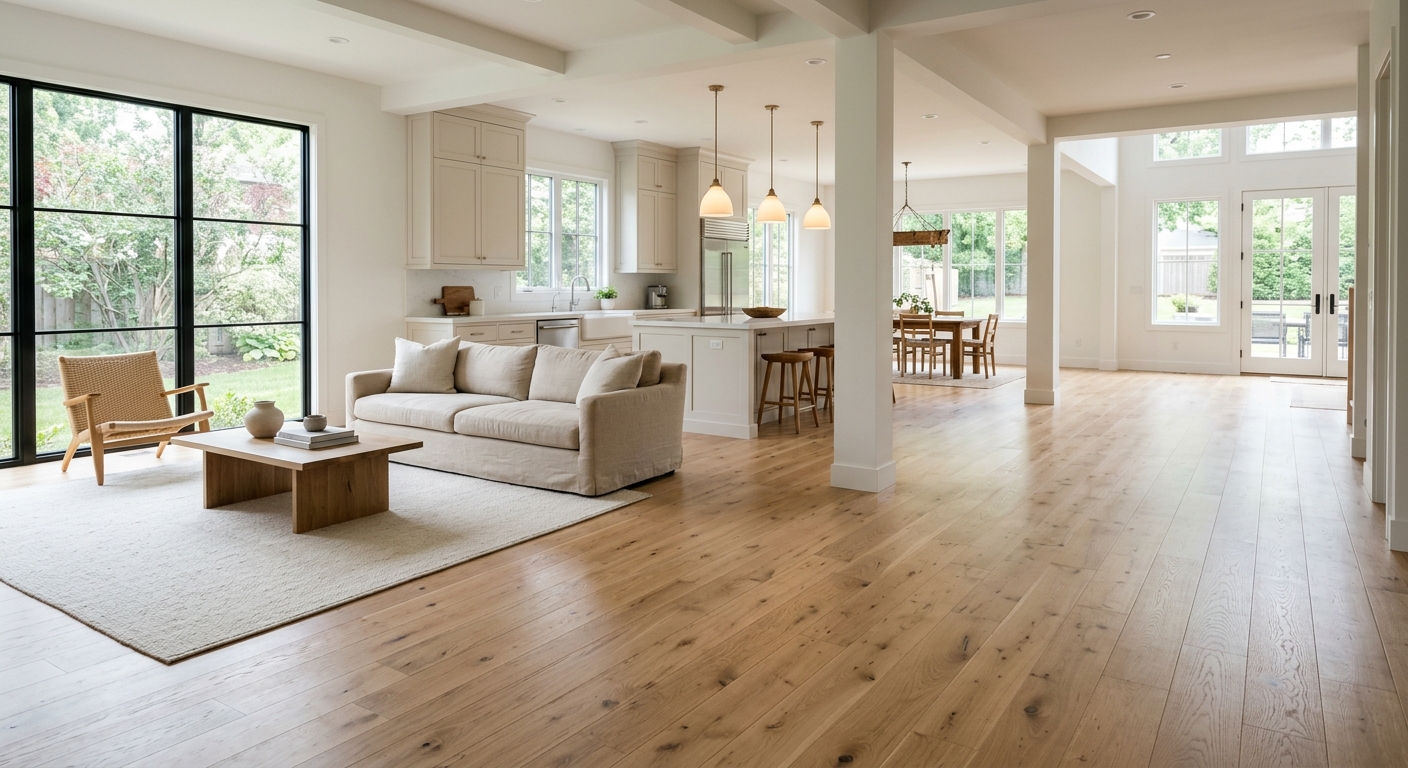
Flooring options and costs in Hinton
Hinton homeowners usually have three realistic budget lanes when planning new floors: laminate or vinyl for value, engineered hardwood for a “real wood” look, and tile or carpet where comfort and moisture control matter most. With 2,875 homeowner households in Hinton (Statistics Canada, 2021 Census), many projects are renovations in established neighbourhoods where older basements and retrofits are common.
That local housing age matters. About 53.6% of homes in Hinton were built before 1981 (Statistics Canada, 2021 Census), so it’s common to see subfloor levelling, patching, or underlayment upgrades before the finish goes down. In practice, those prep steps often show up in estimates as an additional $1–$4 per sq ft for smoothing, vapour barrier corrections, or crack repairs—especially if you’re moving from carpet to a hard surface.
In the Banff–Jasper–Rocky Mountain House economic region, indoor humidity swings are a real cost driver. Winter air tends to be very dry, then shoulder seasons bring higher humidity; that movement is hard on solid hardwood and can cause gapping or cupping if the environment isn’t tightly controlled. Basements and slab-adjacent spaces also raise costs: cool concrete and occasional moisture migration mean many contractors recommend engineered hardwood or luxury vinyl plank (LVP) over solid wood. If your home is also set up with in-floor radiant heat, product selection tightens to radiant-compatible options, which can nudge material pricing toward the higher end.
Contractors are especially busy in areas like West Hinton and the newer foothills edges, where families often upgrade open-concept living spaces for durability and resale appeal. From there, the comparison table below helps you translate options into expected cost per square foot.
| Type |
Best Room |
Moisture Resistance |
Lifespan |
Price per sq ft |
| Solid hardwood (nail-down, above grade only) |
Living/dining, bedrooms |
Low (not recommended over concrete/basements) |
25–45 years |
$9 – $18 |
| Engineered hardwood (float or glue, above + on-grade) |
Main floor, hallways |
Medium to high (more stable than solid) |
20–35 years |
$10 – $20 |
| Laminate (click-lock, above-grade) |
Bedrooms, living areas (no standing-water risks) |
Low to medium (handle spills only with fast cleanup) |
10–20 years |
$4 – $9 |
| Luxury vinyl plank / LVP (waterproof, any level) |
Kitchen, entry, basements |
High (waterproof core, good for humidity swings) |
15–25 years |
$6 – $14 |
| Porcelain / ceramic tile |
Kitchen, bathrooms, mudrooms |
High (excellent water resistance) |
30–50 years |
$10 – $22 |
| Carpet (broadloom or modular tile) |
Bedrooms, family rooms |
Low (needs protection from damp basements) |
8–15 years |
$3 – $7 |
Prices are estimates only and vary by project scope, site access and material selection.
What affects the price of flooring in Hinton
Even when two contractors quote the “same” floor, it’s common to see swings of 30–50% across the Banff–Jasper–Rocky Mountain House region. The biggest reasons are technical prep (subfloor and moisture), product compatibility with radiant heat, and how much labour is required to bring the surface flat and ready. In Hinton specifically—where about half the housing stock is older than 1981—prep work isn’t a small line item; it’s often the deciding factor in whether the job stays near the mid-range laminate/vinyl band or climbs toward engineered/tile pricing.
Humidity swings drive material selection and cost. Solid hardwood expands and contracts with indoor moisture; it’s not a basement-ready material, and it can’t be installed over concrete like a typical engineered floor. That’s why quotes often steer you toward engineered hardwood or LVP in areas exposed to fluctuating humidity, and why basements commonly require vapour barrier verification and careful transitions. In colder mountain homes that incorporate in-floor radiant heat, many installers must use radiant-compatible flooring, narrowing choices and sometimes pushing material pricing upward.
Older houses in Hinton can also demand levelling or repair before installation. If you’re converting from carpet over an uneven subfloor, it’s not unusual to see an additional $1–$4 per sq ft for flattening, patching, or underlayment corrections. A practical example: a $4–$9/sq ft laminate can become closer to an $8–$14 effective budget once you add levelling, underlayment upgrades, and transitions. Similarly, the difference between LVP and engineered hardwood isn’t always the sticker price; it’s whether your basement and slab conditions are driving moisture risk mitigation.
| Price Factor |
Why It Matters |
Cost Impact |
| Room area in sq ft |
Directly affects material quantities and labour time. |
Small jobs can cost proportionally more per sq ft due to mobilization. |
| Subfloor condition |
Levelling or patching may be mandatory for click-lock and for long-life tile/grout lines. |
Often adds $1–$4 per sq ft when repairs are needed. |
| Moisture / below-grade install |
Rules out solid hardwood in basements and requires proper vapour control for hard surfaces. |
May push you into engineered or LVP, and add vapour barrier/systems labour. |
| Material choice |
Solid vs engineered vs LVP vs tile changes both installation complexity and expected lifespan. |
Can swing budgets from the $4–$9 band up toward $10–$22 depending on finish. |
| Removal and disposal of existing flooring |
Carpet pad, tack strips, underlay, and old adhesives require labour and disposal. |
Can add a meaningful fixed labour charge plus dump fees. |
| Stair nosing / transitions |
Stairs need extra pieces, precise cuts, and safer edging. |
Charged per step or per linear foot; increases total material and labour. |
| Radiant heat compatibility |
Some products aren’t rated for radiant heat cycling or face too much movement. |
May increase material cost but reduces long-term failures. |
| Installation method |
Float, glue-down, and nail-down each require different prep and labour intensity. |
Nail-down and glue-down typically cost more when prep is extensive. |
Permits & regulations in Alberta
In Alberta, the act of installing flooring on its own generally does not require a building permit. That’s good news for Hinton homeowners: swapping carpet for laminate, or installing tile over an existing subfloor, is typically treated as a finish work scope. However, permits can come into play when flooring projects expand into related systems—especially electrical and structural/moisture remediation.
Work that may require permits includes: electrical changes connected to in-floor radiant heating controls/circuits (or any new wiring work tied into the radiant system) and certain structural modifications that go beyond minor subfloor patching—such as significant structural repairs or modifications to load-bearing elements. Moisture remediation can also indirectly trigger requirements if it involves more than surface-level correction and requires engineered solutions, but many common underlayment/vapour barrier upgrades proceed without permits.
For condos, the bigger limitation is usually not municipal permitting—it’s the condominium’s rules. Sound transmission requirements (STC/IIC expectations) and mandatory underlay under hard flooring may restrict what you can install on upper floors. Always review the condo declaration and ask the board for written approval before installing hardwood or tile on above-grade common-area levels.
To verify your contractor in Hinton, do three checks: (1) confirm Alberta licensing status through the appropriate online contractor/registration lookup, (2) request a current certificate of liability insurance showing coverage amounts and effective dates, and (3) confirm WSIB/WCB coverage with a clearance letter or proof of account in the name of the legal business. If they can’t provide these immediately, that’s a major warning sign.
Best flooring for each room in your Hinton home
Choosing flooring by room is the fastest way to avoid expensive mistakes in Hinton’s mountain climate. Humidity swings in the Banff–Jasper–Rocky Mountain House region mean you need to think beyond “looks” and focus on movement tolerance, water exposure, and comfort—especially if your home is older (many built before 1981) or has a basement with seasonal moisture variation.
Living and dining areas see daily traffic but not standing water, so engineered hardwood or a high-quality laminate are common choices. Engineered hardwood gives you a wood feel while staying more dimensionally stable than solid hardwood during humidity shifts. For bedrooms—particularly primary bedrooms—carpet remains popular because it’s warm underfoot, buffers noise, and feels comfortable in winter mornings. Kitchen floors are typically better with luxury vinyl plank (LVP) or large-format porcelain tile because spills are frequent and cleaning is easier without worrying about moisture migration.
Basements (finished) are where local conditions really steer decisions. LVP is the clear winner: it’s waterproof, tolerates below-grade humidity, and installers can pair it with proper vapour control and an appropriate underlayment. Solid hardwood and many laminate products struggle in basements due to their sensitivity to moisture and concrete temperature behaviour. Bathrooms should be porcelain or ceramic tile only, with appropriate waterproofing and grout detailing.
If your home uses in-floor radiant heat, prioritize radiant-compatible products. That compatibility narrows options but improves comfort and reduces risks of buckling or delayed release. Budget-wise, it can be worth paying more once: for example, spending near $10–$22/sq ft for tile in a bathroom is typically cheaper than redoing a failed moisture-sensitive floor after one or two wet seasons.
| Room |
Best Material |
Why |
Moisture Risk |
Price Band per sq ft |
| Living / dining room |
Engineered hardwood |
Wood aesthetics with better stability during Hinton humidity swings. |
Low (manage spills and maintain indoor humidity) |
$10 – $20 |
| Master bedroom |
Carpet or engineered hardwood |
Carpet adds warmth and sound control; engineered hardwood suits families who prefer hard floors. |
Low |
$3 – $18 |
| Secondary bedrooms |
Laminate or LVP (if kids/pets) |
Laminate is a cost-effective option; LVP is more forgiving if accidents happen. |
Low to medium |
$4 – $14 |
| Kitchen |
Luxury vinyl plank (LVP) or porcelain tile |
LVP handles spills well; tile stands up to moisture and heavy cleaning. |
Medium (spills and frequent wet mopping) |
$6 – $22 |
| Basement (finished) |
Luxury vinyl plank (waterproof) |
More tolerant of below-grade moisture and seasonal humidity movement. |
High (cool concrete, vapour dynamics) |
$6 – $14 |
| Bathroom |
Porcelain / ceramic tile |
Best long-term water resistance with proper underlayment and waterproofing approach. |
Very high |
$10 – $22 |
How to choose a flooring contractor in Hinton
When you’re hiring a flooring contractor in Hinton, your goal is to confirm three things: capability, compliance, and clear pricing. Start with Alberta compliance. Ask for their Alberta business registration details, then request a certificate of liability insurance (coverages and expiry dates visible). For worker protection, verify WSIB/WCB coverage with a clearance letter or direct proof of account tied to the legal company name. If they avoid paperwork or can’t provide it quickly, you’re taking on risk you don’t need.
Next, get 2–3 itemised written quotes—not lump sums. A solid quote breaks out labour and materials separately, includes removal and disposal (or clearly states it’s excluded), and lists the underlay/vapour barrier plan where relevant. Scope clarity matters: confirm whether permit pulls are included if electrical changes are required for radiant heat controls, and whether stair work, transitions (reducers/t-moulding), and levelling materials are priced line-by-line.
Warranty should be explicit: workmanship warranty length, product/manufacturer warranty coverage, and whether warranties are transferable if you sell your home. For payment, never let it drift to a heavy deposit—aim for 10–15% upfront only, then hold back the remainder until completion and final cleanup. Finally, get your timeline in writing: start date, expected duration, and how delays are handled.
- Ask who does the install and whether the crew matches the quote (no “we’ll send whoever” answers).
- Confirm they address subfloor flatness/level and provide a plan if levelling is needed.
- Require a moisture approach for basements (vapour barrier and LVP rating, not just “we’ll lay it down”).
- Make sure radiant heat compatibility is stated for your exact product and installation method.
- Check that labour and materials are itemised separately in the quote.
- Verify stair nosing and transitions are included (or quoted per step/linear foot).
- Confirm removal and disposal of existing flooring is included or priced.
- Request proof of liability insurance and WSIB/WCB clearance before work starts.
- Get start date, completion target, and day-by-day expectations in writing.
- Ask for warranty terms in writing (workmanship and manufacturer coverage).
- Do a walkthrough and have them note any uneven areas or prior moisture concerns in the proposal.
- Avoid contractors who push large deposits or won’t sign the scope.
Red flags I see in Hinton include: (1) no moisture plan for basements, (2) vague “flooring warranty” claims without workmanship warranty details, (3) quotes that omit transitions/stair work until the end, (4) inability to show insurance/WSIB/WCB clearance, and (5) pushy payment schedules that ask for more than 10–15% upfront.
Frequently asked questions — flooring in Hinton
What's the most durable flooring for pets and kids?
For most Hinton households with pets and kids, waterproof luxury vinyl plank (LVP) is the most forgiving option. The key advantage in the Banff–Jasper–Rocky Mountain House region is moisture tolerance: humidity swings and occasional spills are easier to manage with a waterproof core than with solid hardwood or many laminates. If you’re budgeting, LVP often lands around the $6–$14 per sq ft range, while carpet can be cheaper at roughly $3–$7 per sq ft but stains and odours can become a maintenance issue with pets. For pets that scratch, choose thicker wear layers and textured finishes to hide minor marks. If you want a “real wood” look, engineered hardwood is also durable but still needs prompt spill cleanup.
How do I choose flooring for humidity in Hinton?
Humidity is where Hinton projects either succeed or fail. Winter indoor air can be very dry, then humidity rises during shoulder seasons; solid hardwood can react by gapping or cupping if the home isn’t consistently climate-controlled. In basements, cool concrete and vapour movement make the risk higher, so solid hardwood isn’t a good match. Many installers in the region recommend engineered hardwood or LVP because they’re more dimensionally stable and easier to manage with proper vapour barrier/underlayment. If you’re considering tile, it’s also a stable choice in wet areas. Practically, ask your contractor to describe their humidity/moisture plan in writing—especially for below-grade spaces and any home with in-floor radiant heat cycles.
Do condos restrict hard flooring?
Often, yes—though the restriction usually isn’t “hard flooring is banned,” it’s sound transmission requirements. In Alberta condominium buildings, corporations commonly require specific underlay thickness and flooring type to meet STC/IIC expectations on upper floors. That can affect whether hardwood, tile, and even some LVP installations are approved. Before you buy, review the condo declaration and ask for written board approval, especially if you’re replacing carpet in a unit with children above you or communal noise concerns. Your contractor should be able to document the underlay plan and product suitability. In older Hinton-style homes, condos are less common than single-family, but when they do exist, paperwork and sound specs can be a real gating item.
How do I compare flooring quotes?
Start by comparing “apples to apples.” Request itemised quotes that separate labour, subfloor prep/levelling, materials, removal/disposal, and transitions (including stair nosing). Make sure each quote states how moisture will be handled—especially if your scope includes a basement or concrete slab areas. Also confirm radiant heat compatibility if the house has in-floor heating; some products require specific installation instructions. If one quote is much lower, check for skipped items like vapour barriers, levelling compound, or missing underlayment. As a price reference, laminate or vinyl plank commonly sits around the $4–$9 and $6–$14 per sq ft bands respectively, while tile is frequently around the $10–$22 range depending on format. The best quote is the one that explains what you’re paying for.
Can I install flooring over existing tile in Hinton?
Sometimes, but it depends on the condition of the tile and what’s under it. If the existing tile is well-bonded, flat, and not too high for door clearances, some installers will remove the loose grout edges or level with an appropriate underlayment system before installing floating floors or suitable surfaces. For some flooring types, leaving tile in place can be workable; for others, it can create problems with height transitions or movement. If the tile is cracked, uneven, or has moisture issues, the safer route is removal and proper subfloor correction—particularly in basements where vapour dynamics matter. If you want LVP or laminate, ask your contractor about underlayment and flatness requirements. A good quote will include whether tile removal is included or excluded and how they’ll handle height at thresholds.
What is the best flooring for a high-traffic area in Hinton?
For high-traffic areas—entries, hallways, and main living zones—engineered hardwood and LVP are typically the top performers. Engineered hardwood offers a natural look with better stability than solid hardwood during humidity swings, which helps prevent unwanted movement in Hinton’s seasonal air changes. LVP can be even more practical if you expect spills: it’s waterproof and handles moisture surprises better than wood-based products. In terms of budgeting, you’ll often see LVP around $6–$14 per sq ft and engineered hardwood closer to about $10–$20 per sq ft depending on thickness and finish. Whichever you choose, request proper subfloor prep and transitions—those details are what keep high-traffic floors looking good instead of separating at seams or telegraphing imperfections.