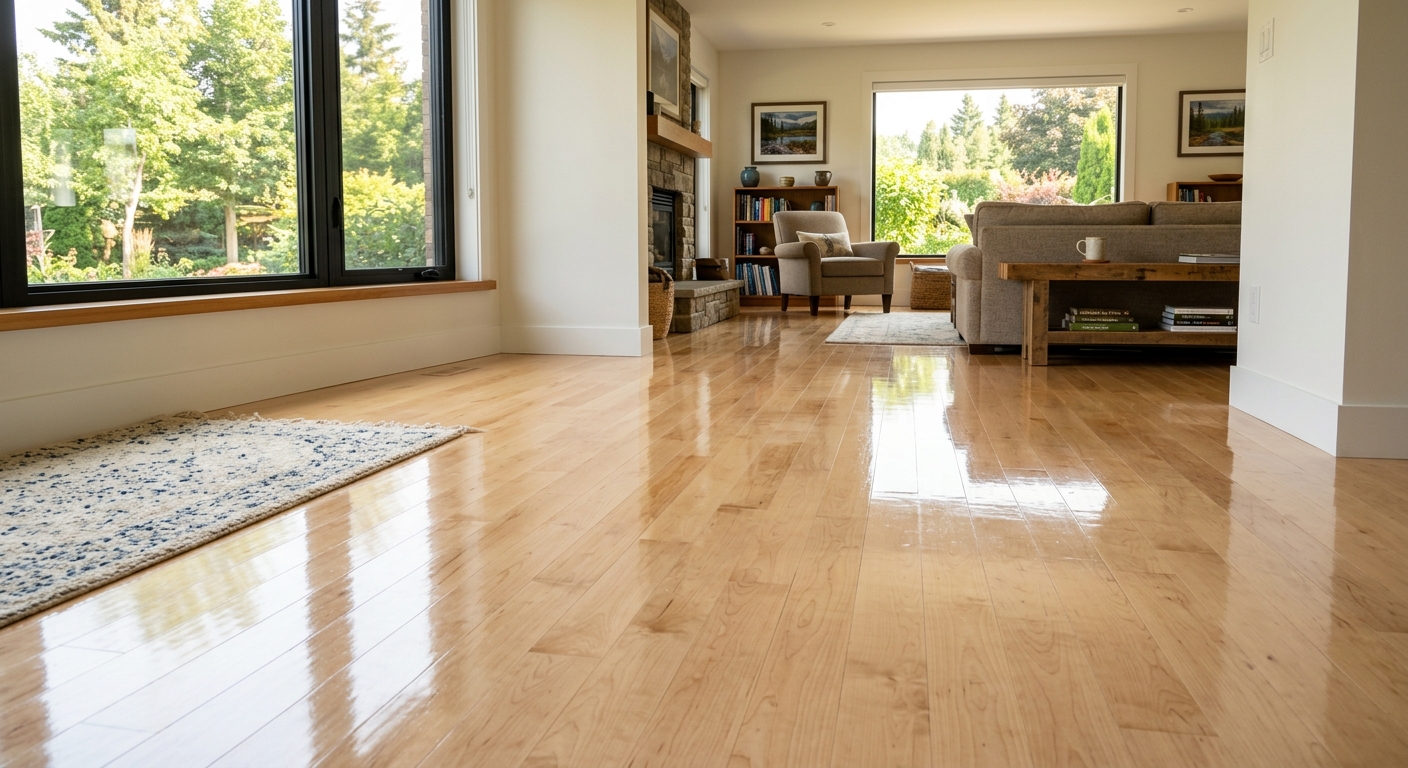
Flooring options and costs in Lantzville
Lantzville homeowners usually don’t shop for flooring in a vacuum—they’re working around older houses, coastal humidity, and basements that may have seen decades of moisture risk. With 51.0% of local dwellings built before 1981 (Statistics Canada, 2021 Census), it’s common to see wavy plywood, patched subfloors, or uneven concrete that need levelling or repair before installation. That extra prep is one reason the “same flooring” quote can come in meaningfully different across homes in Lantzville and nearby Nanaimo-area streets—especially where entryways and hallway subfloors have been altered over the years.
On Vancouver Island and the Coast, indoor relative humidity often swings outside the ideal 35–55% range, and that matters for dimensional stability. Solid hardwood expands and contracts with moisture, so we typically limit it to above-grade, stable rooms. Engineered hardwood and luxury vinyl plank (LVP) generally tolerate coastal moisture better because of their layered construction, and they’re usually the safer choice for on-grade and below-grade situations where vapour barriers and mitigation systems are in play.
Labour availability also affects your total cost. When multiple contractors are busy with moisture remediation, levelling, and radiant-compatible installations, scheduling can shift and project planning takes longer. This is particularly in demand around Lantzville’s older residential pockets near the Village area, where many homes were built long before modern subfloor standards.
Below is a practical cost guide to help you compare options before you request an itemised quote.
| Type |
Best Room |
Moisture Resistance |
Lifespan |
Price per sq ft |
| Solid hardwood (nail-down, above grade only) |
Main living areas on a stable subfloor |
Low to moderate (needs controlled humidity) |
25–40 years |
$9,–$18,– |
| Engineered hardwood (float or glue, above + on-grade) |
Main floor, hallways, bedrooms |
Moderate to high (better dimensional stability) |
20–35 years |
$10,–$17,– |
| Laminate (click-lock, above-grade) |
Living rooms and bedrooms with controlled humidity |
Moderate (not for chronic damp) |
10–25 years |
$5,–$10,– |
| Luxury vinyl plank / LVP (waterproof, any level) |
Kitchen, bathrooms, finished basements |
High to very high (waterproof core systems) |
15–25 years |
$7,–$12,– |
| Porcelain / ceramic tile |
Bathrooms, kitchens, entryways |
Very high (water and vapour tolerant) |
25–50 years |
$12,–$25,– |
| Carpet (broadloom or modular tile) |
Bedrooms and stairs (comfort-focused) |
Moderate (sensitive to persistent moisture) |
7–15 years |
$4,–$9,– |
Prices are estimates only and vary by project scope, site access and material selection.
What affects the price of flooring in Lantzville
In Lantzville, it’s very normal to see floor projects swing by roughly 30% to 50% for the “same room size” when you compare real quotes across the Vancouver Island and Coast market. The main reasons are technical and local: indoor humidity swings, below-grade moisture risk, and how much subfloor work is needed to get a flat, stable base. The broader BC market also drives labour pricing—when contractors are booked with levelling, moisture remediation, and radiant-compatible prep, you’ll see that reflected in scheduling and labour rates.
Technically, solid hardwood expands and contracts with humidity. Because of that, it generally cannot be glued or floated over concrete, and it performs poorly in basements or any room with chronic dampness. Engineered hardwood and LVP handle Vancouver Island humidity swings far better, and they’re commonly paired with appropriate underlayment and vapour control. In colder pockets where electrically heated homes and radiant systems are more common, radiant-compatible flooring becomes a constraint—this can eliminate some solid hardwood installs and steer homeowners toward many engineered woods, most laminates, LVP, and tile.
Older local housing stock increases prep. With 51.0% of dwellings built before 1981 (Statistics Canada, 2021 Census), you’ll often pay for subfloor levelling or patching before install. I’ll typically see an additional $1 to $4 per sq ft for levelling/repair, and sometimes more if there are moisture-related repairs.
Two common examples from Lantzville: (1) removing an existing vinyl floor and discovering uneven concrete often adds hours for grinding/patching—pushing a laminate project that “should be” near the $5–$10 band upward; (2) finishing a basement with LVP may cost more than carpet at first, but it avoids moisture-driven failure risks—so the investment is justified compared with materials that can’t tolerate below-grade vapour.
| Price Factor |
Why It Matters |
Cost Impact |
| Room area in sq ft |
Materials and labour scale with linear footage, waste, and prep time |
Typically the biggest driver; bigger rooms usually reduce waste-per-sq-ft |
| Subfloor condition — levelling or repair needed before install |
Uneven plywood and patched concrete can cause gaps, squeaks, and early wear |
Often adds about $1 to $4 per sq ft in older Lantzville homes |
| Moisture / below-grade install — rules out solid hardwood |
Solid wood struggles with moisture movement; basements need stable, waterproof solutions |
May require LVP/tile and moisture-control measures; can add scope before flooring goes down |
| Material choice — solid vs. engineered vs. LVP vs. tile |
Higher-end products cost more and may need different underlayment systems |
Solid hardwood projects often land higher than laminate/LVP; tile can exceed $12–$25 per sq ft |
| Removal and disposal of existing flooring |
Old glue-down residue, underlay, and disposal fees change the labour and time |
Can add several dollars per sq ft depending on build-up and waste handling |
| Stair nosing / transitions — charged per step or per linear foot |
Transitions aren’t optional in most homes; they protect edges and reduce failure |
Often noticeable on multi-room layouts and split levels |
| Radiant heat compatibility — limits material options |
Some materials won’t tolerate surface temperatures and expansion characteristics |
May increase cost by steering you to compatible LVP/engineered/tile, or changing underlayment |
| Installation method — float vs. glue-down vs. nail-down |
Different methods require different labour time, adhesives, and subfloor flatness |
Nail-down can be lower prep if subfloor is stable; glue-down requires stricter surface prep |
Permits & regulations in British Columbia
In British Columbia, a standard flooring replacement typically does not require a building permit. That said, some related work can trigger permitting—especially when you start touching electrical systems, structural subfloor components, or moisture remediation that involves engineered methods. For example, if you’re installing or altering in-floor heating circuits (hydronic or electric), that electrical scope may require electrical permits and inspections. If you’re replacing damaged joists, sistering framing, or doing significant structural subfloor repairs, you may also need a permit depending on the extent and whether a building envelope issue is being addressed.
In condominiums, the corporation’s rules on sound transmission (often described through STC/IIC expectations) can restrict underlay choices and sometimes require specific products under hard flooring. If you’re installing hardwood, engineered wood, tile, or anything that transmits more impact sound, always review the condo declaration and ask for board approval in writing before you start—especially on upper floors.
For a homeowner in Lantzville, you can verify a contractor before signing: confirm their business registration and whether they carry the right credentials for their trade (check the public online listings available to British Columbia), and ask for a current certificate of insurance (liability) showing your address as applicable. For work coverage, request proof of WSIB/WCB coverage (depending on the nature of the contractor’s workforce and coverage structure) and ask for a clearance letter or current status document. Finally, request itemised proof of warranty terms in writing before scheduling—so you’re protected if there’s a workmanship issue after the coastal humidity settles.
Best flooring for each room in your Lantzville home
Choosing flooring in Lantzville is mostly about matching each room’s moisture exposure and comfort needs to a material that can handle Vancouver Island humidity swings and older subfloor realities. In living and dining areas, homeowners usually want warmth underfoot and a floor that tolerates daily humidity movement without cupping or gapping. Engineered hardwood or high-quality laminate is a strong balance: they’re more dimensionally stable than solid hardwood, and many are compatible with radiant heat systems when installed with the correct underlayment and temperature controls.
For bedrooms, carpet remains popular because it improves comfort and sound absorption—helpful in homes where older construction can transmit noise more readily. In contrast, kitchens should be waterproof-ready. LVP or large-format porcelain tile stand up best to spills and frequent cleaning. For basements (especially finished areas), LVP is usually the clear winner in Lantzville. Below-grade spaces can experience vapour pressure and moisture migration; solid wood and most laminates are poor choices when moisture risk is chronic.
Bathrooms are the simplest decision: porcelain or ceramic tile only. Tile tolerates moisture and allows proper sealing and grout detailing to protect the substrate.
Radiant heat compatibility matters too. Because electrically heated homes and radiant systems are increasingly common on Vancouver Island, we often steer away from materials that aren’t rated for radiant use.
Example of where price differences are justified: if tile runs near the $12–$25 per sq ft band but the project is a kitchen or bath, you’re paying for long-term moisture tolerance and easier maintenance. If the same home installs carpet in a damp-prone basement, the cheaper upfront material can become expensive quickly once moisture-related odours or matting appear.
| Room |
Best Material |
Why |
Moisture Risk |
Price Band per sq ft |
| Living / dining room |
Engineered hardwood |
Warm look with better dimensional stability for coastal humidity |
Low to moderate (manage humidity, ensure flat subfloor) |
$10,–$17,– |
| Master bedroom |
Carpet or engineered hardwood |
Carpet adds comfort and reduces sound; engineered handles stability better than solid |
Low |
$4,–$17,– |
| Secondary bedrooms |
Laminate (click-lock) or LVP (if moisture-prone) |
Practical and durable for everyday wear; LVP is easier if humidity is less controllable |
Low to moderate |
$5,–$12,– |
| Kitchen |
Luxury vinyl plank (LVP) or porcelain tile |
Water resistance for spills; tile is the toughest option for wet cleaning |
Moderate (spills and frequent mopping) |
$7,–$25,– |
| Basement (finished) |
Luxury vinyl plank (waterproof) |
Handles below-grade moisture and vapour better than wood or laminate |
High |
$7,–$12,– |
| Bathroom |
Porcelain / ceramic tile |
Moisture-tolerant and long-lasting with proper underlayment and sealing |
Very high |
$12,–$25,– |
How to choose a flooring contractor in Lantzville
Choosing a contractor in Lantzville comes down to verified coverage, transparent quoting, and workmanship quality—especially on Vancouver Island where humidity swings and older subfloors increase the chance of movement if prep is rushed. First, verify British Columbia licensing where applicable to their trade, and confirm liability insurance is current (ask for an up-to-date certificate of insurance). Next, request proof of WSIB/WCB coverage—then confirm the clearance letter or status document dates match your project start. If a contractor can’t provide paperwork quickly, that’s a major warning sign in a homeowner’s market.
Ask for 2–3 itemised written quotes, not just a lump sum. You want a breakdown that separates demolition/removal, subfloor levelling/repair, underlayment/vapour barrier components, flooring materials, trim, transitions, and labour. Also ask what’s included: permit pull (if any related work needs it), disposal, and whether they protect stairs and door thresholds during install.
Warranty matters on both fronts. Confirm the workmanship warranty length and whether it’s transferable if you sell the home. Also check the manufacturer warranty conditions for your specific product and installation method.
On payment schedule, never pay more than 10–15% upfront. Hold back payment until the job is complete and you’ve inspected transitions, edges, and the overall level/finish.
Finally, get a start date and completion estimate in writing. In Lantzville, timing can be affected by subfloor repair and moisture assessment, so a clear schedule protects you from indefinite delays.
- Verify their current certificate of liability insurance before you book materials.
- Ask for WSIB/WCB coverage proof (clearance letter/status) and confirm it covers the work crew.
- Request 2–3 itemised quotes with labour and materials separated.
- Confirm subfloor levelling/repair scope and whether it includes prep tolerances.
- Ask how they handle existing glue residue, nails/screws, and uneven seams.
- Confirm underlayment/vapour barrier is specified for your exact floor type and moisture risk.
- Ensure transitions and stair nosing are listed (per step or per linear foot).
- Check that removal and disposal are included (or priced separately) in writing.
- Review what’s excluded: mould, damp remediation beyond cosmetic repair, and subfloor replacement thresholds.
- Verify warranty terms: workmanship duration, manufacturer warranty, and any exclusions.
- Confirm payment schedule: no more than 10–15% upfront, with holdback at completion.
- Get a written start date and completion window, including inspection/adjustment time.
Red flags we commonly see in the Lantzville market: a quote with no line-by-line scope, no written warranty details, refusing to provide insurance/coverage documents, lowball pricing that ignores levelling or moisture prep, and “lump sum” numbers that later expand once materials arrive or subfloor issues are discovered.
Frequently asked questions — flooring in Lantzville
What is luxury vinyl plank and is it worth it in Lantzville?
Luxury vinyl plank (LVP) is a layered synthetic floor with a waterproof core designed to resist spills and tolerate moisture better than solid hardwood or most laminates. In Lantzville and across Vancouver Island and the Coast, humidity swings and older basements make “moisture-tolerant” a big deal—especially where vapour control and seasonal indoor conditions can push materials outside ideal ranges. LVP is also a strong option if you want radiant-compatible flooring, since many LVP products are rated when installed with the right underlayment and temperature settings. Budget-wise, LVP often lands in the neighbourhood of $7,–$12,– per sq ft installed, which can compare favourably to tile when you include subfloor prep. For chronic dampness, LVP is usually safer than carpet and far more reliable than solid wood.
How much does flooring cost in Lantzville?
Flooring cost in Lantzville depends on room size, the condition of the subfloor, and how much prep is needed before installation. Across Vancouver Island and the Coast, realistic all-in installed budgets usually align with the common BC price bands: laminate/vinyl plank typically sits around $5,–$10,– (laminate band) and carpet around $4,–$9,–, while tile is often $12,–$25,– per sq ft. Hardwood is generally higher, with solid hardwood commonly landing in the $9–$18 per sq ft installed range. Because 51.0% of local homes were built before 1981 (Statistics Canada, 2021 Census), levelling and repair are frequent extras—expect possible subfloor work of roughly $1 to $4 per sq ft before the new floor goes down.
Hardwood vs laminate vs vinyl plank — which is best?
There isn’t one “best” floor for every Lantzville room—there’s a best match to moisture, comfort, and your home’s subfloor conditions. Solid hardwood is beautiful but it’s mainly for above-grade, stable rooms because it moves with humidity and isn’t a good fit for concrete or basement moisture risk. Engineered hardwood improves stability but still needs an appropriate installation plan. Laminate is cost-effective and can look great, usually staying in the $5,–$10,– per sq ft range, but it’s not the first choice for chronic dampness. Vinyl plank (LVP) is often the practical winner where spills or below-grade moisture are concerns because many waterproof cores tolerate Vancouver Island humidity swings better. If you’re comparing total value, LVP’s reliability can outweigh a lower initial material price—especially in basements where older construction may require extra moisture-focused prep.
What flooring is best for a Lantzville basement?
For a Lantzville basement, the safest choice is usually waterproof, dimensionally stable flooring—most commonly LVP. Vancouver Island and the Coast basements can face vapour pressure and seasonal humidity fluctuations that solid hardwood and many laminates can’t tolerate without long-term risk of gapping, cupping, or odour. LVP is designed for “any level” installs and pairs well with the underlayment and vapour barrier approach your contractor recommends. If the basement is finished and the subfloor is uneven, you’ll likely still need levelling or repair—this is common because older homes were built with different framing and sheathing standards. While LVP may cost more than the cheapest options up front, it often prevents costly replacements later. In most projects, homeowners budget around $7,–$12,– per sq ft for LVP installed, depending on prep and product grade.
Can I install hardwood over concrete?
Often, the answer is “only with the right type of hardwood and the right system.” In practice on Vancouver Island, solid hardwood is typically limited to above-grade nail-down installs because it responds strongly to humidity changes and generally shouldn’t be glued or floated over concrete. If you want a wood look on a concrete slab, engineered hardwood is usually the better option because it’s more dimensionally stable and can be installed using a glue-down or float method appropriate to your slab condition. Before anyone installs, the slab needs to be clean, dry, flat, and properly tested/treated for moisture, and transitions need to be detailed correctly to manage expansion. If you’re in a home built before 1981 (Statistics Canada, 2021 Census), plan for possible levelling or repairs first—these prep steps can be as important as the flooring type.
How long does flooring installation take?
Installation time in Lantzville depends on floor type, room complexity, and how much subfloor work is required. A straightforward laminate or LVP install in one open room can often be done in a day or two, while multi-room projects with transitions, stair details, and removal can take several days. Tile takes longer due to layout, setting, and curing time, and it commonly extends the schedule. Carpet installs tend to be faster than tile and can be quick once the subfloor is prepared. The big schedule variable is prep: if your home needs levelling, patching, or moisture-focused repairs, that can add days before flooring is installed. Always ask the contractor for a written start date and completion estimate that includes prep, acclimation (for wood and some products), and final walkthrough.