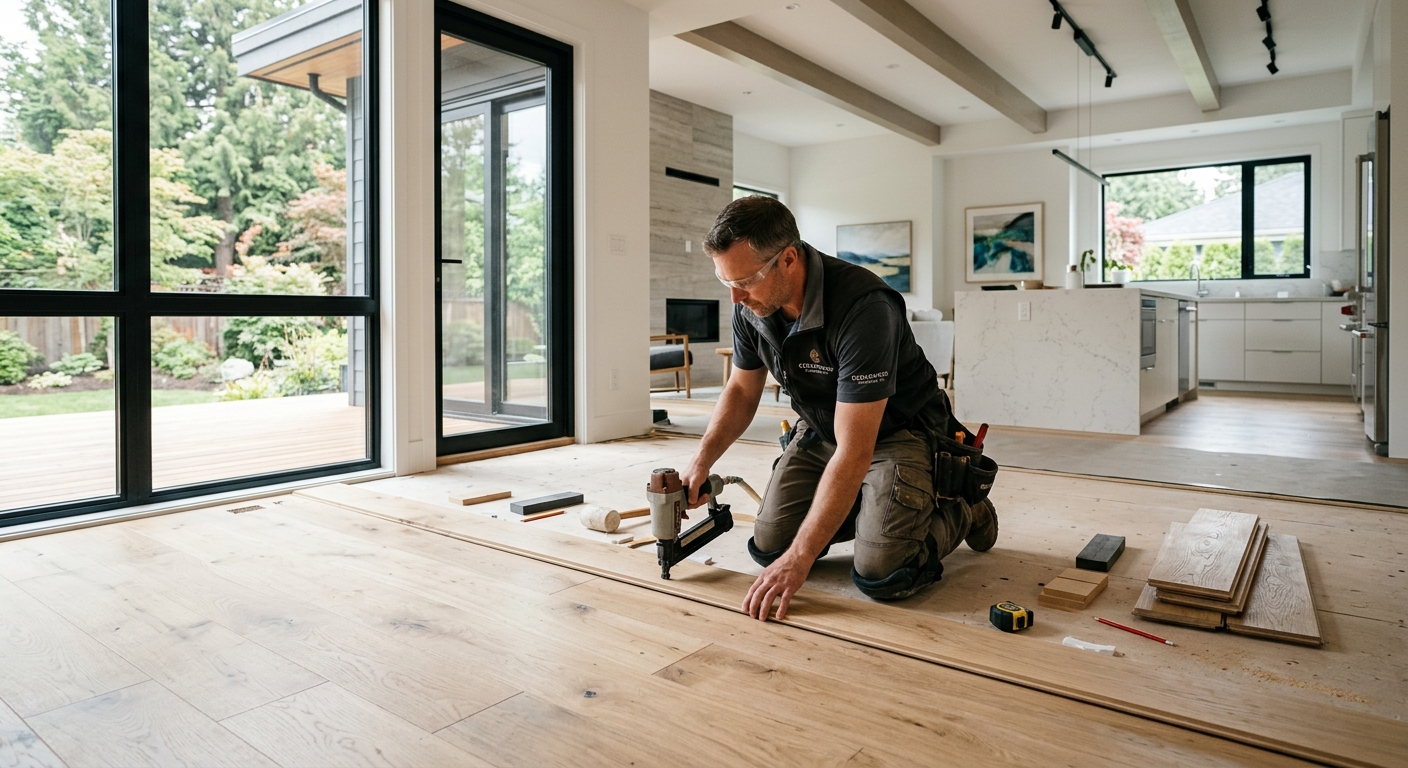
Flooring options and costs in Aurora
Aurora homeowners usually price flooring around the realities of our Toronto-area indoor humidity swings: gaps can open, floors can feel “tight” in winter, and finishes can dull faster if the subfloor isn’t prepared well. That matters even more locally because many homes are older—22.2% of dwellings in Aurora were built before 1981—so you’ll often see prep like levelling, plywood patching, or moisture mitigation before new material goes down. With a population of 62,057 (Statistics Canada, 2021 Census) and strong renovation demand across the GTA, labour scheduling and material handling can also keep pricing from being “budget simple.”
In practice, solid hardwood looks timeless in above-grade living spaces, but it’s more sensitive to seasonal moisture movement and it’s not a smart choice over concrete or in basements. For Aurora projects, engineered hardwood and luxury vinyl plank (LVP) are usually the safer value: they’re built for Toronto’s moisture variability and are far more forgiving when you have partial slab/joist transitions, older subfloors, or in-floor heating.
Trade demand is especially high around East Aurora and the central corridors near Wellington Street, where homeowners commonly update flooring during kitchen and main-floor refreshes. Once you know which product category fits your moisture risk and installation constraints, the next step is comparing realistic per-square-foot ranges for Aurora so you can budget confidently.
| Type |
Best Room |
Moisture Resistance |
Lifespan |
Price per sq ft |
| Solid hardwood (nail-down, above grade only) |
Living / dining on framed subfloors |
Low–Medium (humidity sensitive; avoid basements and concrete) |
30–60 years |
$9 – $18 |
| Engineered hardwood (float or glue, above + on-grade) |
Main floor, hallways, bedrooms |
Medium–High (better dimensional stability) |
20–35 years |
$9 – $16 |
| Laminate (click-lock, above-grade) |
Living areas with controlled moisture |
Medium (water-resistant top, but edges can swell) |
10–25 years |
$4 – $9 |
| Luxury vinyl plank / LVP (waterproof, any level) |
Kitchen, basement, main floor |
High (waterproof core; best for below-grade) |
15–25 years |
$5 – $11 |
| Porcelain / ceramic tile |
Kitchen, bathrooms, entries |
Very high (tile tolerates moisture well) |
25–50 years |
$12 – $25 |
| Carpet (broadloom or modular tile) |
Bedrooms and stairs for comfort |
Low (risk from spills and moisture) |
8–20 years |
$5 – $11 |
Prices are estimates only and vary by project scope, site access and material selection.
What affects the price of flooring in Aurora
If you’re comparing two quotes for the same room in Aurora, it’s common to see a 30–50% spread in the total project price—even when the material “looks the same.” In the Toronto economic region, wages and renovation demand tend to run higher, and many older-area homes require more prep than homeowners expect. Add in wide seasonal humidity swings (dry winter, humid shoulder seasons) and you get a job where subfloor moisture control and installation method can drive cost as much as the finish you pick.
The biggest technical driver is moisture and below-grade risk. Solid hardwood expands and contracts with humidity, so it can’t be glued or floated over concrete, and it’s a poor fit for basements where vapour and moisture are more consistent. Engineered hardwood and LVP are built to handle Aurora’s reality better, and they’re the go-to when you’re working over on-grade slabs or finishing a lower level.
For Aurora homes built before 1981, you’ll frequently see levelling and repair. That typically adds about $1–$4 per sq ft depending on whether it’s patching with plywood/feather finish, replacing damaged OSB, or correcting dips. In concrete-heavy situations, a product that starts around the laminate/vinyl range (for example, $4–$9 for laminate/LVP categories) can still end up costing more if you need moisture mitigation and labour-heavy prep.
Two concrete examples we see often: (1) a main floor with squeaky subfloor sections usually needs additional fastening and levelling, pushing labour up quickly; (2) a basement conversion to finished space often requires a full vapour-safe approach with LVP—worth it because solid wood and most laminate are simply too risky in below-grade humidity.
| Price Factor |
Why It Matters |
Cost Impact |
| Room area in sq ft |
Material and labour are both calculated by floor square footage, plus waste |
Directly scales the total—bigger rooms often reduce waste % |
| Subfloor condition |
Levelling compounds, plywood replacement, or fastening repairs add labour and parts |
Commonly adds $1–$4 per sq ft in older Aurora homes |
| Moisture / below-grade install |
Rules out solid hardwood and can change underlayment and adhesives |
Can shift you from $9–$18 solid to engineered/LVP ranges for stability |
| Material choice |
Installation method, backing, and performance under humidity differ by product |
Hardwood typically sits higher than laminate/vinyl; tile is usually the premium |
| Removal and disposal of existing flooring |
Time-consuming demo, haul-away and sometimes patching damaged subfloor |
Often a significant add-on versus “new build” installs |
| Stair nosing / transitions |
Stairs require extra edging pieces and careful fitting for safety |
Charged per step or per linear foot, increasing totals quickly |
| Radiant heat compatibility |
Heat affects expansion—some products are not rated for it |
May limit you to engineered wood, tile, or compatible LVP models |
| Installation method |
Float vs. glue-down vs. nail-down changes time, materials and subfloor requirements |
Glue-down can require stricter flatness and moisture checks |
Permits & regulations in Ontario
In Ontario, a flooring installation itself usually does not require a building permit. Replacing flooring on existing subfloors is generally considered a finish trade. The permit conversation typically begins when your scope includes electrical or structural changes. For example, if you’re adding or altering in-floor heating circuits, you may trigger electrical permitting and inspections because that work ties into your home’s electrical system. Similarly, if you open up the subfloor for significant structural repair or moisture remediation that involves wiring, plumbing, or major framing changes, your contractor may need to coordinate approvals.
In condominiums, even when no permit is required, the building’s rules matter. Many corporations restrict or require specific underlay and sound control requirements (commonly discussed in terms of STC/IIC). For any hard-surface installation—especially hardwood or tile above grade—review your unit’s condo declaration and confirm the underlay and installation method in writing before work starts.
Step-by-step, Aurora homeowners should verify: (1) the contractor’s Ontario licensing/registration where applicable (confirm the correct trade category for the work they’re doing); (2) liability insurance—request a current certificate of insurance showing adequate coverage limits; and (3) WSIB/WCB clearance for worker coverage. Ask for clearance letters or proof of account status, and check dates so you’re not relying on expired paperwork. Then get those documents before signing final paperwork, not after the first day on site.
Best flooring for each room in your Aurora home
Picking the “right” flooring in Aurora is less about fashion and more about managing moisture, traffic, comfort and cleanability through our seasonal swings. In living and dining spaces, engineered hardwood or a higher-quality laminate can deliver warmth without the same humidity sensitivity as solid wood. For master bedrooms, homeowners often choose carpet for comfort and quiet, or engineered hardwood for durability if allergies or pets are a concern.
In kitchens, we steer most clients to luxury vinyl plank (LVP) or large-format porcelain tile. Both handle water, dropped dishes, and routine mopping far better than laminate, and they tolerate Aurora’s freeze-thaw garage-to-foyer traffic when you manage entry mats properly. For finished basements, LVP is usually the clear winner: it’s waterproof, works well with below-grade conditions, and is far safer than solid hardwood and most laminate where vapour pressure and temperature swings are persistent.
Bathrooms should be porcelain or ceramic tile only because the system is designed for moisture. If you’re installing over radiant floor heating (common in newer builds and some renovations around the Toronto market), engineered wood, compatible tile, and certain LVP products typically work better than traditional solid hardwood due to expansion and heat cycling considerations.
To see value in price differences: a homeowner may be choosing between laminate at $4–$9 per sq ft and engineered hardwood closer to the $9–$16 band. The added cost is often justified when the job needs fewer “edge risk” compromises around humidity, or when they want a more natural feel that holds up through years of seasonal movement.
| Room |
Best Material |
Why |
Moisture Risk |
Price Band per sq ft |
| Living / dining room |
Engineered hardwood |
Warm underfoot with better stability than solid hardwood in humidity swings |
Low–Medium (manage indoor humidity; keep spills cleaned fast) |
$9 – $16 |
| Master bedroom |
Carpet or engineered hardwood |
Carpet adds comfort and sound dampening; engineered keeps durability |
Low (unless you have an attached bath leak risk) |
$5 – $16 |
| Secondary bedrooms |
Laminate or carpet |
Balances cost and durability for everyday traffic |
Low (still protect against wet mopping near seams) |
$4 – $11 |
| Kitchen |
Luxury vinyl plank (LVP) or porcelain tile |
Water resistance and easy cleaning; LVP is forgiving for minor spills |
Medium (daily moisture exposure from sinks and splashes) |
$5 – $25 |
| Basement (finished) |
Luxury vinyl plank (LVP) |
Waterproof core and better tolerance of below-grade humidity vapour |
High (vapour pressure and occasional dampness) |
$5 – $11 |
| Bathroom |
Porcelain / ceramic tile |
Designed for moisture; durable grout-and-tile maintenance system |
High (use correct underlayment and sealing) |
$12 – $25 |
How to choose a flooring contractor in Aurora
Choosing the right flooring contractor in Aurora starts with documentation and clear scope. Verify Ontario licensing/registration where applicable for the work they’ll perform, then request liability insurance certificates showing your project is covered. For worker coverage, confirm WSIB/WCB status with a current clearance letter or proof of account standing (ask for it before the install begins). Don’t accept “we’re covered” without paperwork—insist on dates and coverage limits.
Next, compare quotes the right way. Get 2–3 itemised written estimates that separate labour, materials, underlayment, adhesives/fasteners, transitions/stair work, and removal/disposal. You’re aiming to avoid the “lump sum trap,” where prep costs and stair details surface later as change orders. Ask what’s excluded: subfloor levelling, plywood replacement, moisture testing, grout/caulking, floor levelling compound, and whether permit pulls (if any) or condo paperwork help is included.
Warranty should be spelled out: workmanship warranty length, product/manufacturer warranty terms, and whether it’s transferable to subsequent owners. Payment schedules should be conservative—typically no more than 10–15% upfront, with the balance held back until the job is complete and cleaned up. Finally, demand a written start date and completion estimate so you’re not guessing around material lead times.
- Provide WSIB/WCB clearance or proof of account status (with dates).
- Provide liability insurance certificate before you sign.
- Quote includes labour + materials as separate line items.
- Clear scope for subfloor levelling/repair: what’s included and what’s extra.
- Moisture mitigation plan stated for on-grade slabs or below-grade work.
- Removal and disposal included (or priced separately, explicitly).
- Transitions and stair nosing listed by step/linear foot.
- Underlay/foam requirements specified (especially for condos and floating floors).
- Installation method stated (float, glue-down, nail-down) and why it matches your subfloor.
- Warranty documented for both workmanship and product.
- Payment schedule with low upfront deposit and holdback until completion.
- Written schedule: start date, estimated duration, and cleanup expectations.
Red flags we see in Aurora: quotes with no subfloor-prep line items, vague warranties (“we’ll try”), contractors who won’t show insurance/WSIB documents, missing transition/stair pricing, and promises to “avoid moisture checks” for basements or on-grade areas.
Frequently asked questions — flooring in Aurora
What flooring holds up best to pets in a Aurora home?
For most Aurora households with pets, luxury vinyl plank (LVP) is the most practical balance of comfort and durability. It’s waterproof, handles accidents better than laminate, and it’s typically quieter than tile when installed with the right underlayment. If you prefer a more natural look, engineered hardwood can also work well above grade, but it needs solid subfloor prep and careful spill cleanup because Toronto-area humidity swings can still affect wood products over time. In terms of budgeting, many LVP projects land in the $5–$11 per sq ft band, and you’ll often find the extra spend compared with basic laminate is justified by easier cleanup and better moisture tolerance. (Statistics Canada, 2021 Census)
How do I fix squeaky floors in my Aurora home?
Squeaks usually come from movement between subfloor layers or loose fastening, not from the new flooring material itself. In Aurora homes—especially those with older framing—fixing squeaks often means opening the existing surface or lifting a small section to locate the flexing boards, then re-fastening to joists and correcting dips/flatness. Once the subfloor is stable, you can install engineered hardwood or LVP without “chasing” the sound later. A key point: if you skip subfloor work, you may get additional noise, uneven plank locking, or failure of floating floors over unstable framing. Quotes can vary by prep scope; older stock built before 1981 (Statistics Canada, 2021 Census) more often needs this kind of repair before you spend on finishes.
What is luxury vinyl plank and is it worth it in Aurora?
Luxury vinyl plank (LVP) is a synthetic floor made for residential moisture tolerance, with a waterproof core in most quality product lines. In Aurora and the broader Toronto region, LVP is worth it when you want confidence around spills, entryway moisture from winter melt, and—most importantly—below-grade humidity in finished basements. LVP also performs well where your home has temperature and humidity swings through the year. Compared with laminate (often $4–$9 per sq ft), LVP typically sits in the $5–$11 band and gives you better spill forgiveness and less worry about edges swelling. It’s also a strong match when radiant heat is involved, because many LVP products are rated for that use (within manufacturer guidelines).
How much does flooring cost in Aurora?
Aurora flooring costs depend heavily on the product category and how much prep your subfloor needs. As a practical guide for budgeting: laminate or vinyl plank products often fall in the $4–$9 per sq ft range, while hardwood materials typically start around $9 and can reach $18 per sq ft depending on quality and installation requirements. Tile usually budgets higher, commonly $12–$25 per sq ft. The part homeowners miss most is prep: older homes may need levelling or plywood replacement, which can add roughly $1–$4 per sq ft before the finished floor is even installed. For below-grade projects, you’ll almost always be better off pricing LVP rather than solid hardwood because solid wood is risky over moisture and concrete conditions.
Hardwood vs laminate vs vinyl plank — which is best?
There isn’t one universal “best”—it depends on your moisture risk and how much movement your home experiences. Solid hardwood is beautiful, but it’s humidity-sensitive and should be kept above grade and away from concrete. Engineered hardwood is a better “wood look” compromise for Aurora’s climate swings, but it still isn’t the best answer for high-vapour basement conditions. Laminate can be cost-effective in living areas, often in the $4–$9 band, but edges can swell if water gets into seams. Luxury vinyl plank (typically $5–$11) is usually the best overall for families who want moisture forgiveness and durability, especially where there’s any basement or high-traffic entry exposure. In Toronto-area renovations, many homeowners end up happiest with engineered wood on the main floor and LVP in the basement for a consistent, low-worry transition.
What flooring is best for a Aurora basement?
For most finished basements in Aurora, the best choice is luxury vinyl plank (LVP) because it’s waterproof and more tolerant of below-grade moisture vapour than solid hardwood or typical laminate. Basements also experience temperature changes that can amplify movement, so a stable, waterproof system reduces the risk of buckling or swelling. If you have a slab or suspect moisture, LVP gives you the safest performance path and simplifies cleanup from occasional dampness events. If you love tile, porcelain is also excellent for moisture, but it comes with higher material cost and heavier installation work. In pricing terms, many LVP basement projects budget within the $5–$11 per sq ft band, while tile often runs $12–$25 per sq ft depending on finish selection.