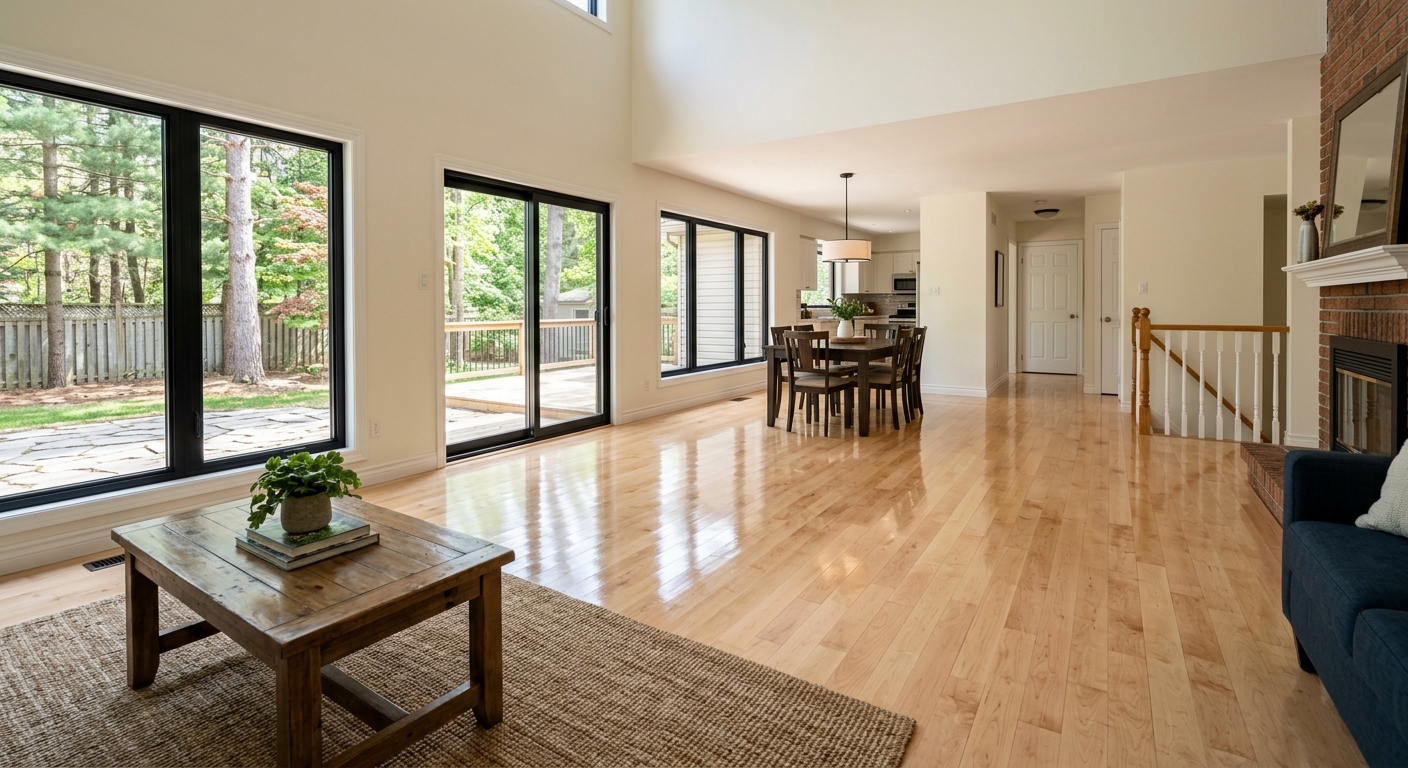
Flooring options and costs in Cobourg
Cobourg homeowners usually have plenty of flooring choices, but the “best” option depends on how your home moves through Ontario seasons. With 52.1% of dwellings in the area built before 1981, many renos start with uneven subfloors, old plank subflooring, or patch repairs that must be levelled or corrected before finish flooring goes down. That prep work can materially change your budget before you even price the surface.
In the Muskoka–Kawarthas market—including Cobourg—indoor humidity swings are significant between winter heating and humid summer air, especially in houses with older ventilation setups. Solid hardwood expands and contracts with humidity, and it’s a poor fit for basements or any below-grade concrete. For that reason, engineered hardwood and luxury vinyl plank (LVP/LVT) are commonly selected for dimensional stability, particularly over concrete slabs and in moisture-prone areas.
Labour availability also matters. When contractors are busy in peak reno months, install timelines and levelling complexity can raise costs—especially when we’re dealing with 20+ year flooring removals, transitions, and stair nosing. In Cobourg’s East Side and north-end neighbourhoods (including older pockets near the downtown core), demand is steady for engineered wood and waterproof vinyl because so many homes have original framing and older subfloor conditions.
Below is a practical comparison of typical flooring ranges you’ll see for common materials in Cobourg, then we’ll break down what drives your final installed price.
| Type |
Best Room |
Moisture Resistance |
Lifespan |
Price per sq ft |
Price Range |
| Solid hardwood (nail-down, above grade only) |
Living room, dining room (above grade) |
Low to moderate (humidity-sensitive; not for basements) |
25–60 years |
$9–$18 |
$9–$18 |
| Engineered hardwood (float or glue, above + on-grade) |
Main floor living, hallways, bedrooms (above/on grade) |
Moderate to high (better dimensional stability) |
20–40 years |
$10–$17 |
$10,500 – $17,000 |
| Laminate (click-lock, above-grade) |
Bedrooms, living areas (not below grade) |
Moderate (core quality matters; avoid standing water) |
10–25 years |
$4–$9 |
$4,000 – $9,000 |
| Luxury vinyl plank / LVP (waterproof, any level) |
Kitchen, main floor, basement (finished) |
High (waterproof surfaces when installed correctly) |
15–30 years |
$5–$12 |
$5,500 – $12,000 |
| Porcelain / ceramic tile |
Bathrooms, kitchens, entries |
Very high (tile itself is waterproof) |
30–50+ years |
$12–$25 |
$12,000 – $25,000 |
| Carpet (broadloom or modular tile) |
Bedrooms, upstairs living areas |
Low to moderate (susceptible to dampness) |
7–15 years |
$4–$10 |
$4,000 – $10,000 |
Prices are estimates only and vary by project scope, site access and material selection.
What affects the price of flooring in Cobourg
Even for the same room size, Cobourg quotes can vary by 30–50% across Muskoka–Kawarthas and the broader Ontario market because the biggest cost swings are rarely the “pretty part.” The real drivers are subfloor condition, moisture-control steps, and how the contractor handles removal, levelling, and transitions. Two crews can both install “engineered hardwood,” but one may include proper underlayment, subfloor flatness correction, and protection during humidity transitions—while the other pushes the risk into future squeaks or cupping.
In this region, indoor humidity swings are the technical reason solid hardwood becomes tricky: it expands and contracts, and solid wood shouldn’t be glued or floated over concrete. Basement slabs are also common moisture sources, so we often recommend engineered products over fibreboard/underlay systems and waterproof LVP for below-grade areas. In colder Ontario homes with radiant heat, the selection narrows further; solid hardwood is typically a poor fit, while many vinyl, tile, and certain laminates rated for temperature cycling perform better.
Older regional housing stock is another consistent cost factor. With over half of local homes dating before 1981, levelling with self-levelling compound, shimming, or adding plywood underlayment is frequently required. Expect common extras around $1–$4 per sq ft for flatness correction, depending on how uneven the subfloor is.
Concrete examples from Cobourg: a main-floor install over an old plywood-and-plank surface may require additional skims and fastener work (higher labour). A basement conversion from bare concrete to finished flooring may add a vapour barrier and, in some cases, waterproof underlay systems that protect against seepage. Material pricing also follows the same bands homeowners see—LVP can land in the $4–$12 range, while tile often sits from $12–$25 depending on format and thickness.
| Price Factor |
Why It Matters |
Cost Impact |
| Room area in sq ft |
Material quantity and labour time scale directly with surface area. |
Low to moderate variability; typically the most predictable cost line item. |
| Subfloor condition — levelling or repair needed before install |
Old boards, squeaks, dips, and patchwork must be corrected for a flat, long-lasting finish. |
Can add noticeable budget swings: roughly $1–$4 per sq ft in many Cobourg renos. |
| Moisture / below-grade install — rules out solid hardwood |
Concrete and damp zones require correct vapour control and product selection. |
Often increases costs by adding underlayment, vapour barriers, and extra prep steps. |
| Material choice — solid vs. engineered vs. LVP vs. tile |
Each product has different installation systems and tolerance for moisture/heat cycling. |
Large difference: LVP/laminate typically lower than tile; solid hardwood often needs more restrictions. |
| Removal and disposal of existing flooring |
Demo time, hauling, and subfloor cleaning affect labour and disposal fees. |
Commonly a meaningful add-on, especially with old glue-down flooring. |
| Stair nosing / transitions — charged per step or per linear foot |
Stairs and doorways require finishing pieces and extra measuring/fit time. |
Can materially raise totals, particularly in multi-level homes. |
| Radiant heat compatibility — limits material options |
Some finishes tolerate temperature cycling; others can gap or fail prematurely. |
May increase cost if you must switch from a cheaper option to a compatible one. |
| Installation method — float vs. glue-down vs. nail-down |
Method changes labour hours, prep requirements, and adhesive/vapour-control materials. |
Glue-down and prep-heavy installs typically cost more than floating systems. |
Permits & regulations in Ontario
In Ontario, installing flooring by itself generally does not require a building permit. That said, related work can trigger permit requirements, and your quote should clearly separate “finish flooring” from “building services.” For example, structural subfloor repair that affects load-bearing components, any moisture remediation that involves more than surface patching (and may require proper engineering in complex cases), and changes to in-floor heating circuits can involve electrical permits. If your renovation includes new wiring for radiant systems, upgrading thermostats, or modifying an electrical panel circuit feeding in-floor heat, expect permit involvement through the electrical side.
In condominiums, regulations are often less about permits and more about bylaws. The corporation’s rules on sound transmission (often referenced through STC/IIC expectations) can restrict underlay choices and affect hard surface installs on upper floors. Before installing hardwood or tile above grade in a multi-unit building, review your condo declaration and request board approval in writing—especially if you plan to use rigid underlay or a product not previously approved for impact sound.
If you’re hiring in Cobourg, verify your contractor’s Ontario credentials and paperwork before work begins:
- Request the contractor’s Ontario licence/registration details (where applicable for their trade) and confirm validity on the appropriate government registry.
- Ask for a current certificate of insurance (general liability) showing coverage amounts and the jobsite address.
- Confirm WSIB/WCB clearance or coverage letter for the workers who will be on your site.
- Ensure they can provide product warranty terms and their own workmanship warranty in writing.
Best flooring for each room in your Cobourg home
Choosing the right flooring for Cobourg means matching product performance to moisture, traffic, and comfort—then accounting for Muskoka–Kawarthas humidity swings. For living and dining rooms, engineered hardwood or high-quality laminate can deliver warmth and a clean look while handling seasonal movement better than solid hardwood. In master bedrooms, carpet remains a top choice for comfort and sound absorption, particularly for older Cobourg homes where impact noise can be noticeable.
For kitchens, LVP (waterproof) or large-format porcelain tile usually makes the most sense. Spills, sink leaks, and high foot traffic are unavoidable, and tile’s waterproof surface and easy cleaning are ideal. Bathrooms should be porcelain or ceramic tile only—avoid carpet and most floating cores where moisture could sit.
Basements are where Cobourg homeowners feel the climate reality most. Waterproof LVP is the clear winner for finished basements because it tolerates below-grade moisture conditions far better than solid wood and most laminate. If you’ve got radiant or in-floor heating (increasing in Ontario renos and newer builds), prioritise radiant-compatible options. Many solid hardwoods are limited with temperature cycling, while quality vinyl, tile, and selected laminates handle heat adjustments more reliably.
Here’s a practical example: if your finished basement is 500 sq ft, a mid-range LVP approach may land in the $4–$12 band, while adding tile could move you toward $12–$25 per sq ft once labour and prep are included. The higher upfront cost is justified for long-term waterproof performance in bathrooms and wet zones, but for most basements the waterproof vinyl path provides a better cost-to-performance ratio.
| Room |
Best Material |
Why |
Moisture Risk |
Price Band per sq ft |
| Living / dining room |
Engineered hardwood |
Warm look with better dimensional stability for seasonal humidity swings. |
Low (if kept above grade and not exposed to damp spots) |
$9–$18 |
| Master bedroom |
Carpet or engineered hardwood |
Carpet adds comfort and sound absorption; engineered gives a cleaner, durable surface. |
Low to moderate (depends on basement-adjacent walls and ventilation) |
$4–$10 |
| Secondary bedrooms |
Laminate (above grade) or LVP (if moisture is a concern) |
Laminate is budget-friendly for dryness; LVP is a safer choice for older homes with humidity issues. |
Low (above grade) to moderate (if ventilation is poor) |
$4–$9 |
| Kitchen |
Luxury vinyl plank or porcelain tile |
Waterproof performance for spills; tile also suits radiant heat compatibility when designed properly. |
Moderate to high |
$4–$25 |
| Basement (finished) |
Luxury vinyl plank (waterproof) |
Handles below-grade moisture and vapour conditions better than solid wood and most laminates. |
High |
$5–$12 |
| Bathroom |
Porcelain / ceramic tile |
Moisture-proof surface with long-term wear resistance and easy cleaning. |
Very high |
$12–$25 |
How to choose a flooring contractor in Cobourg
Picking the right flooring contractor in Cobourg is less about flashy pictures and more about proof: coverage, detailed scopes, and installers who understand moisture and subfloor prep. Start by verifying Ontario compliance paperwork. For licensing/registration, ask for the contractor’s business number and trade licence details (where applicable for their work). Request a current certificate of insurance for general liability (and confirm it includes the jobsite address). Then confirm workers’ coverage—WSIB/WCB clearance letters should match the team who will be on your property.
Next, get 2–3 itemised written quotes. You want a breakdown that separates materials from labour and clearly lists subfloor levelling, underlay, vapour barriers, transitions, and stair work. Avoid lump-sum offers without line items for demo, disposal, and prep; that’s where cost overruns hide. Make sure the scope spells out exclusions (e.g., mould remediation, structural subfloor rebuilding, or electrical work if radiant heating is involved) so you aren’t surprised after demo.
Warranty matters: ask for (1) workmanship warranty length, (2) manufacturer warranty coverage terms, and (3) whether warranties transfer if you sell your home. Payment schedule should be conservative—typically no more than 10–15% upfront, with remaining payments tied to milestones. And always insist on a written start date and completion estimate.
- Ask for an itemised quote: labour, materials, underlay/vapour barrier, transitions, and removal/disposal.
- Confirm disposal is included (what’s hauled away, and where).
- Ask how they’ll achieve subfloor flatness before installation (self-levelling, shimming, plywood overlay, fastener fixes).
- Get details on moisture control for basements (vapour barrier type and coverage, not just “underlay”).
- Confirm stair nosing and transition pricing per step or per linear foot.
- Ask whether they protect adjacent surfaces during demo and install (trim, drywall, cabinets).
- Verify they can work around radiant heat safely if you have in-floor heating.
- Request a workmanship warranty document and the exact terms (what voids coverage).
- Check the certificate of insurance for active dates and coverage limits.
- Confirm WSIB/WCB clearance letter for the workers on your job.
- Hold back most payment until the job is complete and final cleanup is done.
- Get a clear schedule in writing, including material lead times.
Red flags in Cobourg to watch for: (1) quotes that don’t mention moisture prep for basements, (2) no written workmanship warranty, (3) inability to provide insurance/WSIB/WCB documentation, (4) “lump sum only” pricing without subfloor/levelling line items, and (5) pushing for large upfront payments beyond 10–15% without milestones.
Frequently asked questions — flooring in Cobourg
How do I compare flooring quotes?
To compare quotes in Cobourg, insist on like-for-like scopes. Ask for the same material spec (brand, thickness, wear layer if engineered/LVP, and grade if laminate), and confirm the underlay/vapour barrier included. Quotes should list subfloor prep separately—levelling compound, plywood overlay, fastener work, and any moisture remediation steps. Also compare install method: floating vs. glue-down vs. nail-down changes labour and long-term performance. For example, if one quote has LVP at the $5–$12 band but another uses only basic underlay or skips vapour protection, the cheaper price may cost more later. Finally, check transitions and stair nosing—these are commonly extra. If your basement is involved, ensure solid hardwood is excluded for below-grade areas.
Can I install flooring over existing tile in Cobourg?
Often, yes—but it depends on the condition of the tile and the product you’re installing. In Cobourg renos, we commonly see tile removed or levelled before new floors, because existing tile can be uneven, and the added height may affect doors and stairs. If the tile is well-bonded, flat, and firmly adhered, some installs (like LVP with the right underlay and proper levelling where needed) can work over it. However, you still must address grout ridges and flatness—if the surface is not flat, plank joints can fail prematurely. For tile over tile, laminate and some floating products may also be possible, but moisture control and sound requirements (especially in condos) can complicate choices. A contractor should measure flatness and confirm that the total build-up will meet your transition needs.
What is the best flooring for a high-traffic area in Cobourg?
For high-traffic zones like entries, hallways, and main living routes in Cobourg, luxury vinyl plank and porcelain tile are usually the most dependable. LVP is waterproof and handles daily spill risk, and it stands up well to scuffs when you choose a quality wear layer. Tile is extremely durable and moisture-proof, but it’s typically more expensive—often in the $12–$25 range once the full install is considered. Engineered hardwood can also be a strong choice for above-grade areas, but it needs careful humidity control and should not be used in damp basements. If you have radiant in-floor heat, tile and many vinyl products are typically easier to match to temperature cycling than traditional solid hardwood. The “best” option is also about your subfloor: if your floor isn’t flat, prep costs may matter more than the material.
How do I prepare my subfloor before new flooring?
In Ontario and especially in the Muskoka–Kawarthas climate, subfloor preparation is where long-term performance is won or lost. A proper prep plan starts with inspection and flatness checks: removing loose material, fixing squeaks, and identifying dips or high spots. If you have older housing stock (many Cobourg homes are pre-1981), you’ll often see uneven plywood or aged plank layers that need fastening, patching, or an overlay. For moisture-prone spaces and below-grade installs, moisture control comes next—vapour barriers and the correct underlay system for the product. Solid hardwood is typically ruled out over concrete or in basements due to humidity movement, while engineered hardwood and waterproof LVP can be more appropriate when installed correctly. Get the contractor to explain exactly what they’ll do (levelling compound, plywood underlayment, vapour barrier type) and include it in the written scope.
Is cork or bamboo flooring a good choice in Cobourg?
Cork can be a comfortable choice in dry, above-grade areas because it has natural cushioning, and it can handle normal household living conditions. Bamboo is harder and can look great, but both cork and bamboo—depending on their construction—still need careful consideration for Cobourg’s humidity swings. In moisture-prone areas and basements, you generally want to avoid products that can be sensitive to sustained dampness; this is where waterproof LVP and tile often outperform natural materials. If you’re considering cork or bamboo, ask whether it’s fully sealed, how the product responds to seasonal humidity changes, and whether it’s approved for your specific subfloor type. The wrong underlayment or skipping vapour control in below-grade applications can lead to edge swelling and odours over time. For a typical Cobourg main floor, cork or bamboo can work, but in basements or near damp walls, waterproof options are safer.
What is the difference between floating and glued-down flooring?
Floating flooring (common with click-lock laminate and many floating LVP installations) is not fixed to the subfloor. Instead, it “floats” over an underlay, and the pieces lock together. This method can help reduce minor subfloor imperfections and makes future removal easier, but it relies on correct underlay, expansion gaps, and flatness. Glued-down flooring is adhered directly to the subfloor (often used with certain engineered hardwood or specific vinyl systems). Glue-down installs typically require stricter surface prep and a moisture-appropriate substrate, but they can reduce movement between planks and often help with stability in some applications. In Cobourg’s climate, the choice matters: solid hardwood is generally nail-down above grade only, while engineered and some vinyl systems handle humidity and basement conditions better when the installer uses the right vapour barrier and underlay. Your contractor should recommend the method based on your room’s moisture risk and subfloor condition.