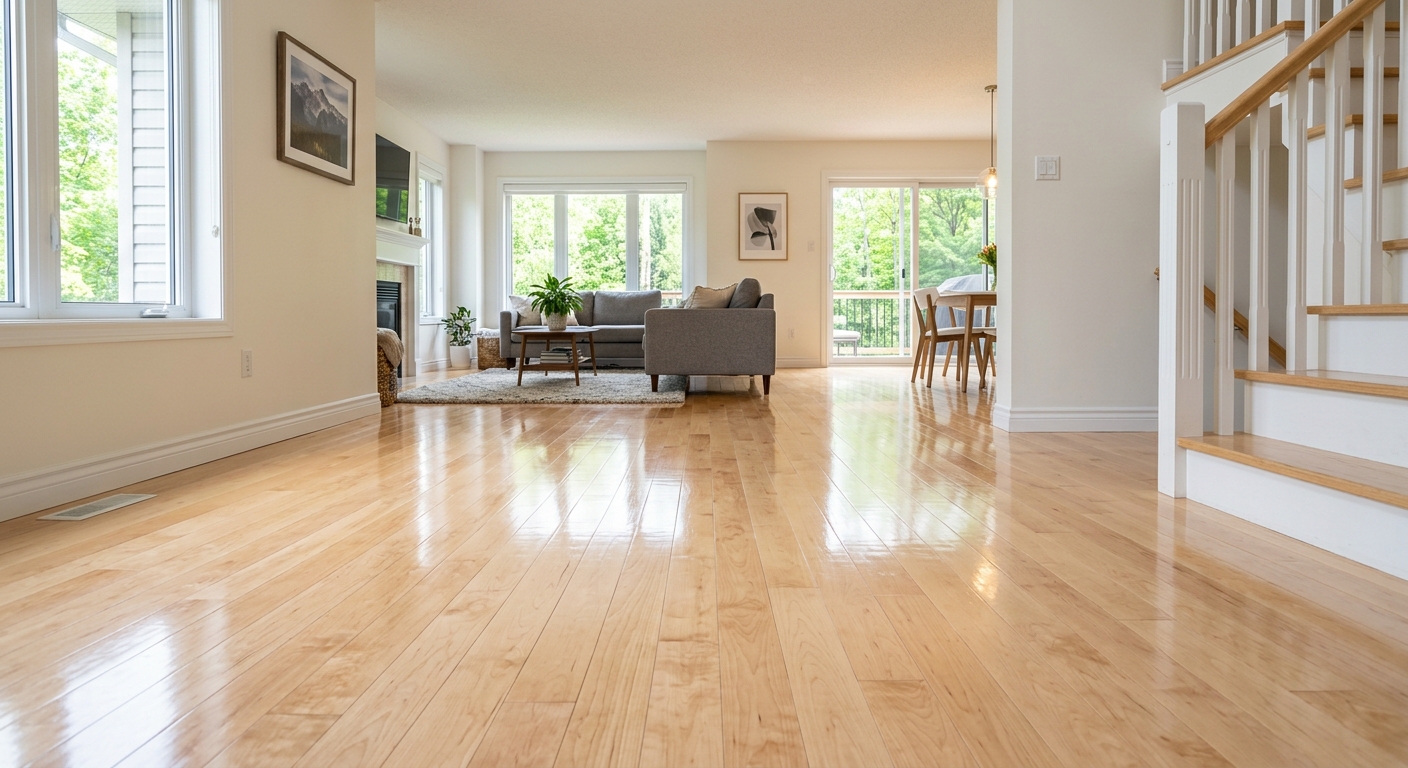
Flooring options and costs in Newmarket
Newmarket homeowners usually have a clear range of flooring choices, but the final price depends on how your home is built and how it performs through Toronto-area humidity swings. With 87,942 residents (Statistics Canada, 2021 Census), Newmarket is part of the wider GTA renovation market, where demand keeps labour busy and material pricing responsive. A key local planning point: 30.1% of homes in the area were built before 1981 (Statistics Canada, 2021 Census). In older houses—common around established pockets like GO transit-adjacent areas and older neighbourhood streets—pre-install work often matters as much as the flooring itself, including subfloor levelling, plywood repair, or moisture mitigation before you can lay new material.
Contractors in the Toronto economic region also tend to quote higher than smaller centres because of stronger renovation demand and higher general construction wages. That’s why the same “basic” project can land 30–50% apart when one quote includes sound underlay, subfloor repair, and proper moisture testing while another uses a faster install path. The climate is a big driver too: indoor humidity can swing through the seasons, which makes traditional solid hardwood more sensitive. In most above-grade rooms, engineered hardwood or well-rated laminate balances appearance and stability; for any basement work, luxury vinyl plank (LVP) is typically the safer direction. If you’re installing over radiant heat, it can also steer you toward engineered wood, tile, or certain vinyl products rather than solid hardwood.
Use the table below as your baseline for typical material-and-install pricing in Newmarket, then we’ll break down what pushes quotes up or down.
| Type |
Best Room |
Moisture Resistance |
Lifespan |
Price per sq ft |
| Solid hardwood (nail-down, above grade only) |
Living / dining, hallways |
Low–medium (humidity sensitive; not for basements or concrete) |
25–60 years |
$9–$18 |
| Engineered hardwood (float or glue, above + on-grade) |
Main floor, bedrooms |
Medium–high (handles seasonal swings better) |
20–40 years |
$9–$16 |
| Laminate (click-lock, above-grade) |
Bedrooms, living areas |
Medium (water-resistant top layer; leaks still matter) |
10–25 years |
$4–$9 |
| Luxury vinyl plank / LVP (waterproof, any level) |
Kitchen, basement, busy zones |
High–excellent (waterproof core suitable for below-grade) |
15–30 years |
$6–$12 |
| Porcelain / ceramic tile |
Kitchen, bathrooms, entryways |
Excellent (best for wet zones) |
25–50 years |
$12–$25 |
| Carpet (broadloom or modular tile) |
Bedrooms, stairs for comfort |
Low–medium (needs good dry-back and maintenance) |
8–15 years |
$5–$11 |
Prices are estimates only and vary by project scope, site access and material selection.
What affects the price of flooring in Newmarket
In the Toronto area, two quotes for the same room can differ by 30–50% because the “flooring line item” is only part of the job. What really changes the price is how much prep work is required, how moisture is managed, and whether the installer is building the floor system correctly for Toronto-area humidity swings. In Newmarket’s housing stock—where a meaningful share of homes date back to the pre-1981 era (Statistics Canada, 2021 Census)—subfloors may be uneven, layered with older underlay, or in need of plywood replacement. That’s why you’ll often see a project that starts as “laminate at $4–$9 per sq ft” end up costing like a higher tier once levelling, patching and moisture mitigation are included.
Technically, indoor humidity is the key driver above grade. Traditional solid hardwood expands and contracts more with moisture, and it can’t be glued or floated over concrete; it also performs poorly in basements and other below-grade spaces where vapour pressure is higher. That’s why engineered hardwood and LVP pricing is relatively more predictable in the GTA. For basement work, LVP is usually the right fit because it’s designed for below-grade installations and waterproof performance, while most laminate and all solid hardwood are riskier in those conditions.
Here are common Newmarket examples that move costs up or down: (1) If your subfloor needs self-levelling or patching, many projects add roughly $1–$4 per sq ft for the prep alone. (2) If your concrete slab is dusty or has moisture issues, a proper moisture mitigation step can add cost but prevents future buckling—especially under laminate. (3) If you’re comparing solid hardwood (often landing closer to $9–$18 per sq ft) versus engineered wood, the engineered option typically reduces call-backs tied to humidity movement, which is a real value consideration in the region’s seasonal swings.
| Price Factor |
Why It Matters |
Cost Impact |
| Room area in sq ft |
Larger areas use more product and more labour hours; it also affects waste allowance |
Low to moderate per sq ft; ramps up on complex layouts |
| Subfloor condition |
Levelling compounds, plywood repair, or patching may be required before any finish floor |
Often adds roughly $1–$4 per sq ft in older homes |
| Moisture / below-grade install |
Rules out solid hardwood; requires mitigation or waterproof systems for basements |
Can shift project tier; LVP typically increases reliability |
| Material choice |
Solid hardwood, engineered wood, LVP, and tile vary widely in material cost and system requirements |
Major swing; e.g., tile often in $12–$25 per sq ft band |
| Removal and disposal of existing flooring |
Demo, haul-away, and prep time vary depending on thickness and adhesive |
Can add a meaningful fixed amount plus labour |
| Stair nosing / transitions |
Trim, nosings, and transition strips are labour-intensive and priced per step or linear foot |
Usually a project add-on, especially with hardwood/ tile junctions |
| Radiant heat compatibility |
Heat changes how materials expand; not every product is rated for it |
May require specific underlay/adhesives and approved flooring types |
| Installation method |
Float, glue-down, and nail-down have different prep, adhesives, and finishing steps |
Labour and material costs vary; glue-down tends to require tighter prep |
Permits & regulations in Ontario
In Ontario, installing new flooring by itself typically does not require a building permit. However, there are common related scopes that can trigger other approvals—especially where you’re altering structure, addressing moisture, or working near electrical systems. For example, if you’re repairing or replacing subfloor framing in a way that affects structure, or adding or modifying in-floor heating circuits, you may need permits through the electrical pathway. Similarly, if the work involves significant moisture remediation that changes how the home manages water (not just replacing surface finishes), your contractor may need to coordinate documentation depending on the extent.
In condos, the rules are often about sound rather than permits. Many corporations restrict flooring types and require specific underlay to meet sound transmission targets (commonly discussed as STC/IIC). Before you install hardwood or tile on upper floors, review the condo declaration and request written board approval when required.
To verify a contractor in Newmarket, start with a licensing and compliance check, then prove insurance. Ask for: (1) their Ontario contractor registration/licensing details (and confirm the trade category they are performing), (2) a certificate of liability insurance showing the correct business name and active coverage, and (3) proof of WSIB/WCB clearance (or a clearance letter) for the relevant scope. You can also request a current insurance COI directly from the contractor—don’t rely only on a photo. For the best protection, keep copies of insurance and WSIB/WCB paperwork with your signed estimate.
Best flooring for each room in your Newmarket home
Choosing the right flooring in Newmarket comes down to matching material performance to moisture exposure, day-to-day traffic, and comfort needs through the year. With Toronto-area indoor humidity swings and a large older-home base, stability matters. For living and dining rooms, engineered hardwood or high-quality laminate is usually the sweet spot: they deliver warmth and style without the higher movement risk of solid hardwood. For master bedrooms, carpet remains a popular comfort choice for softness and sound absorption, but engineered hardwood is also a strong option if you want easy cleaning.
In kitchens, go with luxury vinyl plank (LVP) or large-format porcelain tile. LVP is water-resistant to waterproof depending on the product, and it stands up well to spills and frequent wet-clean cycles. For basements, LVP is the clear winner: it’s built for below-grade installs and vapour tolerance, while solid hardwood and most laminate are less reliable over moisture-prone concrete slabs. Bathrooms should be porcelain or ceramic tile only, since it’s designed for continuous wet conditions.
Radiant floor heating is increasingly common in new builds, and it affects what you can install. In practice, many homeowners pair radiant heat with engineered wood, tile, or select vinyl products that are rated for heat transfer and expansion. For a simple pricing example: if tile is around $12–$25 per sq ft, you’re paying for long-term wet-zone performance; that’s often justified versus laminate or carpet in kitchens and bathrooms where failures are expensive.
Below is a room-by-room shortlist to help you compare like-for-like during quote shopping.
| Room |
Best Material |
Why |
Moisture Risk |
Price Band per sq ft |
| Living / dining room |
Engineered hardwood |
Warm feel and better dimensional stability than solid hardwood in seasonal swings |
Low to medium (manage indoor humidity) |
$9–$16 |
| Master bedroom |
Carpet or engineered hardwood |
Carpet adds comfort and sound control; engineered wood keeps allergies/cleaning easier |
Low |
$5–$11 |
| Secondary bedrooms |
Luxury vinyl plank (LVP) |
Good durability for kids and frequent traffic; easier upkeep than carpet |
Low (still avoid standing water) |
$6–$12 |
| Kitchen |
Luxury vinyl plank (LVP) or porcelain tile |
Handles spills and frequent cleaning; tile adds maximum heat and water resistance |
Medium (spills and mopping) |
$6–$25 |
| Basement (finished) |
Luxury vinyl plank (LVP) |
Built for below-grade moisture/vapour conditions; reduces risk of buckling |
High (typical basement vapour pressure) |
$6–$12 |
| Bathroom |
Porcelain / ceramic tile |
Best wet-zone performance and longevity with correct installation |
Very high (continuous moisture) |
$12–$25 |
How to choose a flooring contractor in Newmarket
To hire confidently in Newmarket, verify three things up front: Ontario licensing/registration (as applicable to the work they perform), liability insurance, and WSIB/WCB coverage. Ask the contractor for their certificate of insurance and WSIB/WCB clearance letter before work begins, and confirm the documents match their business name and address. If they’re hesitant or only provide insurance after you “agree,” treat that as a warning sign. You can also request clearance documentation for the specific trade labour they’re providing, since misalignment is a common source of disputes on renovation jobs.
Next, get 2–3 itemised written quotes. The best quotes show labour and materials separately, include removal/disposal, spell out underlay and adhesives, and list what’s included for transitions and stairs. Avoid lump-sum proposals that don’t identify the product grade, thickness, wear layer (for vinyl), or expected subfloor prep. A quote should answer: is the subfloor level tested? Is moisture mitigation included where needed? Is permit pulling included if you’re changing electrical/in-floor heating?
Warranty matters too. Confirm the workmanship warranty length and what’s covered (and what isn’t). Ask whether the product warranty is tied to you or transferable to future owners. For payment, never pay more than 10–15% upfront; use a holdback until the job is fully complete and final cleanup is done. In Ontario projects, timelines are part of the protection—get the start date and completion estimate in writing.
- Provide proof of liability insurance and confirm policy validity before signing.
- Provide WSIB/WCB clearance for the crew doing the install.
- Use an itemised quote showing labour, underlay, adhesives, trims, and transitions.
- State whether moisture testing is included for slab/basement projects.
- Spell out subfloor prep steps (levelling, plywood repair, nail-down vs glue-down method).
- Confirm stair nosing and transition pricing per step or linear foot.
- Clarify removal and disposal: what gets hauled away, and how waste is managed.
- List the exact flooring SKU or product specification (thickness, wear layer, AC rating, etc.).
- Ask for a workmanship warranty and coverage terms in writing.
- Confirm whether the manufacturer warranty requires specific underlay/adhesives to stay valid.
- Set a payment schedule with a holdback until full completion and walkthrough.
- Request a written schedule (start/completion) and who is responsible for delays.
In Newmarket, I’ve seen the same problems repeat: (1) “cash discount” quotes that don’t include proper documentation, (2) installers who skip moisture mitigation in basements, (3) unclear subfloor responsibility when levelling is needed, (4) vague warranties (“up to”) without coverage terms, and (5) lack of detail on transitions/stairs that later inflates cost.
Frequently asked questions — flooring in Newmarket
What is the best flooring for a high-traffic area in Newmarket?
For high-traffic areas in Newmarket homes—think hallways, entries, and main living zones—luxury vinyl plank (LVP) and engineered hardwood are usually the most practical. LVP is tough and waterproof, which helps with Toronto-area humidity swings and everyday spills; many homeowners choose it for basements too. Engineered hardwood gives you a more traditional look but stays more dimensionally stable than solid hardwood in seasonal moisture changes. Price-wise, LVP is commonly in the $6–$12 per sq ft range, while engineered hardwood often sits higher, roughly in the $9–$16 band depending on grade. If the area gets a lot of wet footwear in winter, LVP tends to win on real-world maintenance.
How do I prepare my subfloor before new flooring?
Preparation is where floors succeed or fail, especially in older Newmarket homes where subfloor issues are more common. Start by having the contractor assess flatness and condition: check for squeaks, dips, loose boards, and failing underlay layers. For above-grade installs, levelling may be needed to prevent click-lock gaps in laminate or uneven load on LVP. For basements or concrete slabs, preparation often includes cleaning, verifying moisture conditions, and adding the correct underlayment or moisture mitigation system—solid hardwood is generally not recommended there. Many projects add about $1–$4 per sq ft when levelling or plywood repair is required. Good prep also includes fastening/smoothing where required so your new floor feels solid and stays quiet.
Is cork or bamboo flooring a good choice in Newmarket?
Cork can be comfortable and it helps with sound, but in Newmarket’s climate it still needs careful consideration around moisture. Cork flooring is more sensitive to sustained humidity than engineered wood or waterproof vinyl, and it’s not a basement “default” choice. Bamboo is a hardwood product and can move with moisture—so it’s typically an above-grade option only, with good indoor humidity control. If you’re trying to keep risk low in areas affected by seasonal humidity swings, engineered hardwood or quality LVP is usually the safer bet. Cork and bamboo are not automatically off the table for Newmarket, but they need the right installation system, proper acclimation, and a dry subfloor. When homeowners insist on these materials, we tighten prep and moisture checks because call-backs are more expensive than doing it right up front.
What is the difference between floating and glued-down flooring?
Floating flooring (common with click-lock laminate and many engineered options) is not mechanically fastened to the subfloor. Instead, planks or planks-and-boards interlock and the flooring “floats” over a suitable underlay. This method tolerates slight subfloor movement better and can simplify installation, but you still need a flat surface and correct expansion gaps. Glued-down flooring uses adhesive to bond directly to the subfloor, which can improve stability for certain engineered products and help with sound depending on the system. Glued-down also demands stricter subfloor prep because imperfections telegraph through and adhesive coverage must be correct. In Newmarket, where humidity can swing through the year, your choice should match the manufacturer’s installation requirements—especially around concrete and any below-grade area.
What flooring holds up best to pets in a Newmarket home?
For pets, the best-performing options in Newmarket are typically luxury vinyl plank and quality laminate (above grade). LVP is waterproof and usually handles accidents and frequent cleaning better than carpet or traditional hardwood. It also tends to resist dents better than many soft floors, especially when you choose thicker products and a good underlay system. Carpet can be comfortable, but it’s harder to keep looking clean if you deal with shedding, moisture events, or long-term odours; you’ll likely spend more on maintenance. Hardwood—solid or engineered—can work, but you have to be strict about moisture control and quick spill cleanup to avoid staining and movement issues. Budget-wise, many pet-focused LVP installs land around $6–$12 per sq ft, while engineered hardwood is often higher, commonly within the $9–$16 band depending on grade.
How do I fix squeaky floors in my Newmarket home?
Squeaks are usually a subfloor or fastener issue, not the finish flooring itself. In many older Newmarket homes, squeaks come from loose subfloor boards rubbing on joists, insufficient fastening, or layers that have shifted over time. The fix depends on what’s underneath: sometimes tightening/adding screws or nails from above solves it if the flooring can be lifted safely. If you’re installing new flooring, it’s often better to locate the squeak first and address it during prep rather than after the new floor is down. If the squeak is caused by movement at joists, you may need to correct the structural fastening pattern (not just add underlay). A good contractor will recommend a plan for squeak testing and subfloor stability before install—especially important if you’re planning engineered wood or tile where unevenness can cause additional issues.