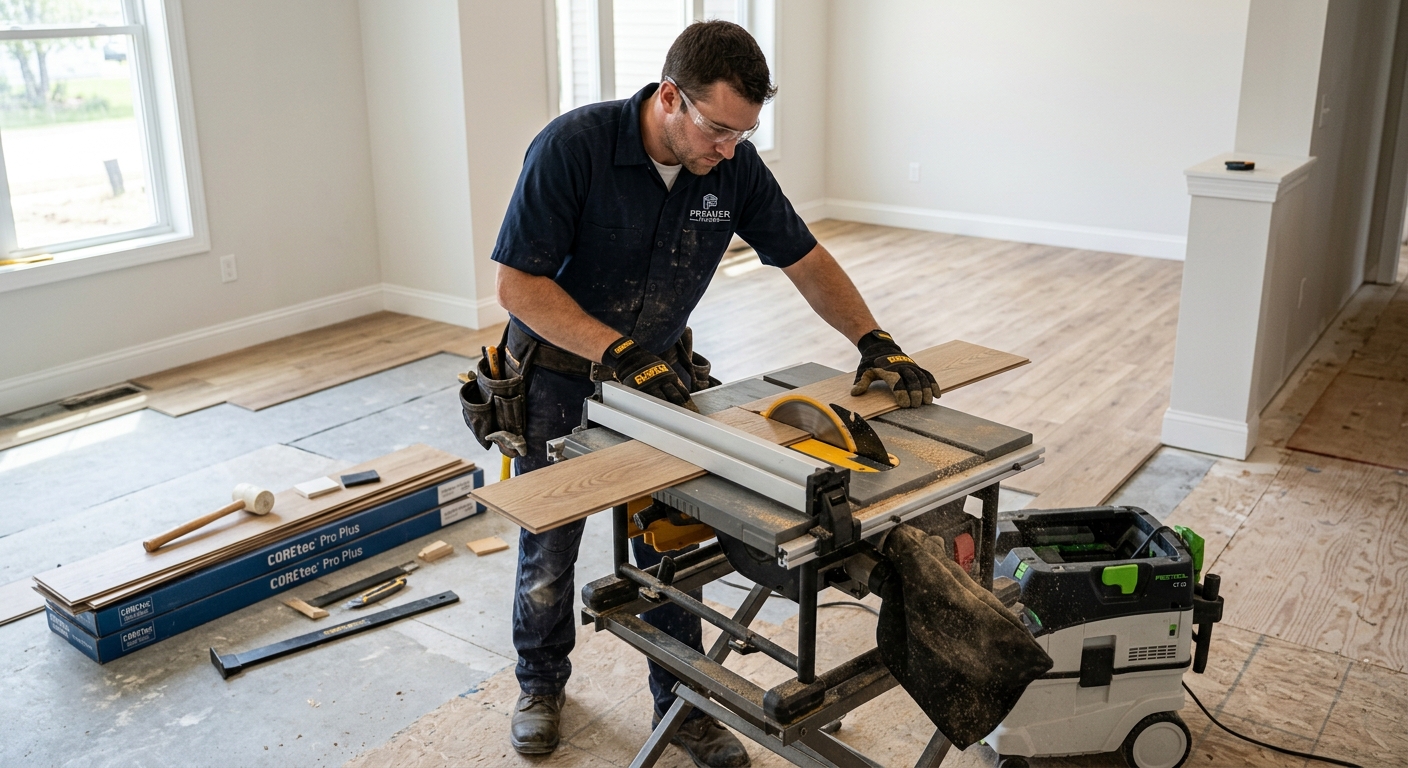
Flooring options and costs in Englehart
Flooring in Englehart comes down to fit, function, and how your house handles moisture. With 84.6% of homes built before 1981, many properties have older subfloors and uneven spots that need levelling, patching, or targeted repairs before any new material can perform well. That prep is a major reason estimates can swing even when the finish looks similar. At the same time, Englehart has a small housing market—460 homeowner households (67.6% of households own)—so the cost of labour and scheduling can vary depending on installer availability and how much floor area needs attention.
In Ontario’s colder seasons, indoor humidity can swing from dry heated months to more humid shoulder seasons, which stresses solid products. Basement moisture and below-grade vapour are also common in older stock, pushing many homeowners toward engineered wood or luxury vinyl plank (LVP) that tolerate humidity changes better than solid hardwood. Solid hardwood is still a beautiful option for main floors, but it’s typically limited to above-grade areas with stable moisture control and a proper subfloor. If your home has in-floor heating (or you’re planning it), contractors may steer you toward radiant-compatible engineered wood or LVP so the system heats efficiently without damaging the finish.
In Englehart, upgrades are especially common around the downtown core and older residential pockets where many houses were built mid-century, and where subfloor correction is often needed. Below is a practical comparison of common flooring types and what you can typically expect to pay per square foot.
| Type |
Best Room |
Moisture Resistance |
Lifespan |
Price per sq ft |
| Solid hardwood (nail-down, above grade only) |
Main floor living spaces |
Low to moderate (not for basements) |
30+ years (with stable indoor humidity) |
$11 – $18 |
| Engineered hardwood (float or glue, above + on-grade) |
Living / dining / bedrooms |
Moderate to high (better with humidity swings) |
20+ years |
$11 – $17 |
| Laminate (click-lock, above-grade) |
Bedrooms and hallways |
Moderate (spills need quick cleanup) |
10–25 years |
$4 – $10 |
| Luxury vinyl plank / LVP (waterproof, any level) |
Basements, kitchens, main floor |
High to waterproof |
15–25 years |
$5 – $10 |
| Porcelain / ceramic tile |
Bathrooms and kitchens |
Very high (if properly installed) |
25+ years |
$12 – $22 |
| Carpet (broadloom or modular tile) |
Bedrooms |
Low to moderate (avoid wet basements) |
8–15 years |
$3 – $8 |
Prices are estimates only and vary by project scope, site access and material selection.
What affects the price of flooring in Englehart
In Englehart (and across Ontario’s Northeast region), it’s common to see the same “type” of flooring priced 30–50% differently from one quote to another. The big reason is that flooring isn’t just the surface—it’s the prep, the transitions, and the installation method. In homes with older construction (84.6% built before 1981), subfloor corrections can add real labour: levelling compound, plywood patching, or moisture remediation before any planks, boards, or tile can be set properly. Those steps can easily move your total from a mid-band to the upper band even when you choose a similar-look finish.
Technical drivers are also tied to how Ontario homes behave through the seasons. Indoor humidity swings cause solid hardwood to expand and contract; in basements or areas with below-grade vapour, solid hardwood is typically a poor performer. Engineered hardwood and LVP are designed to better tolerate humidity changes and below-grade installs. That’s why many Northeast homeowners land on engineered wood or LVP where moisture risk is higher—while solid hardwood is usually kept to above-grade rooms with stable conditions.
Budget examples you’ll feel in your quote: if your subfloor needs repairs, costs may add roughly $1–$4 per square foot; if your job requires substantial levelling, that labour commonly pushes you toward the higher end of the $11–$18 hardwood-style bands. For value flooring, laminate or vinyl can start around the $4–$10 range, but once prep is heavy (or transitions are numerous), the “cheap per square foot” advantage can narrow. Finally, homes with colder-season heating—especially if radiant heat is present—often require radiant-compatible materials, which can affect the product choice.
| Price Factor |
Why It Matters |
Cost Impact |
| Room area in sq ft |
Materials, underlayment, and labour are calculated per square foot |
Low to moderate for small rooms; larger projects reduce per-sq-ft overhead |
| Subfloor condition |
Levelling or repair is required for flatness and proper click/nail performance |
Can add approximately $1–$4/sq ft in older homes needing patching |
| Moisture / below-grade install |
Solid hardwood is typically ruled out; additional vapour mitigation may be needed |
Higher for basements; usually shifts you to engineered wood or waterproof LVP |
| Material choice |
Solid vs. engineered vs. LVP vs. tile changes both product cost and install time |
Hardwood-style often lands in the $11–$18 range; laminate/LVP often $4–$10 |
| Removal and disposal of existing flooring |
Old flooring, tack strips, and underlay take time and may require extra hauling |
Moderate; can be a major driver if it’s glued down |
| Stair nosing / transitions |
Transitions are charged per step or per linear foot and affect material waste |
Moderate to high, especially for multi-level homes |
| Radiant heat compatibility |
Limits options to materials designed to handle temperature swings efficiently |
Can add cost if you must upgrade to radiant-compatible product lines |
| Installation method |
Float vs. glue-down vs. nail-down changes labour, prep, and cure times |
Often increases cost for glue-down and tile compared with click-lock |
Permits & regulations in Ontario
In Ontario, installing flooring itself generally does not require a building permit. However, related work can trigger permitting requirements—so a careful scope matters. The typical examples that may require permits include structural subfloor work that changes framing or supports, moisture remediation that involves engineered systems or significant remediation work, and in-floor heating circuits that connect to electrical components. If you’re adding or modifying radiant heat, electrical permits may be required depending on how the system is tied into your home’s electrical supply.
For condominiums, permits can be less about the flooring and more about sound control. Many condo boards require specific underlay products or restrict hard flooring on upper floors due to noise transfer. Before any installation, you should review your condo declaration/bylaws and request board approval in writing—especially if you’re installing hardwood or tile above grade areas where impact sound is a concern.
To verify a contractor in Englehart, do three things before money changes hands: (1) confirm their Ontario licence/registration status where applicable by checking their online listing (many contractors use provincial business registry details and trade directories), (2) request a certificate of insurance for liability coverage and ensure it matches the job address, and (3) confirm WSIB/WCB coverage if they’re operating as required for employees/subcontractors. Ask for documents and keep copies; if anything doesn’t line up, choose another installer.
Best flooring for each room in your Englehart home
Choosing the right flooring by room is the quickest way to avoid problems in an Englehart home. Living and dining areas typically see everyday traffic and must handle normal humidity swings, so engineered hardwood or high-quality laminate are common sweet spots: they give warmth and style without the same humidity sensitivity as solid hardwood. In the master bedroom, you can lean either direction—carpet for comfort and sound absorption, or engineered hardwood for a clean, low-allergen feel. For kitchens, waterproof performance matters most. Luxury vinyl plank (LVP) is usually the best value because it handles splashes and quick cleanups, and it can also tolerate minor subfloor variation better than tile.
Basements are where Ontario’s below-grade reality shows up. Finished basements often face moisture vapour movement, and solid wood and most laminate aren’t ideal in those conditions. In Englehart, LVP is the clear winner for finished basements because it’s waterproof and more forgiving during installation. Bathrooms should be porcelain or ceramic tile only, since they’re built for wet use—just ensure the installer follows proper prep and waterproofing practices.
If your home has (or will add) in-floor heating, pay attention to radiant heat compatibility. Many installers in the Northeast market will specify products that can tolerate temperature cycling without gapping or excessive expansion. For example, if you compare carpet at roughly $3–$8 per square foot versus LVP at $5–$10, the extra cost is often worth it for basements where moisture risk would otherwise shorten carpet or laminate lifespan. That’s where the “cheapest per square foot” choice can become the most expensive overall.
| Room |
Best Material |
Why |
Moisture Risk |
Price Band per sq ft |
| Living / dining room |
Engineered hardwood |
Warm look, strong dimensional stability through humidity swings |
Low to moderate |
$11 – $17 |
| Master bedroom |
Carpet or engineered hardwood |
Carpet adds comfort and sound control; engineered wood is easier to maintain |
Low |
$3 – $17 |
| Secondary bedrooms |
Laminate |
Good durability for daily traffic with straightforward maintenance |
Low |
$4 – $10 |
| Kitchen |
Luxury vinyl plank (LVP) |
Waterproof surface handles spills; comfortable underfoot compared to tile |
Moderate (spills) |
$5 – $10 |
| Basement (finished) |
Luxury vinyl plank (LVP) |
Waterproof and better suited to below-grade vapour conditions |
High |
$5 – $10 |
| Bathroom |
Porcelain / ceramic tile |
Designed for wet areas; long-term wear when installed correctly |
High |
$12 – $22 |
How to choose a flooring contractor in Englehart
When you hire a flooring contractor in Englehart, start by verifying coverage and professionalism—because subfloor issues and moisture problems are where inexperienced crews lose money fast, and homeowners pay later. First, ask for their Ontario business/registration details and confirm the company is legitimate and operating. Next, request a certificate of liability insurance and ensure it covers the job site and dates of work. Finally, confirm WSIB/WCB coverage if they use employees or subcontract trades in Ontario; don’t accept verbal reassurance—ask for documents and keep copies.
Then get 2–3 itemised written quotes, not a single lump sum. A proper quote breaks labour and materials (flooring, underlayment/vapour barrier where appropriate, transitions, stair nosing, and any subfloor levelling/patching). Read the scope for inclusions and exclusions: is removal and disposal included? Who deals with trim/door undercutting? Is the contractor pulling/using any moisture mitigation product, and is that specified? Ask whether permits are included when in-floor heating or electrical work is involved.
Warranty matters too. Verify the workmanship warranty length, what it covers (e.g., gapping, separation, installation defects), and whether it’s transferable if you sell your home. For payment schedule, avoid large deposits—generally keep upfront payments to 10–15% maximum and hold back until the job is complete and your punch-list is addressed. Finally, insist on a written timeline with a start date and an estimated completion date.
- Ask for the quote in writing with a line-by-line labour/material breakdown.
- Confirm liability insurance and WSIB/WCB coverage before work begins.
- Request proof of product warranties and installation/workmanship warranty terms.
- Ensure the quote specifies underlayment/vapour barrier for your chosen floor type.
- Confirm how uneven subfloors will be measured and corrected (levelling method).
- Clarify removal/disposal: what is taken away and what stays with you.
- Check transition details: stair nosing, thresholds, and matching trims.
- Ask who handles moisture issues (testing, remediation plan, and documentation).
- Make sure door trims/undercutting and baseboard work are included or priced.
- Get the timeline and logistics plan for dust control and protection for stairs/rooms.
- Verify product acclimation time and storage conditions are included in the scope.
- Do a site walkthrough and ask for a detailed measurement and waste factor.
Red flags in Englehart include: quotes that don’t mention subfloor prep at all (especially in older pre-1981 homes), installers who avoid discussing moisture conditions in basements, no written workmanship warranty, unclear scope on removal/disposal and transitions, and requesting a large upfront deposit (more than typical 10–15%) without a solid contract and schedule.
Frequently asked questions — flooring in Englehart
How do I prepare my subfloor before new flooring?
In Englehart, subfloor prep is the difference between a floor that looks great for years and one that develops movement, squeaks, or gapping. For older homes (84.6% built before 1981), expect a crew to check flatness first, then address soft spots, loose boards, and any swelling. If you’re installing engineered hardwood or laminate above grade, the goal is a flat, solid surface—levelling compound and patching are commonly part of the plan. For LVP in basements, the prep focus shifts to moisture and vapour—your installer should specify whether a vapour barrier is required and how they’ll handle uneven concrete. If your quote is only priced from the $4–$10 band for laminate/LVP but doesn’t mention levelling or moisture steps, ask what they’ll do to prep the subfloor. (Statistics Canada, 2021 Census)
Is cork or bamboo flooring a good choice in Englehart?
Cork and bamboo can work in Ontario when the product is well-matched to the room’s moisture conditions, but they’re not the default choice for basements. Cork tends to be comfortable and quiet underfoot, which is great for bedrooms and living spaces; however, like other natural materials, it can be sensitive to sustained moisture and humidity swings. Bamboo behaves differently depending on whether it’s engineered or strand-woven, and the key is stability over time—especially in older Englehart homes where indoor humidity may change seasonally. If you have a finished basement, LVP (typically in the $5–$10 per square foot band) is usually the safer value because it’s waterproof and handles below-grade installs better than cork/bamboo. For above-grade rooms with good ventilation, cork or engineered bamboo can be considered, but make sure the installer confirms flatness, acclimation, and whether your room conditions stay within the manufacturer’s humidity limits. (Statistics Canada, 2021 Census)
What is the difference between floating and glued-down flooring?
Floating floors “click” together and sit on a cushion/underlay without being fixed to the subfloor. That method is common for laminate and many engineered hardwood installs, and it’s usually faster to install—often helping keep costs closer to the lower $4–$10 style bands for value products (depending on your exact material). Glued-down flooring is bonded directly to the subfloor or slab, which can improve stability on large areas and may suit some engineered systems. In Englehart, the decision often hinges on subfloor condition and moisture: floating installs can tolerate some minor surface irregularity better than some nailed options, but they still require a flat base. Glued-down methods may require extra prep for adhesion—if the slab is irregular or has moisture vapour, it can become a problem. Always confirm the installation method the manufacturer allows, especially if you’re over concrete or using radiant heat. Ontario climate swings can change how floors respond over the seasons, so prep quality matters either way.
What flooring holds up best to pets in a Englehart home?
For pets, the most important factors are scratch resistance, dent resistance, easy cleaning, and how quickly the floor can handle accidents. In Englehart’s older housing stock, you also want a product that tolerates humidity swings—especially if your “pet zone” includes a basement. Luxury vinyl plank (LVP) is usually the best all-around choice because waterproof construction makes accidents easier to clean and helps prevent swelling around spills. In many installs, LVP also comes out in the $5–$10 per square foot range, which can be a practical compromise between durability and cost. If you prefer a wood look, engineered hardwood can work well on main floors when the install is done correctly and your indoor humidity is kept stable. Avoid solid hardwood in basements or areas with moisture risk. If you’re comparing options, ask your contractor how they handle subfloor prep and whether they use the right underlayment for your pet-friendly flooring—these details affect noise and long-term performance.
How do I fix squeaky floors in my Englehart home?
Squeaks usually come from movement between subfloor layers, fasteners loosening, or boards rubbing. The best fix depends on what’s causing the sound, and in Englehart—given the area’s older homes—squeaks often relate to aging subfloor fasteners or uneven joists. Before you install new flooring, identify the squeak source if possible: step on the areas and see whether squeaks change under different weight spots. A contractor may re-fasten the subfloor (screwing down loose boards), add bridging for support, or address nails that are backing out. If the subfloor is failing, installing over it will lock in movement and can shorten the lifespan of your new floor. This is why a proper quote for engineered or laminate should include subfloor assessment and repair in the scope, not just surface installation. If you’re planning tile, squeak issues must be resolved because tile requires a rigid, stable base. In short: fix squeaks before flooring—then your new $11–$18 hardwood-style or $5–$10 LVP floor will perform as intended.
What is luxury vinyl plank and is it worth it in Englehart?
Luxury vinyl plank (LVP) is a hard-surface floor with a vinyl core designed for dimensional stability and, in many lines, waterproof performance. For Englehart homeowners, it’s often worth it because it handles the realities of older homes: humidity changes through Ontario seasons and the moisture vapour that can show up in basements. LVP is also forgiving if your subfloor needs minor levelling, whereas solid hardwood isn’t typically suitable for below-grade areas and laminate can be more vulnerable to swelling from prolonged moisture. In practical cost terms, LVP commonly sits in the $5–$10 per square foot band, which can be less than tile ($12–$22) and often a more budget-friendly alternative than engineered hardwood ($11–$17). The best value happens when the installer specifies the correct underlayment/vapour strategy and does proper prep so your floor lays flat. If you want “warmth without the moisture risk,” LVP is frequently the smartest choice for kitchens and basements in the Northeast market. (Statistics Canada, 2021 Census)