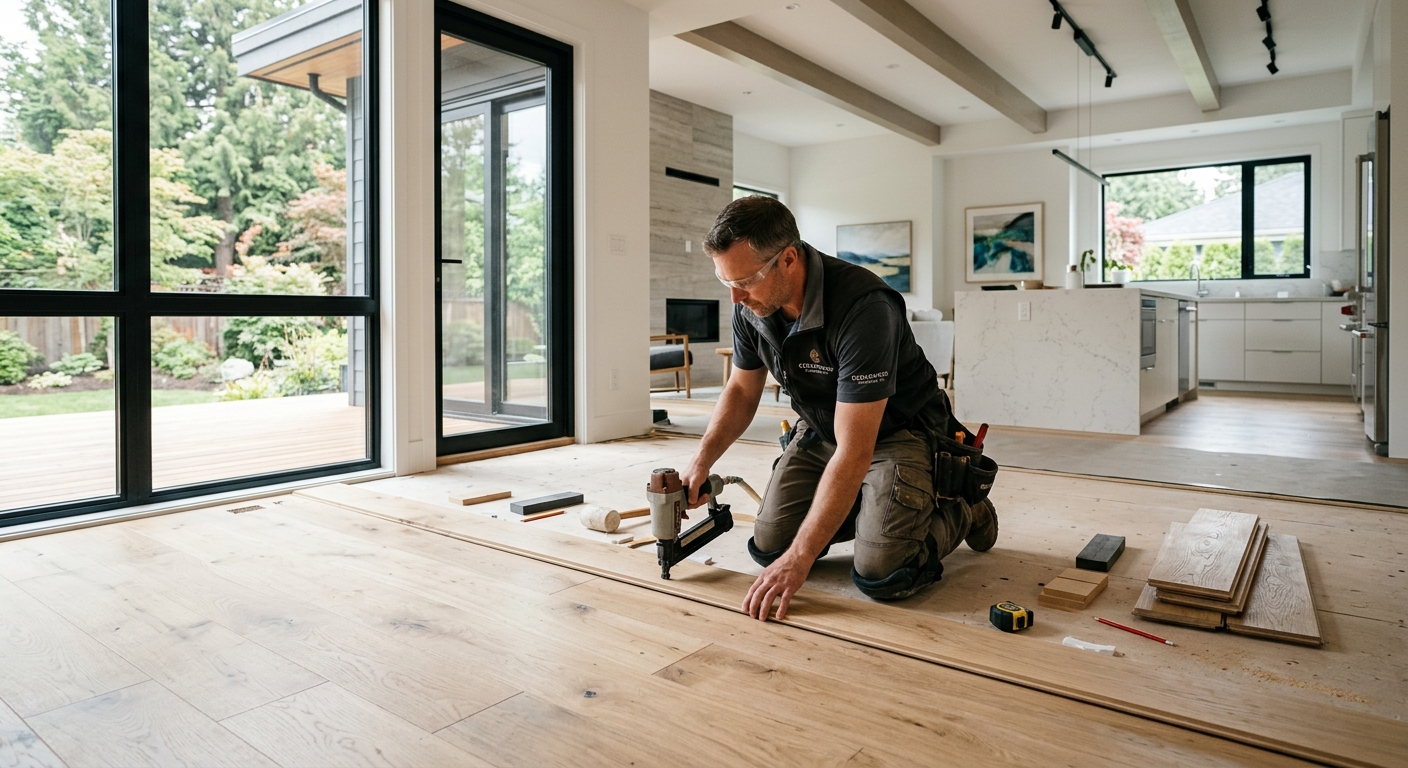
Flooring options and costs in Weston
In Weston, choosing the right flooring starts with understanding how the Toronto-area climate and local housing stock behave year-round. With a population of 17,992 (Statistics Canada, 2021 Census), Weston draws a lot of renovation activity, especially around older pockets where many homes date back to the 1960s–1990s. That matters because pre-install prep—like subfloor levelling, spot repairs, or moisture mitigation—can add real cost even if the finished material looks “mid-range” on paper. In practice, it’s not unusual to see levelling or repairs add roughly $1–$4 per sq ft, and in heavier cases (patch-and-level plus plywood repair) it can stretch higher.
Toronto-area homes also see wide indoor humidity swings across seasons. Solid hardwood expands and contracts with moisture, so it’s typically an above-grade product only. In basements and over concrete, that movement can cause gapping or cupping, and it’s why engineered hardwood and luxury vinyl plank (LVP) are often recommended. Labour costs tend to be elevated in the Toronto renovation market, so the same room layout can come back 30–50% apart when one quote includes full tear-out and moisture steps and another doesn’t. Contractor availability also affects pricing—busy periods and neighbourhood demand can influence scheduling and crew size.
In Weston, trade demand is especially steady in the older residential fabric near the Westwood-area streets and around the established commercial edge, where homeowners often renovate main floors first and later tackle basements. With that in mind, the table below compares common options you’ll see in quotes, including realistic budget ranges to help you compare apples to apples before you book measurements.
| Type |
Best Room |
Moisture Resistance |
Lifespan |
Price per sq ft |
| Solid hardwood (nail-down, above grade only) |
Living room, dining room, bedrooms |
Low (humidity-sensitive; not for basements) |
25–60 years |
$9 – $18 |
| Engineered hardwood (float or glue, above + on-grade) |
Main floor, hallways, bedrooms |
Medium to high (more stable in humidity) |
20–40 years |
$9 – $16 |
| Laminate (click-lock, above-grade) |
Bedrooms, living areas (not basements) |
Low to medium (edges swell if water sits) |
10–25 years |
$4 – $9 |
| Luxury vinyl plank / LVP (waterproof, any level) |
Main floor, basement (finished), offices |
High (waterproof core; manages vapour better) |
15–25 years |
$6 – $12 |
| Porcelain / ceramic tile |
Kitchen, bathroom, entry, some basements |
Very high (with proper underlayment) |
25–50 years |
$12 – $25 |
| Carpet (broadloom or modular tile) |
Bedrooms, stairs, family rooms |
Medium (not ideal for damp basements) |
7–15 years |
$5 – $11 |
Prices are estimates only and vary by project scope, site access and material selection.
What affects the price of flooring in Weston
In Weston (and the wider Toronto region), two quotes for the same square footage can differ by 30–50% because the “hidden work” varies. The biggest technical and labour drivers are humidity behaviour, below-grade moisture risk, and how much subfloor correction is included before install. Toronto-area homes are prone to indoor humidity swings through the seasons, so contractors who plan for proper acclimation, moisture checks, and the correct product system (engineered vs. solid vs. waterproof LVP) often price higher up front, but prevent expensive callbacks later.
Moisture and below-grade installs are the key technical reasons. Solid hardwood expands and contracts with humidity and is typically not installed over concrete or in basements; doing so can create cupping, gapping, and bond failures. Engineered hardwood and LVP are more dimensionally stable and are specifically used where below-grade conditions or higher humidity vapour are a concern. If your Weston home has a colder basement with past seepage or just consistently cool slabs, that can move you from a $9–$18 hardwood-type budget into a more “whole-system” prep and installation approach, frequently paired with LVP or tile.
Subfloor condition also changes cost directly. Many homes from the 1960s–1990s require levelling or plywood replacement before new flooring goes down; even modest repair can add about $1–$4 per sq ft. For example, a 500 sq ft main-floor project at $9–$16 per sq ft engineered hardwood may feel “close” to laminate at $4–$9, but once levelling and moisture mitigation are included, the final difference can become less about product price and more about prep quality. Radiant heat is another cost shaper in newer custom builds: it tends to favour engineered wood, tile, and certain vinyl systems, while it rules out much traditional solid hardwood.
| Price Factor |
Why It Matters |
Cost Impact |
| Room area in sq ft |
Directly drives material quantity, underlay, and time on the floor. |
Higher square footage increases total labour and waste percentage. |
| Subfloor condition — levelling or repair needed before install |
Old Toronto-era subfloors often need patching, plywood replacement, or flatness correction. |
Can add roughly $1–$4 per sq ft (sometimes more if extensive). |
| Moisture / below-grade install — rules out solid hardwood |
Basements and slabs require products designed for vapour and moisture exposure. |
Switching to engineered/LVP may raise material cost, but prevents failures. |
| Material choice — solid vs. engineered vs. LVP vs. tile |
Different systems have different installation methods, underlayment, and tolerances. |
Solid hardwood often lands toward $9–$18; tile can reach $12–$25. |
| Removal and disposal of existing flooring |
Tear-out time and disposal fees vary a lot by old material and thickness. |
Often a meaningful add-on; can swing a quote by thousands. |
| Stair nosing / transitions — charged per step or per linear foot |
Stairs and transitions are labour-intensive and require matching profiles. |
Can significantly increase cost compared with a flat-room-only layout. |
| Radiant heat compatibility — limits material options |
Heat cycling affects expansion and performance of some floor assemblies. |
May require engineered, tile, or specific vinyl specs; can change install method. |
| Installation method — float vs. glue-down vs. nail-down |
Labour time, adhesives, and subfloor tolerances differ by method. |
Glue-down and nail-down generally cost more than float systems. |
Permits & regulations in Ontario
In Ontario, flooring installation itself usually does not require a building permit. However, related work can. If your project involves structural subfloor repair (for example, replacing rotted plywood or correcting joist-area issues that affect structure), moisture remediation steps that change drainage systems, or installing new in-floor heating components and their control wiring, you may run into permit or electrical work requirements.
In condominiums, the bigger “rules” are often board and building management requirements rather than permits. Many corporations have sound transmission expectations on upper floors, meaning you may need specific underlay and may have limitations on hard flooring without the correct sound-rated system. Before ordering engineered hardwood or tile for a unit above another suite, request written board approval and confirm the approved underlayment method and any floating vs. rigid fastening requirements.
How to verify a contractor in Weston, step by step: (1) Check Ontario licensing status using the appropriate provincial business/labour registry pages referenced by the contractor’s public documents (many flooring contractors also hold the relevant trade registrations for the scope). (2) Ask for a current certificate of insurance: liability coverage for property damage and personal injury, with dates clearly shown. (3) Confirm WSIB/WCB coverage for the workers who will be on-site; request a clearance letter or proof of account coverage. (4) When you receive quotes, make sure the scope matches what they’ll actually do—prep, subfloor moisture steps, and removal/disposal—so you’re not relying on assumptions.
Best flooring for each room in your Weston home
In Weston, the “best” floor is the one that matches room moisture exposure and how your home behaves through Ontario seasons. Living and dining areas typically tolerate a wider range because they’re usually above-grade and less exposed to vapour. For those spaces, engineered hardwood or a high-quality laminate can balance a warm look with easier maintenance. Where you’ll notice the difference is in seasonal stability: engineered hardwood is designed to handle humidity swings better than traditional solid wood, which helps avoid gapping over time.
For bedrooms, comfort and quieter walking matter. Carpet still performs well in Weston’s bedrooms because it softens sound and feels warmer underfoot in colder months, but it’s best kept out of high-humidity basements. The kitchen is a different story: splashes, wet mops, and spills make luxury vinyl plank (LVP) or large-format porcelain tile practical. LVP’s waterproof core handles everyday water better, while porcelain tile is the “no worry” choice for splash zones and cleaning.
Basements are where Toronto-area humidity realities show up most. The clear winner in most finished basements is LVP: it’s waterproof and more tolerant of below-grade conditions. Solid hardwood and many laminate systems are riskier over slabs due to moisture vapour and seasonal movement. Bathrooms should be porcelain or ceramic tile only, with a properly planned water-resistant system.
If you’re building or renovating with radiant floor heating, engineered wood, tile, and certain vinyl products are typically the better match than traditional solid hardwood because heat cycles affect expansion. For a practical budget example: if laminate sits around $4–$9 per sq ft but you switch to waterproof LVP near $6–$12 per sq ft in a 400 sq ft basement, the extra cost is usually justified because you’re buying long-term moisture tolerance—not just appearance.
| Room |
Best Material |
Why |
Moisture Risk |
Price Band per sq ft |
| Living / dining room |
Engineered hardwood |
Warm feel with better stability for Toronto humidity swings than solid. |
Low to medium (above-grade; manage spills) |
$9 – $16 |
| Master bedroom |
Carpet or engineered hardwood |
Carpet boosts comfort and sound; engineered keeps a cleaner, harder surface option. |
Low (if dry and above-grade) |
$5 – $16 |
| Secondary bedrooms |
Laminate or carpet |
Laminate is budget-friendly for above-grade rooms; carpet if you want softness and quieter footsteps. |
Low |
$4 – $11 |
| Kitchen |
Luxury vinyl plank (LVP) or porcelain tile |
LVP tolerates splashes; tile handles heavy cleaning and wet messes well. |
Medium to high (spills and damp mopping) |
$6 – $25 |
| Basement (finished) |
Luxury vinyl plank (waterproof) |
Designed for below-grade vapour and moisture conditions; avoids many solid wood failures. |
High (vapour and seasonal coolness) |
$6 – $12 |
| Bathroom |
Porcelain / ceramic tile |
Best in class for water tolerance when installed with proper water-resistant details. |
Very high (frequent wetting) |
$12 – $25 |
How to choose a flooring contractor in Weston
Choosing a flooring contractor in Weston is less about the lowest number and more about proof. Start with Ontario compliance and coverage: ask for the contractor’s Ontario business registration details (and any trade registration relevant to their scope), then request a certificate of liability insurance showing active dates and the correct insured party. For worker protection, confirm WSIB/WCB coverage by asking for a clearance letter or proof of account coverage—don’t accept “we’ll get to it later.” If a contractor can’t provide documentation, treat it as a red flag.
Next, get 2–3 itemised written quotes. You want a line-by-line breakdown of labour (prep, tear-out, install, transitions) and materials (flooring, underlay, adhesives, trim, moisture barriers where needed). Avoid lump-sum quotes that hide whether subfloor levelling, plywood repair, or moisture mitigation is included. Make sure disposal and cleanup are specified (dump fees and removal of old flooring vary in cost). Confirm whether a permit is included when the scope touches electrical or related work.
Warranty is another differentiator. Ask for the workmanship warranty length and what it covers (for example, workmanship defects vs. product performance issues). Confirm whether the manufacturer warranty is tied to the original purchaser and whether it transfers when you sell the home. For payment scheduling, keep it controlled: never pay more than 10–15% upfront, and hold a portion until the job is complete and inspected. Finally, request the start date and completion estimate in writing, plus what happens if materials arrive late.
- Provide WSIB/WCB proof or clearance letter before signing.
- Show a current certificate of liability insurance.
- Include a written scope for subfloor levelling/repairs and moisture checks.
- List disposal and whether existing baseboards get removed or reused.
- Clarify transitions, stair nosing, and thresholds pricing (per step/linear foot).
- State acclimation requirements and who controls the indoor conditions.
- Confirm underlay/moisture barrier type and thickness for LVP/laminate systems.
- Ask who supplies and installs trims, caulking, and colour-matching mouldings.
- Verify warranty terms for workmanship and whether manufacturer warranty transfers.
- Payment schedule: max 10–15% deposit; holdback until completion.
- Get exact start/completion dates and a plan for material delays.
- Require site protection details (plastic, dust control, door protection) in the scope.
In Weston, common red flags I’ve seen on flooring jobs include: quotes that don’t mention moisture/vapour steps for basements, “all-inclusive” pricing that skips transitions and stair work, contractors who won’t put removal/disposal and subfloor prep in writing, charging a large deposit up front without an executed schedule, and no clear warranty or product spec sheet for the exact flooring being installed.
Frequently asked questions — flooring in Weston
What flooring is best for a Weston basement?
For most Weston basements, waterproof luxury vinyl plank (LVP) is the safest and most common choice because it’s designed for below-grade conditions and can handle moisture vapour better than traditional wood systems. Solid hardwood is a high-risk option in basements in Toronto’s climate due to seasonal humidity swings and potential slab/subfloor moisture. If you’re budgeting, LVP often lands around the $6–$12 per sq ft range depending on thickness and wear layer, while carpet is typically not recommended for damp or cool spaces. If your basement slab has a known moisture issue, the prep details matter—ask the contractor what they check and what moisture mitigation steps (if any) they include in the scope.
Can I install hardwood over concrete?
In most Weston projects, traditional solid hardwood is not the best match over concrete. Solid wood is humidity-sensitive and typically requires a suitable above-grade installation method (commonly nail-down over an appropriate substrate). Over concrete, engineered hardwood is often the more realistic choice because it’s built to be more dimensionally stable across temperature and humidity changes, and it can be installed with the correct system. If you have radiant heat, confirm the product’s heat-cycle compatibility in writing. Before anyone installs, insist on verifying slab flatness and addressing moisture risks; otherwise, even the right hardwood can fail due to bond or movement issues.
How long does flooring installation take?
Timelines in Weston depend on square footage, subfloor prep, and whether you have tear-out and stairs/transitions. For a typical above-grade room, many installs fall into a “few days” window once the subfloor is ready—while projects involving plywood repair, levelling, or moisture mitigation can add time. Removal and disposal can also change schedules, especially when baseboards need careful handling. If you’re doing a whole-floor renovation in an older home from the 1960s–1990s era, subfloor correction can be the slow step, even before materials go down. Get a written start date and completion estimate, and ask how long acclimation is expected for the flooring and what indoor conditions the contractor requires.
What flooring works with radiant heat?
Radiant heat is increasingly common in Ontario new builds and custom renovations, and it affects how flooring expands and contracts. As a rule, engineered hardwood, porcelain tile, and certain vinyl products are better suited than traditional solid hardwood because their construction tolerates heat cycling when installed using the manufacturer’s guidelines. Some laminate products can work too, but you must verify radiant-heat approval for the exact product (not just “it’s laminate”). If your home has radiant heat in Weston, ask the contractor to confirm the flooring manufacturer’s recommended temperature settings and whether expansion gaps and installation method (float vs. glue-down) follow those specifications.
Engineered vs solid hardwood — what's the difference?
Solid hardwood is a single piece of wood throughout and is more sensitive to humidity and moisture movement. That’s why it’s generally limited to above-grade installations, not basements or most concrete applications. Engineered hardwood uses layered construction—typically a wood veneer over stable layers—making it more resistant to seasonal indoor humidity swings common in the Toronto area. In practical terms, engineered hardwood is often the easier “hardwood look” choice for homes with concrete slabs or higher humidity conditions, and it’s frequently paired with sound strategies in condominiums. For budget context, solid hardwood commonly appears around $9–$18 per sq ft, while engineered hardwood budgets often sit in a similar range depending on thickness and grade, but with fewer moisture-related risks when installed correctly.
Do I need to level my subfloor first?
Usually, yes—levelness is one of the biggest predictors of a good long-term floor, especially in Weston’s older housing stock. If the subfloor is not flat, floating floors can squeak or flex, click-lock joints may fail prematurely, and tile can crack if the assembly isn’t supported properly. In many Toronto-era homes, you may need levelling compound, sanding, or localized repairs, and sometimes plywood replacement. Even if you choose a budget floor (like laminate around $4–$9 per sq ft), skipping levelling can wipe out the savings through callbacks. A reputable contractor will measure flatness, confirm moisture conditions, and describe what they’re doing—before you pay—so the scope is clear.