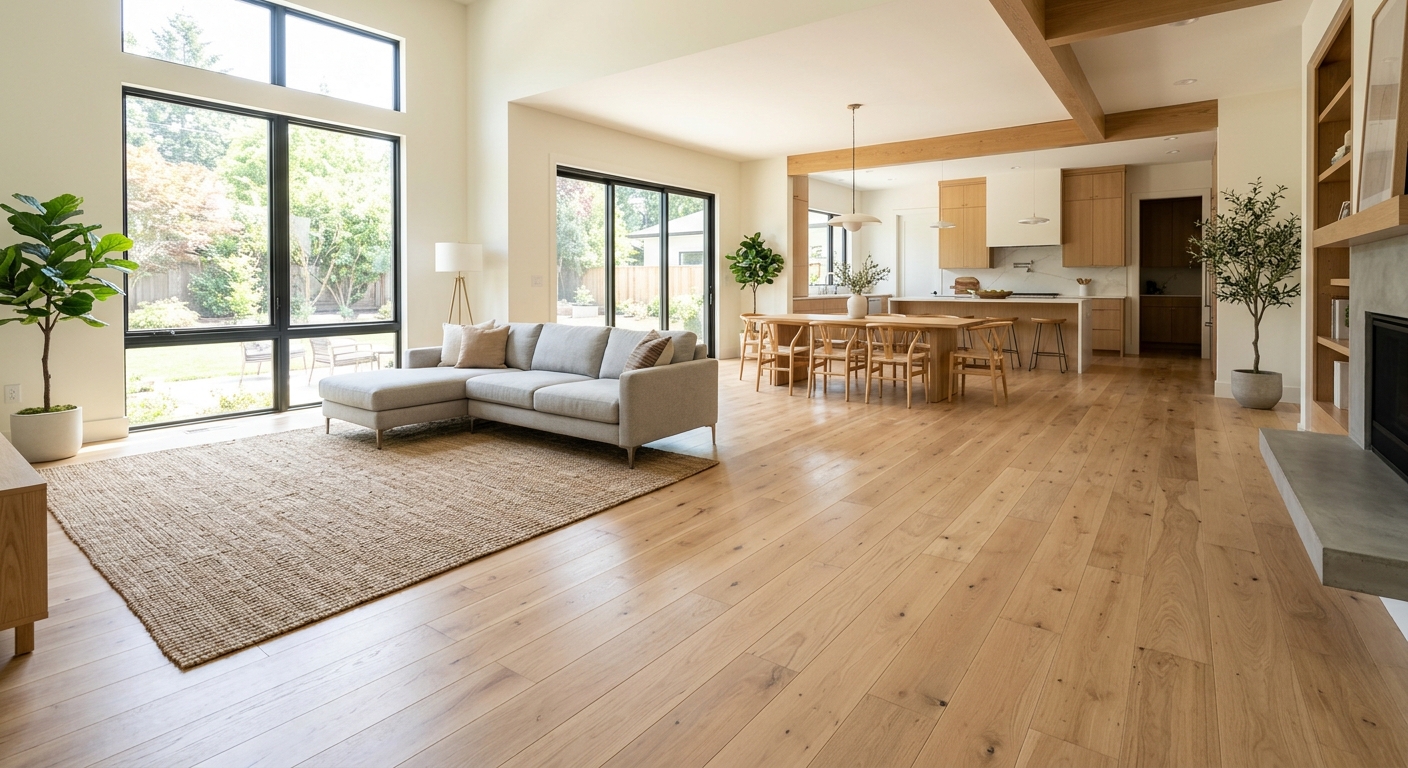
Flooring options and costs in Fort Frances
In Fort Frances, the right flooring choice comes down to more than looks—your home’s age, subfloor condition, and how the Northwest Ontario seasons swing indoors all affect both comfort and installation cost. With 74.6% of local homes built before 1981, many projects start with levelling, patching, and sometimes adding a plywood or OSB underlayment so the new surface is flat and stable. That prep can add a noticeable line item before finish flooring goes down, especially when older bungalows have uneven runs or low spots that telegraph through to clicks, joints, or tile grout lines.
Northwest winters and short, humid summers drive humidity swings that impact material behaviour. Solid hardwood expands and contracts with indoor moisture and isn’t recommended for below-grade areas or installs over concrete. For many Fort Frances basements and lower levels, engineered wood and luxury vinyl plank (LVP) are the safer picks because their stable cores and click systems handle seasonal movement better. The local market is active around Rainy Lake-area properties and older neighbourhood renovations; that steady demand means you can usually find installers for engineered wood and LVP, but prep-heavy jobs can take longer because smaller crews must schedule around remote access and underfloor patching.
Below is a practical comparison of common flooring types and what you can typically expect to pay per square foot in Fort Frances, setting you up to discuss scope and pricing with contractors.
| Type |
Best Room |
Moisture Resistance |
Lifespan |
Price per sq ft |
| Solid hardwood (nail-down, above grade only) |
Living rooms, dining rooms (above grade) |
Low to moderate (needs stable indoor humidity) |
25–50 years (properly maintained) |
$12–$20 |
| Engineered hardwood (float or glue, above + on-grade) |
Living rooms, bedrooms, hallways |
Moderate to high (more forgiving to seasonal movement) |
20–40 years |
$10–$18 |
| Laminate (click-lock, above-grade) |
Bedrooms, living rooms (not basements) |
Moderate (surface water manageable; core can swell) |
10–25 years |
$6–$12 |
| Luxury vinyl plank / LVP (waterproof, any level) |
Kitchen, main floor, finished basement |
High to very high (waterproof cores) |
15–25 years |
$7–$14 |
| Porcelain / ceramic tile |
Kitchen, bathrooms, entries |
Very high (with correct subfloor and grout) |
25–50 years |
$15–$30 |
| Carpet (broadloom or modular tile) |
Bedrooms, stairs |
Low to moderate (avoid below-grade without safeguards) |
7–15 years |
$5–$10 |
Prices are estimates only and vary by project scope, site access and material selection.
What affects the price of flooring in Fort Frances
In Northwest Ontario, it’s common to see quotes for the “same” flooring job vary by 30–50%. The differences usually aren’t in the finish material—they’re in the prep, the moisture plan, and how much of the scope each contractor includes. Fort Frances homes are often a mix of older bungalows and wartime-era builds with uneven subfloors, so levelling, patching, and sometimes new plywood or OSB underlayment can become the largest swing factor.
Technically, humidity is a major driver. Solid hardwood expands and contracts with indoor moisture and can’t be installed over concrete or used reliably in basements; if it’s glued or floated wrong, gaps, cupping, and finish separation are more likely. Engineered hardwood and LVP handle humidity swings far better—especially above grade and in higher-risk zones—because their stable cores and click systems tolerate movement. In colder regions like ours, radiant heat compatibility also matters: solid hardwood is often restricted over in-floor heat systems, while engineered wood, LVP, and tile are typically the more “friendly” choices.
Here are a few real Fort Frances examples that raise or lower costs. If your home has a pre-1981 layout (many do—74.6% built before 1981), you may need patching and underlayment, which commonly runs about $1–$4 per sq ft depending on how bad the floor is. If the job includes removing old flooring and disposing of it, disposal and landfill fees add up. If you choose tile, expect extra labour for subfloor flatness and setting—tile is priced in the $15–$30 range, but poor subfloor prep can erase any savings. On the other hand, LVP often lands in the $7–$14 range and can reduce moisture-related risk in finished basements, which helps keep the project on schedule.
| Price Factor |
Why It Matters |
Cost Impact |
| Room area in sq ft |
Directly drives materials usage and labour hours |
Low rooms cost more per sq ft; large areas spread fixed costs |
| Subfloor condition — levelling or repair needed before install |
Older homes often have dips, loose boards, or weak spots |
Typically adds about $1–$4 per sq ft when underlayment/patching is required |
| Moisture / below-grade install — rules out solid hardwood |
Moisture vapour can ruin wood adhesives or cause cupping |
May add testing, vapour barrier, or switch material (engineered/LVP/tile) |
| Material choice — solid vs. engineered vs. LVP vs. tile |
Different product complexity and warranty rules |
Material price bands shift the budget: LVP ~$7–$14 vs tile ~$15–$30 |
| Removal and disposal of existing flooring |
Demo labour and hauling are often overlooked |
Can add a meaningful per-room amount, especially for stuck-down flooring |
| Stair nosing / transitions — charged per step or per linear foot |
Transitions affect both labour time and extra components |
May add dozens of dollars per step and increases around doorways and hall turns |
| Radiant heat compatibility — limits material options |
Some floors react poorly to in-floor heat cycles |
May move you from solid hardwood to engineered/LVP/tile to stay compliant with product specs |
| Installation method — float vs. glue-down vs. nail-down |
Method changes subfloor prep, adhesives, and labour time |
Glue-down and nail-down generally add complexity vs click-lock floating |
Permits & regulations in Ontario
In Ontario, installing flooring itself typically does not require a building permit. Flooring is usually considered finish work—so you can replace or install new surfaces without pulling a permit. Where projects can trigger permits is when the flooring work is tied to other building systems. For example, if you are doing structural subfloor repairs (especially load-bearing repairs), replacing damaged framing, remediating moisture in a way that involves building envelope work, or altering in-floor radiant heating circuits, you may need permits tied to electrical or structural scope. In multi-unit buildings, you may also need approval because of noise and sound transmission requirements.
For condos in particular, the corporation’s rules on sound transmission (often discussed through STC/IIC targets) can require specific underlay for hard-surface floors on upper levels. Before you buy, review the condo declaration and request written approval—this is especially important for tile and engineered/laminate over occupied floors.
Step-by-step for Fort Frances homeowners:
- Verify contractor licence status using the Ontario government contractor/licensing search tool (where applicable for the trade).
- Ask for a current certificate of insurance (liability) showing the proper coverage dates.
- Confirm WSIB/WCB coverage in writing—obtain a clearance letter or evidence of account status.
- Ensure the quote states who supplies underlayment/vapour barriers and whether moisture testing is included for below-grade areas.
- Keep copies of product warranty terms and the workmanship warranty start date.
Best flooring for each room in your Fort Frances home
Choosing flooring by room is the fastest way to avoid costly “do-overs” in Fort Frances. With long, cold winters and indoor humidity swings, materials need to tolerate seasonal movement—and basements need extra moisture awareness. Statistics Canada reported Fort Frances’ population at 7,466 (2021 Census), and many homes are owner-occupied (73.0% of households) which usually means you want durability you can live with for years, not a quick replacement.
For living and dining areas, engineered hardwood or high-quality laminate offer a good balance of warmth and everyday wear. In bedrooms, carpet can reduce sound and improve comfort underfoot, especially when floors feel colder in winter. Kitchens benefit from luxury vinyl plank (LVP) or large-format porcelain tile: both handle spills well, and tile is ideal where you expect water, grease, and frequent cleaning. For finished basements, LVP is typically the clear winner because it’s waterproof and performs better with below-grade moisture conditions than solid hardwood. Bathrooms should be porcelain or ceramic tile only—water-resistance and grout details matter most.
If you have (or plan for) radiant heat, focus on radiant-compatible products. Solid hardwood is often more limited due to heat-cycle requirements, while engineered wood, LVP, and tile are commonly used with radiant systems. As a dollar example: if tile is budgeted around $15–$30 per sq ft and LVP around $7–$14, you may justify tile in wet rooms for long-term reliability, while using LVP elsewhere to keep your overall cost down.
| Room |
Best Material |
Why |
Moisture Risk |
Price Band per sq ft |
| Living / dining room |
Engineered hardwood |
Warm look with better stability through seasonal humidity changes |
Low (above grade, normal household humidity) |
$10–$18 |
| Master bedroom |
Carpet or engineered hardwood |
Comfort and sound absorption, or a durable alternative to carpet |
Low (avoid moisture sources; keep indoor humidity steady) |
$5–$16 |
| Secondary bedrooms |
Laminate (click-lock) or LVP |
Easy maintenance and good performance for everyday traffic |
Low to moderate (use LVP if spills are likely) |
$6–$14 |
| Kitchen |
Luxury vinyl plank (LVP) or porcelain tile |
Spill tolerance and practical cleaning |
Moderate (water and grease exposure) |
$7–$30 |
| Basement (finished) |
Luxury vinyl plank (waterproof) |
Handles below-grade moisture risk better than wood/most laminate |
High (vapour and seasonal moisture can occur) |
$7–$14 |
| Bathroom |
Porcelain / ceramic tile |
Water-resistance and long service life when installed over a suitable subfloor |
Very high (direct wetting and humidity) |
$15–$30 |
How to choose a flooring contractor in Fort Frances
Choosing a flooring contractor in Fort Frances is less about flashy ads and more about proof: insurance, itemised scope, and realistic prep plans for our older housing stock and moisture conditions. Start by verifying Ontario trade licensing status where applicable, then confirm liability insurance. Ask for WSIB/WCB coverage evidence in writing—a clearance letter or current statement that shows account status. If a contractor can’t provide these documents quickly, that’s a practical risk: if something goes wrong, you’re the one dealing with delays and costs.
Next, get 2–3 itemised written quotes. You want a breakdown that separates labour, underlayment/vapour barrier (if needed), subfloor levelling/repairs, and removal/disposal. Demand line items for transitions and stair nosing too—these are common “quote differences” that can quietly add up. Make sure the quote states whether moisture testing is included for below-grade spaces and what the contractor does if moisture readings exceed product limits.
Check warranty terms carefully: the workmanship warranty length, whether it covers labour only or materials too, and whether it’s transferable if you sell your home. Payment should be controlled—never more than about 10–15% upfront. Hold back a portion until the job is complete and you’ve inspected transitions and the final finish. Finally, insist on a start date and completion estimate in writing so you can align work around winter schedules and occupant needs.
- Request proof of liability insurance and confirm the coverage dates.
- Confirm WSIB/WCB coverage with a clearance letter or equivalent documentation.
- Ask whether they are covering subfloor levelling/OSB or plywood underlayment in writing.
- Get the quote in square feet by room, not a single lump sum.
- Confirm disposal/removal is included (and what’s excluded).
- Ask about moisture testing for basements and what thresholds trigger changes.
- Verify the underlay/vapour barrier spec matches your product (especially for click-lock and tile).
- Review transition details for doorways, hallways, and stairs—who supplies the moulding/trim?
- Ensure stair nosings are priced per step or per linear foot, not “included somewhere.”
- Confirm acclimation time for hardwood/engineered products (if applicable to the brand).
- Ask who handles product defect vs installer workmanship responsibility.
- Get a written start/completion timeline and weather-dependent plan for winter work.
Red flags to watch for: a quote that omits subfloor prep details (especially levelling/patching), refusal to provide insurance/WSIB/WCB documentation, “too good to be true” pricing for tile or engineered wood without explaining extra prep, vague scope language (no mention of removal/disposal or transitions), and requests for large upfront payments or no written workmanship warranty.
Frequently asked questions — flooring in Fort Frances
Engineered vs solid hardwood — what's the difference?
Solid hardwood is one piece of wood (installed typically nail-down) and it responds strongly to indoor humidity. In Fort Frances, humidity swings through the seasons can create gaps or cupping if the indoor conditions aren’t stable—so solid hardwood is usually limited to above-grade areas. Engineered hardwood is built with a multi-layer structure (often with a stable core and a real wood veneer on top). That construction makes it more tolerant of seasonal movement and better suited to on-grade areas where you still want a hardwood look. For below-grade basements, both options can be risky without the right moisture plan, but engineered is still generally more forgiving than solid. For pricing context, solid hardwood often lands in the $12–$20 per sq ft range, while engineered commonly sits closer to the $10–$18 per sq ft band depending on brand and wear layer thickness. (Statistics Canada, 2021 Census)
Do I need to level my subfloor first?
In most Fort Frances renovation projects—especially homes built before 1981—you’ll want to budget for levelling and patching if the subfloor isn’t flat. Even small dips can cause click-lock joints to flex, laminate to fail at seams, and tile to crack over time. Contractors typically check flatness with a straightedge and identify loose subfloor sections, low spots, and any areas that need repair. The cost impact is often noticeable: regional prep can add about $1–$4 per sq ft when plywood/OSB underlayment or patching is required. Whether you “need” it depends on your floor condition and the final product, but for tile and for any product with a thin build-up, a flat substrate is non-negotiable. If a contractor quotes finish flooring only and doesn’t mention subfloor evaluation, ask directly about levelling allowances and whether they’ll correct high/low spots before install.
What's the most durable flooring for pets and kids?
For durability in Fort Frances, luxury vinyl plank (LVP) is often the best all-round choice: it handles spills, it doesn’t mind normal kid messes, and it’s easier to maintain than carpet. With pets, the waterproof nature matters because accidents don’t soak into wood or swell subfloor components. In most basements and high-moisture areas, LVP is also a practical option versus solid hardwood and many laminate cores. If you want maximum hardness and scratch resistance, porcelain tile is very durable too, but it can be colder and harder underfoot—plus it requires a very well-prepped subfloor for long-term performance. For costs, LVP is typically in the $7–$14 per sq ft range, while tile is usually $15–$30 per sq ft depending on the tile and install complexity. If you choose carpet, go for high-traffic carpet and an installation that includes the right pad, but keep it for bedrooms/main areas rather than basements unless moisture is controlled.
How do I choose flooring for humidity in Fort Frances?
Humidity is a real cost driver in Ontario’s Northwest because winters are long and indoor conditions change as homes heat up, then summers bring higher moisture. Solid hardwood expands and contracts with humidity and is not recommended for basements or installations over concrete/slabs. Engineered hardwood and LVP generally handle seasonal movement better due to more stable core construction and installation systems that tolerate normal shifts. In basements around Fort Frances, contractors typically rely on moisture testing, appropriate vapour barriers, and sometimes a subfloor strategy to reduce risks like adhesive failure, cupping, and mould development. A practical approach: keep humidity consistent (use a humidistat if needed), wipe spills promptly, and select products that match the moisture risk of the space. If budget matters, LVP at about $7–$14 per sq ft often provides a strong balance of performance and price compared with solid hardwood in the $12–$20 band.
Do condos restrict hard flooring?
Yes, many condominiums in Ontario restrict or regulate hard flooring because of sound transmission on upper floors. The condo corporation’s rules—often based on STC/IIC performance concepts—may require specific underlay thickness/type, patch requirements, or approval of the exact flooring build-up. For homeowners, the most important step is to check the condo declaration and request written board approval before you install. This is especially important if you’re choosing engineered hardwood, laminate, or tile, where footfall noise can travel through the structure. While flooring installation itself typically doesn’t require a permit, condo approvals are still a “must,” and ignoring them can lead to stop-work orders or removal requirements. If you’re unsure, ask your contractor to provide an installation spec sheet (underlay type, prep steps, and thickness) so the board can assess compliance.
How do I compare flooring quotes?
Comparing quotes in Fort Frances works best when you align scope line-by-line. Ask for itemised written proposals that separate labour, material, underlayment/vapour barrier, subfloor levelling/repair, removal and disposal, stair nosings/transitions, and any moisture testing for basements. Don’t compare only the “final number”—a low quote can be missing levelling, excluding disposal, or assuming the subfloor is already flat. Also confirm warranty terms: how long the contractor’s workmanship warranty lasts and whether it’s transferable, and what the manufacturer warranty covers for the specific product. Payment schedule matters too; a reputable contractor typically won’t ask for large deposits—about 10–15% upfront is a common guideline. When comparing material tiers, use the local price bands: for example, LVP is often $7–$14 per sq ft, while tile is commonly $15–$30 per sq ft. If two quotes differ by those ranges, ask what product grade or build-up change explains the gap.