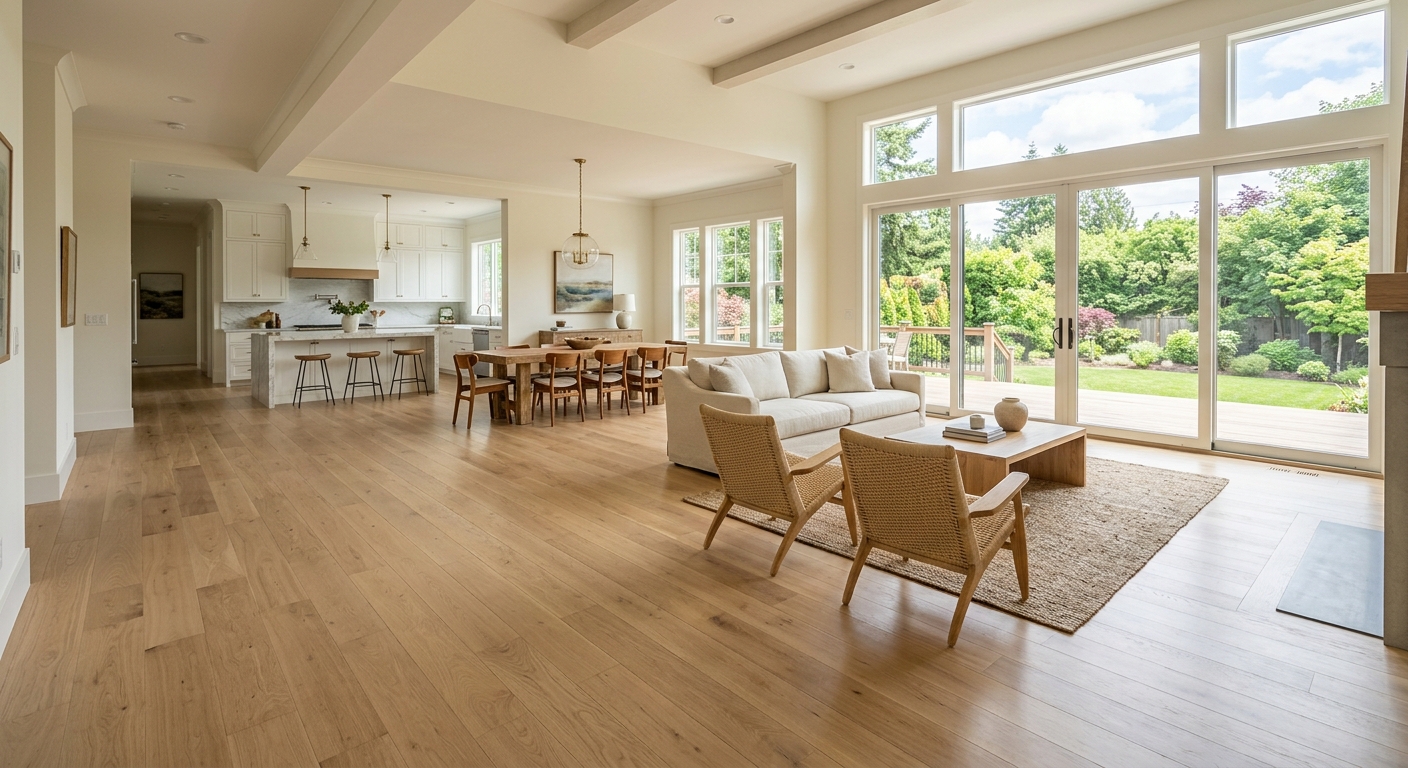
Flooring options and costs in Chapleau
In Chapleau, Ontario, the right flooring choice is less about trends and more about whether it can handle older housing, real-world traffic, and the temperature swings you feel through the winter. With 83.0% of local homes built before 1981, many projects start with subfloor prep—patching, levelling, or correcting uneven areas—before any new material goes down. That prep work is one reason your same “square footage” quote can end up higher than you expected. It also matters that Chapleau’s housing mix includes a high share of single-detached homes (71.8% of dwellings), so contractors often see installs spanning multiple exterior-facing rooms where drafts and humidity changes can be noticeable. (Statistics Canada, 2021 Census.)
In the Northeast climate, indoor humidity swings and moisture exposure—especially in basements and on lower levels—drive costs. Solid hardwood can be sensitive to humidity and is typically limited to above-grade, nail-down work. Engineered wood and luxury vinyl plank (LVP) are commonly chosen because they tolerate moisture changes and are more forgiving over Ontario subfloors that aren’t perfectly smooth. Radiant heat compatibility is also a planning point in colder regions: if your home has in-floor heating, many installers steer you toward products rated to work with heat. In Chapleau, installs are often especially in demand around the downtown/core area and along the main residential streets where older homes are common and owners refresh finishes every few decades.
Below is a practical cost snapshot you can use to compare materials and to understand how prep and install difficulty influence your total.
| Type |
Best Room |
Moisture Resistance |
Lifespan |
Price per sq ft |
| Solid hardwood (nail-down, above grade only) |
Main floor living areas |
Low (avoid basements and slab) |
25–40 years |
$11–$18 |
| Engineered hardwood (float or glue, above + on-grade) |
Main floor and hallways |
Medium to high (tolerates humidity better) |
20–35 years |
$10–$17 |
| Laminate (click-lock, above-grade) |
Living areas and bedrooms |
Medium (protect edges; avoid standing water) |
10–25 years |
$4–$10 |
| Luxury vinyl plank / LVP (waterproof, any level) |
Kitchen, main floor, basement (when finished) |
High (waterproof core) |
15–25 years |
$4–$10 |
| Porcelain / ceramic tile |
Bathrooms and wet zones |
Very high (tiles themselves resist moisture) |
25–50 years |
$12–$22 |
| Carpet (broadloom or modular tile) |
Bedrooms and stairs (as desired) |
Low to medium (avoid high-moisture basements) |
8–15 years |
$3–$8 |
Prices are estimates only and vary by project scope, site access and material selection.
What affects the price of flooring in Chapleau
In Chapleau and the wider Northeast Ontario market, you’ll often see quotes for the same “type of flooring” land 30–50% apart. The big reason is that flooring is never just the material: humidity conditions, below-grade moisture, subfloor irregularities, and finish details (stair transitions, trim removal, disposal) change the labour time and the amount of prep required. With local homeowner households owning the majority of residences (77.2% of households own), many jobs are full renos rather than small room upgrades, which increases the amount of removal, patching, and matching trims across open-plan areas. (Statistics Canada, 2021 Census.)
Technically, indoor humidity swings matter because solid hardwood expands and contracts with moisture; it cannot be glued or floated over most concrete/suspect slabs and performs poorly in basements. Engineered hardwood and LVP handle humidity and below-grade conditions far better, so they’re often the practical choices when moisture is a concern. Colder regions also favour radiant heat compatibility—when in-floor heating is present or planned, it can rule out some solid hardwood installs and limit laminate options to products rated for heat. Older regional housing stock frequently needs levelling or repair; that prep commonly adds about $1–$4 per sq ft before flooring even starts.
Two common Chapleau examples: first, if you’re replacing carpet in a finished basement, the existing underlay may be hiding moisture or unevenness—if subfloor patching is required, your cost can climb toward the higher end of the LVP band. Second, when switching from laminate to engineered hardwood on a main floor, even small high/low spots can require a longer prep window; you may spend closer to the mid range of hardwood pricing (around the $11–$18 solid hardwood band) only if the substrate is ready. If moisture remediation is required, the job often shifts from “install” to “investigate and correct,” which is where budgets either get protected or get exceeded.
| Price Factor |
Why It Matters |
Cost Impact |
| Room area in sq ft |
More flooring means more material, more labour hours, and more trim/fasteners |
Direct: larger areas typically reduce per-sq ft mobilization impact |
| Subfloor condition |
Levelling compounds, patching, and repairs are labour-intensive—especially in pre-1981 homes |
Often adds $1–$4 per sq ft before install |
| Moisture / below-grade install |
Rules out solid hardwood and can change underlayment and sealing choices |
Can add $1–$5 per sq ft if remediation or membranes are required |
| Material choice |
Solid vs. engineered vs. LVP vs. tile changes prep needs, subfloor tolerance, and install method |
Typically shifts you between bands (e.g., hardwood $11–$18 vs. LVP $4–$10) |
| Removal and disposal of existing flooring |
Carpet tack strips, old underlay, and glued-down residues take time and disposal capacity |
Often adds a noticeable line item; can be higher on basements |
| Stair nosing / transitions |
Stairs are detail work: nosing, matching heights, and transition profiles |
Usually charged per step or per linear foot; adds to total even if sq ft is small |
| Radiant heat compatibility |
Only certain products tolerate heat cycles without cupping or joint failure |
May require an upgraded material, increasing material cost |
| Installation method |
Float, glue-down, and nail-down have different labour, moisture checks, and time requirements |
Changes labour time; glue-down and tile often cost more |
Permits & regulations in Ontario
In Ontario, the flooring installation itself usually does not require a building permit. What can trigger permits is associated work that affects structure, electrical systems, or major in-floor components. For example, if you need structural subfloor repairs (like joist modification, significant sistering, or anything beyond surface patching), that may involve additional approvals depending on the extent of work. If your project includes in-floor heating upgrades or new circuits—especially any wiring tied to a heating system—electrical permits may be required through the appropriate electrical pathway.
In condominiums (and some multi-unit buildings), you also need to follow the corporation’s sound-transmission rules. Hard flooring on upper floors often has underlay requirements to meet specific STC/IIC performance targets, and board approval may be required for hardwood or tile. Even in a single family home, if you’re changing the flooring height and interfering with door clearances, vents, or any engineered assemblies, it’s smart to document what’s being adjusted.
To verify your Chapleau contractor’s compliance, ask for three things before signing: (1) their Ontario licence/registration details via the appropriate online registry search or their public business listing; (2) proof of liability insurance showing coverage limits and the effective dates; and (3) confirmation of WSIB/WCB coverage (or a clearance letter where applicable). A legitimate contractor will provide certificates on request and match the insured name on your quote contract.
Best flooring for each room in your Chapleau home
When choosing flooring in Chapleau, match the material to the room’s moisture risk, traffic pattern, and comfort needs—not just its look. Living and dining areas typically tolerate seasonal humidity changes better than basements, so engineered hardwood or high-quality laminate are common balances of warmth and durability. In a master bedroom, carpet is still a strong pick if you want quiet underfoot and softer feel during colder months; otherwise, engineered wood works well where you can maintain stable indoor humidity.
Kitchens are the “spill zone,” so luxury vinyl plank (LVP) is usually the most practical value: waterproof cores handle splashes and easy cleaning. If you prefer a premium finish, large-format porcelain or ceramic tile is an excellent moisture choice too, but it adds more labour due to prep, underlayment, setting work, and grout considerations. For bathrooms, stick with porcelain/ceramic tile only—water resistance is non-negotiable.
Basements are where Chapleau homeowners feel the climate most. LVP is the clear winner in finished basements because it’s waterproof and tolerates below-grade installs far better than solid wood and most laminate. Radiant heat compatibility is also important in Ontario homes that have (or plan) in-floor heating; installers often choose products rated for heat so performance stays consistent and gaps don’t open up.
To see where costs are justified: upgrading from laminate ($4–$10) to LVP ($4–$10) may not sound like a huge leap on paper, but if your basement has any historical moisture or you need a more forgiving install, the “extra” usually shows up as fewer failures and less rework—especially compared with trying to push solid hardwood into a damp-prone area.
| Room |
Best Material |
Why |
Moisture Risk |
Price Band per sq ft |
| Living / dining room |
Engineered hardwood |
Warm feel with better tolerance to humidity than solid; suits main-floor installs |
Low to medium |
$10–$17 |
| Master bedroom |
Carpet or engineered hardwood |
Carpet adds comfort and sound absorption; engineered wood is a durable alternative |
Low |
$3–$17 |
| Secondary bedrooms |
Laminate or carpet |
Laminate handles daily traffic well; carpet keeps things warm in winter |
Low |
$3–$10 |
| Kitchen |
Luxury vinyl plank (LVP) |
Waterproof core, easier cleanup, and good dimensional stability with spills and cleaning |
Medium |
$4–$10 |
| Basement (finished) |
Luxury vinyl plank (LVP) |
Handles below-grade moisture vapour better than solid wood; forgiving over imperfect subfloors |
High |
$4–$10 |
| Bathroom |
Porcelain / ceramic tile |
Best match for repeated wet conditions; long service life |
Very high |
$12–$22 |
How to choose a flooring contractor in Chapleau
Choosing a contractor is what keeps your project from turning into a “trial-and-error” renovation. Start with verification. For Ontario compliance, request the contractor’s Ontario registration/licence information and proof of liability insurance, then confirm WSIB/WCB coverage. You can check liability certificates for coverage dates and the insured legal name; for WSIB/WCB, ask for a clearance letter or the current confirmation document. If they hesitate, that’s a real warning sign.
Next, get 2–3 itemised written quotes instead of one lump sum. You want a breakdown that separates labour (removal, prep, install, trim work) from materials (underlayment, membranes, adhesives where needed, transitions, stair nosing) so you can compare apples to apples. Read the scope line-by-line: what’s included for subfloor levelling, moisture testing, and disposal? Is permit pulling (if needed for electrical or heating changes) included or excluded? Is moving appliances included? What’s the timeline for start and completion?
Warranty matters too. Confirm the workmanship warranty length and what it covers, and ask whether the product warranty is transferable to you. For payment, never pay more than 10–15% upfront; hold back a portion until the job is complete and cleaned up properly. Set expectations in writing for dust control, floor protection, and the final walkthrough.
- Ask for proof of Ontario registration/licence before scheduling
- Request a current liability insurance certificate with limits
- Confirm WSIB/WCB coverage (or provide a clearance letter)
- Get 2–3 quotes with a labour/materials line-item breakdown
- Insist on written scope for removal, levelling/patching, and disposal
- Confirm whether moisture testing and subfloor priming/membranes are included
- Clarify underlay requirements (especially for laminate and LVP)
- Ask about stair nosing, transitions, and how they’re priced
- Review warranty terms for both workmanship and product
- Set a payment schedule with no more than 10–15% upfront
- Get start date and completion estimate in writing
- Require floor protection and clean-up procedures at job end
In Chapleau, red flags I commonly see include: vague quotes that don’t specify underlayment/adhesives or levelling, refusing to provide insurance/WSIB paperwork, starting without discussing moisture concerns for basements, promising “solid hardwood anywhere” despite humidity/grade risks, and a payment schedule that demands most of the money upfront without a contract-backed completion date.
Frequently asked questions — flooring in Chapleau
What flooring holds up best to pets in a Chapleau home?
For most Chapleau homes, luxury vinyl plank (LVP) is the best all-rounder because it’s waterproof and handles everyday accidents without swelling like older wood floors can. It also stands up well to paw traffic and frequent cleaning with typical household cleaners. If you prefer the warmth of wood look, engineered hardwood can work on main floors, but you still need good indoor humidity control and you should keep it out of high-moisture basement zones. A budget-friendly value range is often LVP at about $4–$10 per sq ft, which is why many pet owners choose it for kitchens and main levels. Just plan for felt pads on furniture and prompt spill cleanup—“waterproof” doesn’t mean “leave water sitting for days.”
How do I fix squeaky floors in my Chapleau home?
Squeaks usually come from movement between subfloor layers or between joists and the fasteners—not from the surface finish itself. In a pre-1981 Chapleau house, the fix often starts during subfloor inspection: check for loose boards, worn nails/screws, and gaps. A contractor may add screws through the subfloor into joists, then re-secure any loose underlayment before new flooring goes down. The key is that flooring replacement doesn’t always stop squeaks if the cause remains. If you’re planning engineered wood or laminate, correcting the squeak substrate first prevents future clicking and joint separation. Budget-wise, add subfloor repair/levelling time (commonly about $1–$4 per sq ft depending on scope) so your finished floor stays stable.
What is luxury vinyl plank and is it worth it in Chapleau?
Luxury vinyl plank (LVP) is a vinyl flooring with a wear layer on top and a resilient core designed to resist water and moisture changes better than laminate and far better than solid hardwood. In Chapleau’s Northeast winters, humidity swings and basement moisture are common reasons homeowners avoid moisture-sensitive materials on lower levels. LVP is typically installed floating in many systems, which can also reduce sensitivity to minor subfloor unevenness (as long as prep is done to spec). It’s often priced in the practical band of $4–$10 per sq ft, and that’s part of why it’s so popular for kitchens and finished basements. Whether it’s “worth it” depends on your room: if you have below-grade moisture concerns, LVP usually pays off in fewer call-backs and less risk than trying to push hardwood into the wrong environment.
How much does flooring cost in Chapleau?
In Chapleau, your total project cost depends on the material band plus prep, removal, and any moisture or levelling work. As a starting point, solid hardwood commonly falls around $11–$18 per sq ft, while laminate and LVP are typically in the $4–$10 per sq ft range. Tile usually lands closer to $12–$22 per sq ft because of labour-heavy prep and setting work. Carpet installation often starts around $3–$8 per sq ft depending on product and backing. For older homes (83.0% built before 1981), you may also need subfloor levelling/repair before installation, which commonly adds roughly $1–$4 per sq ft. The best way to get accuracy is an itemised quote that separates material from labour and lists prep inclusions clearly.
Hardwood vs laminate vs vinyl plank — which is best?
“Best” in Chapleau is mostly about where you’re installing. Hardwood (especially solid hardwood) is a premium look, but solid is generally limited to above-grade, nail-down installs and it doesn’t like basement humidity swings. Laminate is a solid value option for above-grade rooms, but it’s less forgiving if spills or moisture reach the seams. Vinyl plank (LVP) is often the most practical for families because it’s waterproof and performs better over below-grade conditions. If you’re choosing strictly by cost, laminate/LVP typically sit around $4–$10 per sq ft, while solid hardwood is more like $11–$18 per sq ft. If you tell your contractor the exact rooms, existing subfloor condition, and whether there’s a basement moisture history, the decision becomes much clearer—and usually results in less rework.
What flooring is best for a Chapleau basement?
For a Chapleau basement, LVP is usually the best choice because it’s waterproof and handles moisture vapour and below-grade installs far better than solid hardwood and most laminate. Basements in older Northern Ontario homes often have more humidity variation, and even a “dry” basement can still present seasonal moisture movement. Tile can work too, especially if you manage proper underlayment and leveling, but it’s more labour-intensive due to prep and setting. Carpet is sometimes used, but it’s higher risk if moisture conditions aren’t consistently controlled. Practically, many homeowners select LVP in the $4–$10 per sq ft band, then budget for proper subfloor prep to protect the installation. The smartest step is to confirm your substrate condition and whether moisture remediation is needed before installing any finish.