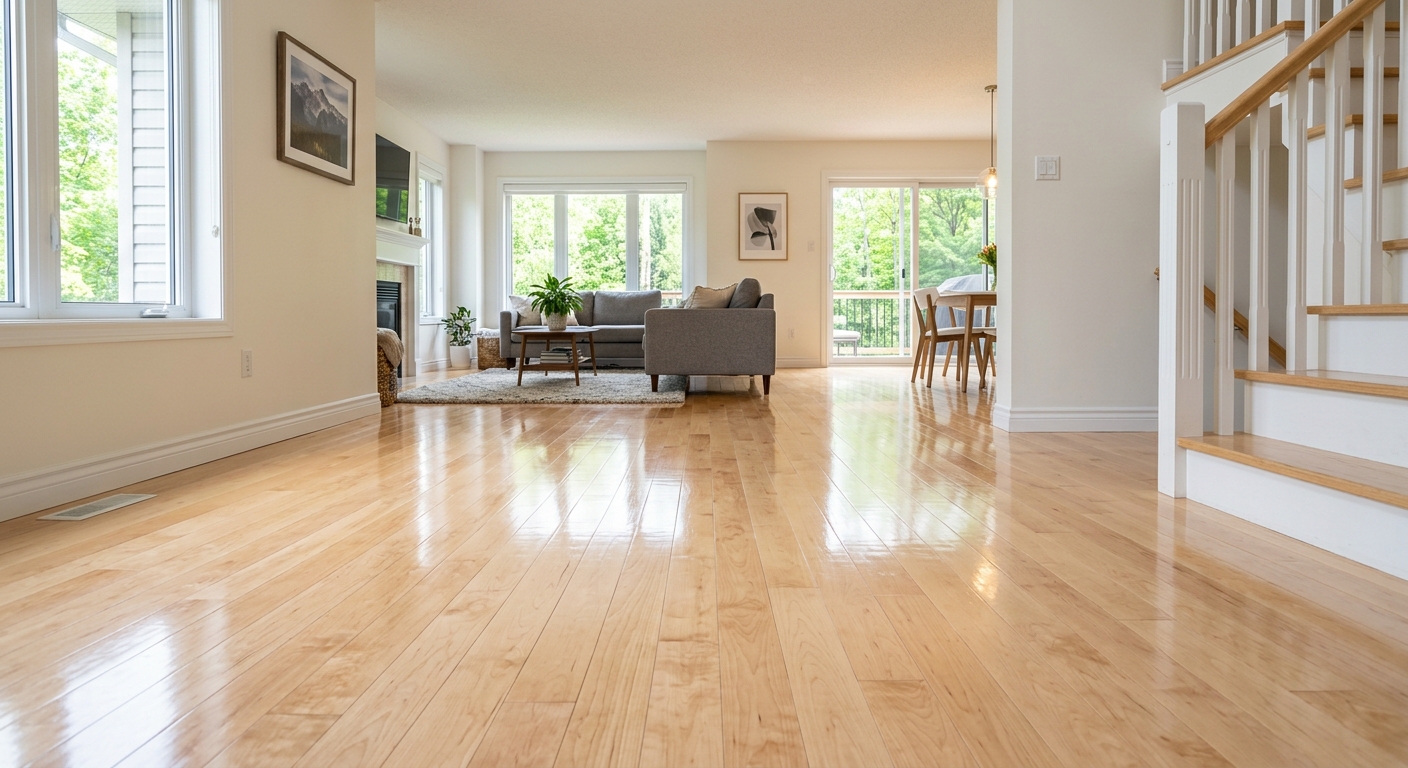
Flooring options and costs in South River
In South River, Ontario, the right flooring choice is mostly about how your home behaves—especially because a large share of housing stock is older. According to the Statistics Canada 2021 Census, 77.1% of homes in the area were built before 1981, and that age often means subfloor unevenness, patching, or moisture checks are part of “prep,” not an afterthought. When crews need to level or repair the surface before installing new flooring, it can push the total project up by roughly $1–$4 per sq ft, depending on how extensive the corrections are.
South River also sits in a climate that brings cold winters and humidity swings, which matters for dimensional stability. In the Northeast Ontario market, this is why many homeowners choose engineered hardwood or luxury vinyl plank (LVP): they handle humidity changes better than solid hardwood and are more forgiving on slab or on-grade conditions. Solid hardwood is still a premium finish, but it’s typically limited to above-grade rooms where moisture control is tighter.
Contractor availability and labour scheduling affect pricing too. When multiple homes in the same neighbourhood are lining up for renovations—like the older residential pockets along the main built-up area—quotes can vary based on how quickly subfloor prep crews and flooring installers can get on site.
With those realities in mind, here’s a practical cost comparison you can use when reviewing your estimate, before you decide what’s worth investing in.
| Type |
Best Room |
Moisture Resistance |
Lifespan |
Price per sq ft |
| Solid hardwood (nail-down, above grade only) |
Living / dining rooms, main-floor bedrooms |
Low to moderate; expands/contracts with humidity |
25–40 years (with proper conditions) |
$11–$18 |
| Engineered hardwood (float or glue, above + on-grade) |
Main floor and hallways |
Moderate to good; better dimensional stability |
15–30 years |
$9–$16 |
| Laminate (click-lock, above-grade) |
Living areas and bedrooms (dry rooms) |
Low to moderate; fails if exposed to standing water |
10–20 years |
$4–$10 |
| Luxury vinyl plank / LVP (waterproof, any level) |
Kitchen, basement, main areas needing durability |
High; waterproof core handles moisture vapour better |
15–25 years |
$6–$13 |
| Porcelain / ceramic tile |
Kitchen, bathrooms, entryways |
High when properly installed with correct underlay |
25–50 years |
$12–$22 |
| Carpet (broadloom or modular tile) |
Bedrooms; limited basement use depending on moisture |
Low to moderate; needs dry subfloor |
6–12 years |
$3–$8 |
Prices are estimates only and vary by project scope, site access and material selection.
What affects the price of flooring in South River
In South River and across Ontario’s Northeast region, quotes for the “same” flooring can differ by 30–50% because the hidden work varies: subfloor preparation, moisture testing, underlayment selection, and how many transitions or stairs are involved. Two homes may both be 800 sq ft, but if one has a sound subfloor and the other has uneven concrete or damaged OSB from prior leaks, the labour and materials change dramatically.
Technically, indoor humidity swings and any below-grade moisture are the key drivers. Solid hardwood expands and contracts with humidity and performs poorly in basements; it also can’t be glued or floated over concrete in the typical way homeowners expect. Engineered hardwood and LVP handle humidity and below-grade applications far better, which keeps the project from turning into a long, troubleshooting-heavy install. Colder regions (including homes that are draftier and more humidity-sensitive) also favour radiant heat compatibility—so most of your flooring choices will be constrained if you’re planning in-floor heating.
Local examples in South River usually show up in the prep. If you’re retrofitting over an older subfloor built before 1981 (Statistics Canada, 2021 Census), you may need levelling compound, patching, or moisture remediation—adding roughly $1–$4 per sq ft. If your quote is for LVP but includes proper vapour-control steps, it can land in the laminate/vinyl band; if the same home were done in tile instead, the labour-intensive setting work can push costs toward the $12–$22 sq ft range.
The bottom line: flooring material price bands—like laminate/LVP around $4–$10 and tile around $12–$22—are only part of the story. The rest is what your subfloor and moisture conditions demand.
| Price Factor |
Why It Matters |
Cost Impact |
| Room area in sq ft |
Larger areas increase materials and installer hours |
Direct: ±5–15% per 100 sq ft, depending on layout |
| Subfloor condition |
Levelling/repair is labour-intensive and may require materials |
Typically +$1–$4 per sq ft |
| Moisture / below-grade install |
Rules out solid hardwood; requires correct vapour control for some systems |
Can add $0.50–$3 per sq ft |
| Material choice |
Solid vs engineered vs LVP vs tile changes both product and prep needs |
Often swings total cost by 20–60% |
| Removal and disposal of existing flooring |
Old adhesive, underlay, and subfloor damage can extend the job |
Commonly +$300–$1,500 total depending on thickness and access |
| Stair nosing / transitions |
Transitions are measured and installed per step or per linear foot |
Often +$150–$600 total |
| Radiant heat compatibility |
Limits material types and may require specific underlayment |
Can add $0.50–$2 per sq ft |
| Installation method |
Float vs glue-down vs nail-down affects labour time and flatness requirements |
Can vary by $1–$3 per sq ft for the same room |
Permits & regulations in Ontario
In Ontario, the flooring installation itself typically does not require a building permit. That said, some associated work can trigger permit or inspection requirements, especially when it touches electrical systems or structural elements. For example, if you’re installing or modifying in-floor heating circuits (radiant heat), the electrical portion may require an electrical permit and work by an appropriately licensed electrical contractor. If you need structural subfloor repair that affects support, you may also see permit requirements depending on the extent of modifications.
In condominiums, the biggest constraint is often the building’s sound-transmission rules. Even when a permit isn’t required, condo corporations commonly require specific underlay and installation methods to meet sound targets (STC/IIC performance). Before installing hardwood or tile on upper floors, review the condo declaration and request board approval in writing—especially if you’re changing flooring thickness or removing existing sound-rated underlay.
For South River homeowners, verify a contractor properly before work begins:
- Confirm their Ontario licence status where applicable for the trade/service they perform (and that they are registered for the scope of work).
- Request a clearance letter or proof of status if they are an incorporated business.
- Ask for WSIB/WCB coverage evidence (or a clearance letter/waiver confirmation if they are not required).
- Provide liability insurance certificate naming you as additional insured where possible.
- Use the contractor’s certificate of insurance—don’t rely on verbal reassurance.
Best flooring for each room in your South River home
Choosing flooring room-by-room is especially important in South River because moisture tolerance and comfort needs change as you move through the house. For living and dining areas, homeowners usually want warmth underfoot and long-term looks; engineered hardwood or high-quality laminate can deliver a practical balance, as long as the subfloor is properly prepped. In master bedrooms, carpet remains a strong option for comfort and sound absorption, provided the basement is dry and the bedroom subfloor stays stable.
Kitchens are a different story: splashes, standing water risk, and easier cleaning push many households toward luxury vinyl plank (LVP) or large-format porcelain tile. In finished basements, LVP is often the best choice because it’s fully waterproof and handles below-grade moisture conditions far better than solid wood and most laminate. Bathrooms should be porcelain or ceramic tile only, with correct installation details to manage moisture at joints and edges.
Radiant heat compatibility is also worth planning for. If your home has in-floor heating (or you’re adding it), solid hardwood is often less predictable than engineered products and LVP designed for heat—so your installer should confirm the product’s radiant rating before you buy.
To justify the extra cost with real numbers: switching from laminate around $4–$10 to LVP around $6–$13 can be worth it in kitchens or basements because it reduces the risk of edge swelling and damage from spills or damp subfloor conditions—costly problems that laminate and many “water-resistant” products can’t reliably prevent.
| Room |
Best Material |
Why |
Moisture Risk |
Price Band per sq ft |
| Living / dining room |
Engineered hardwood |
Warm feel with better stability than solid in typical Ontario humidity swings |
Low (if above-grade and HVAC-controlled) |
$9–$16 |
| Master bedroom |
Carpet or engineered hardwood |
Carpet adds comfort and sound; engineered holds up well if subfloor is level |
Low to moderate |
$3–$16 |
| Secondary bedrooms |
Laminate (click-lock) or carpet |
Good value and easy maintenance in dry rooms |
Low to moderate |
$4–$10 |
| Kitchen |
Luxury vinyl plank (LVP) |
Waterproof core supports spills, fast cleanup, and high traffic durability |
Moderate to high |
$6–$13 |
| Basement (finished) |
Luxury vinyl plank (LVP) |
Best match for below-grade moisture tolerance and vapour-handling |
High |
$6–$13 |
| Bathroom |
Porcelain / ceramic tile |
Most dependable wet-area finish with long service life |
High |
$12–$22 |
How to choose a flooring contractor in South River
For homeowners in South River, protecting your project starts with verification. First, confirm Ontario licensing status for the specific scope they’re advertising, and ask for proof of liability insurance (certificate available before the job starts). Next, request evidence of WSIB/WCB coverage or a clearance letter where applicable—this matters if an installer is injured on your property. Don’t accept “we’re covered” as a statement; ask to see documents.
Then get 2–3 itemised written quotes rather than one lump-sum number. A proper quote separates materials and labour, lists underlayment/vapour-control items, includes stair nosing and transitions, and names any levelling or patching work. Pay close attention to what’s excluded: some contractors remove existing flooring but don’t include disposal, while others include prep materials but not subfloor repair.
Warranty matters in two categories: workmanship and product. Ask how long the installer warranty lasts, whether it’s transferable to a future owner, and what voids it (often improper maintenance, wrong underlayment, or changes to heating systems). Payment schedule should be conservative—never more than about 10–15% upfront, and hold back enough to ensure completion.
Finally, timeline: insist on a written start date and completion estimate. In older homes built before 1981 (Statistics Canada, 2021 Census), prep can add days if moisture or flatness issues show up after removal.
- Ask for proof of liability insurance and confirm the coverage is current.
- Request WSIB/WCB coverage documentation or clearance letter.
- Verify the installer’s Ontario registration/licensing for the scope of work.
- Get itemised quotes: materials, labour, underlay/vapour barrier, and levelling compound.
- Confirm removal scope and disposal (“haul away” included or not).
- Make sure stair nosing and transitions are priced per step/linear foot where applicable.
- Confirm who supplies transition strips, trims, and thresholds (and the finish colour).
- Ask about subfloor flatness requirements and how they measure before install.
- For basements, require a moisture/vapour plan if LVP is being installed.
- Request their workmanship warranty terms in writing.
- Agree on a payment schedule with a final holdback until completion.
- Get start and completion dates in the contract or proposal.
Red flags in South River include: refusing to provide insurance/WSIB documents, quoting without listing prep (levelling/patching/moisture steps), using “all-in” pricing with no disposal details, promising hardwood in basements without a moisture plan, and pressuring you to pay most of the job upfront.
Frequently asked questions — flooring in South River
What is the difference between floating and glued-down flooring?
In South River Ontario, floating floors are typically click-lock planks or boards that rest over an underlayment without being mechanically fixed to the subfloor. They “float” with a small movement allowance, which is why good subfloor flatness still matters, but they can be more forgiving than glue-down in some situations. Glued-down flooring is attached directly to the subfloor using adhesive, which can reduce movement and feel more solid underfoot, but it requires strict subfloor condition—especially with moisture on concrete or below-grade areas.
As a practical cost note, glued-down installs can cost more due to extra prep and careful adhesive work. If you’re shopping price bands, laminate around $4–$10 is usually floating, while engineered hardwood pricing often sits closer to $9–$16 depending on whether it’s nail-down, click, or glue-down. Your installer should describe the method they’ll use and why it matches your subfloor and moisture situation.
What flooring holds up best to pets in a South River home?
For pet households in South River, the best “survive-real-life” option is usually luxury vinyl plank (LVP) with a solid waterproof core and a wear layer designed for heavy traffic. It tolerates spills, scrapes, and frequent cleanups better than laminate, and it won’t swell the way many wood-based products can when moisture gets into seams. For added comfort, choose a product with a thicker pad built in or pair it with the correct underlayment (only if the manufacturer allows it).
If you prefer hardwood, engineered hardwood is often more practical than solid in homes with humidity swings, but it still isn’t as forgiving as waterproof vinyl. Carpet can be comfortable for pets, yet it can be harder to manage if your home has any dampness—especially if you’re installing into a basement.
In terms of budget, LVP commonly lands in the $6–$13 band, while laminate often sits around $4–$10; the extra for LVP is usually justified by moisture tolerance and easier cleanup.
How do I fix squeaky floors in my South River home?
Squeaks are usually a framing or subfloor issue, not a flooring “surface” problem. In older South River homes—where many were built before 1981 (Statistics Canada, 2021 Census)—subfloor fasteners can loosen over time, or the subfloor can flex. Before you replace flooring, a good contractor will inspect joists, identify where movement is coming from, and confirm whether the subfloor can be reinforced or re-fastened safely.
Often, the fix is to tighten or add screws/fasteners into the joists and reduce movement, sometimes with shimming or targeted repairs. If the squeak is caused by an uneven or poorly supported area, levelling compound won’t stop the noise; it only addresses surface flatness. That’s why it’s worth getting a scope that includes subfloor evaluation—especially if your quote mentions levelling.
Once the squeak is resolved, you can choose an install method that matches the repaired structure. For example, floating laminate around $4–$10 may still squeak if the subfloor underneath moves, while a properly prepped engineered or LVP system generally performs better.
What is luxury vinyl plank and is it worth it in South River?
Luxury vinyl plank (LVP) is a manufactured floor with a wear layer on top and a vinyl core (often described as waterproof) beneath. In South River and throughout Ontario, it’s commonly chosen because it tolerates humidity swings and handles below-grade moisture situations better than solid hardwood and most laminate. If your basement has even occasional dampness, LVP is often the safest “whole-house” value play without needing to overthink long-term dimensional stability.
Is it worth it? For many homeowners, yes—especially when you factor in risk. Laminate in the $4–$10 band can be a budget-friendly look, but a spill, damp concrete edge, or vapour migration can cause swelling at seams. LVP usually costs more, often in the $6–$13 band, but it protects your investment by resisting moisture damage.
Worth noting: LVP still requires correct subfloor prep and proper vapour-control steps on concrete. A good installer will include those details in the quote.
How much does flooring cost in South River?
Flooring cost in South River depends on product type and how much preparation your subfloor needs. As a general guide, laminate and vinyl plank often land in the $4–$10 range, while solid hardwood and higher-end engineered hardwood typically sit higher—solid hardwood commonly falls in the $11–$18 band. Tile is usually in the $12–$22 band because the labour-intensive setting and finishing work takes more time.
Because many homes in the area were built before 1981 (Statistics Canada, 2021 Census), flatness and repair work is a frequent pricing variable. If levelling compound or subfloor patching is required, you may see an additional $1–$4 per sq ft for prep, which is why itemised quotes matter. Also consider removal/disposal, stair nosing, and transitions—those can meaningfully change the total even when the room area is the same.
If you share your approximate sq ft and basement vs main-floor areas, I can help you compare whether a quote is aligned with the right material band.
Hardwood vs laminate vs vinyl plank — which is best?
In South River Ontario, “best” depends on moisture exposure and your tolerance for long-term care. Hardwood (especially solid) is beautiful, but it performs best above-grade with stable humidity. If your home is older and may have humidity swings or a basement environment you can’t fully control, solid hardwood can be a higher-risk choice because it expands and contracts and is not suited for typical below-grade installs.
Laminate is usually the best value look for dry rooms. It’s commonly in the $4–$10 band and is easier to maintain than carpet, but it isn’t truly waterproof; spills or damp subfloor conditions can damage edges and seams over time.
Luxury vinyl plank is often the most practical all-weather option. With a waterproof core, it handles kitchen and basement use better than laminate and typically costs in the $6–$13 band. If you want maximum durability for pets, spills, and variable humidity, LVP is usually the winner for many Northeast Ontario homeowners.
If you’re considering radiant heat, ask your contractor which materials are rated for it before you choose—product suitability can outweigh the price difference.