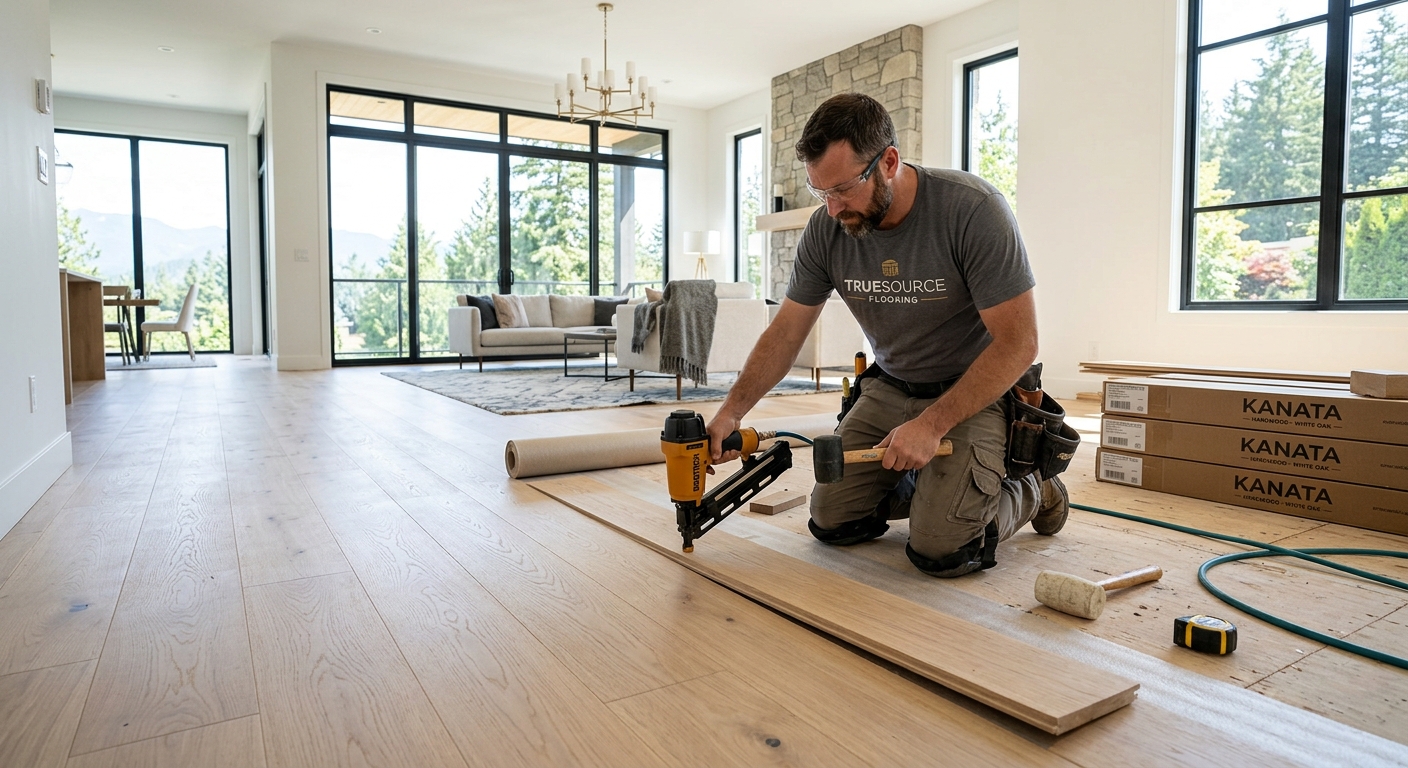
Flooring options and costs in Junction Area
Flooring in Junction Area, Ontario is priced and delivered through a busy Toronto-area renovation market, and the right choice depends heavily on moisture conditions. With a 2021 population of 14,366 in Junction Area (Statistics Canada, 2021 Census), you’ll find plenty of contractors competing for work, but also a lot of older homes where subfloor prep is the real cost driver. Even when your finished floor choice looks mid-range, older regional housing stock often needs levelling, plywood replacement, or moisture mitigation before install—especially where previous repairs or original subfloors weren’t designed for today’s tighter building envelopes. That prep commonly moves projects upward within the $9–$18 hardwood band and the $4–$9 laminate/LVP band, rather than staying strictly in your material-only estimate.
Toronto-area homes also see wide indoor humidity swings across seasons. Solid hardwood expands and contracts more with moisture, and it’s risky over concrete and in basements. For that reason, many homeowners in the Junction Triangle/nearby Bloor West Village area lean toward engineered hardwood or luxury vinyl plank (LVP), which are more dimensionally stable for on-grade and below-grade installs. If you’re adding radiant floor heating (common in newer custom builds), that also affects the quote because many contractors steer you to engineered wood, tile, and certain vinyl systems over traditional solid hardwood.
Use the table below as a budgeting baseline for Junction Area projects, then expect a final number once your subfloor condition and room measurements are confirmed.
| Type |
Best Room |
Moisture Resistance |
Lifespan |
Price per sq ft |
| Solid hardwood (nail-down, above grade only) |
Living / dining on wood subfloor |
Low to moderate; avoid basements and high-humidity installs |
20–35 years |
$9–$18 |
| Engineered hardwood (float or glue, above + on-grade) |
Living / dining / bedrooms |
Moderate to high; more stable with humidity and some below-grade systems |
15–30 years |
$10–$16 |
| Laminate (click-lock, above-grade) |
Bedrooms / hallways |
Moderate; relies on dry subfloor and proper underlay |
10–25 years |
$4–$9 |
| Luxury vinyl plank / LVP (waterproof, any level) |
Kitchens / basements / main floors with moisture risk |
High; waterproof core for spills and below-grade vapour conditions |
15–25 years |
$6–$12 |
| Porcelain / ceramic tile |
Kitchen / bathroom / entry |
Very high; handles moisture and wet areas |
25–50 years |
$12–$25 |
| Carpet (broadloom or modular tile) |
Master / secondary bedrooms |
Low; protect from damp basements and high-spot moisture |
8–15 years |
$5–$11 |
Prices are estimates only and vary by project scope, site access and material selection.
What affects the price of flooring in Junction Area
In Junction Area and across the wider Toronto market, quotes for what looks like the same flooring job can vary by 30% to 50% because contractors price the “hidden work” differently. The big technical driver is Toronto’s indoor humidity swings across seasons. When indoor moisture rises and falls, solid hardwood expands and contracts more, which is why it’s typically limited to above-grade installs on stable subfloors. Basements and concrete floors add risk: solid hardwood cannot be glued or floated over concrete, and it performs poorly where moisture vapour is present. By contrast, engineered hardwood and luxury vinyl plank are designed to handle humidity and—when installed with the right underlayment and vapour control—can better suit on-grade and below-grade applications.
Another cost driver is older housing stock. Many homes from the 1960s–1990s frequently require subfloor levelling, plywood replacement, or moisture mitigation before install. That prep can add roughly $1 to $4 per sq ft, and on a 600 sq ft project it’s the difference between, say, staying near the $4–$9 laminate/LVP band versus creeping toward the $9–$18 hardwood band. Concrete examples in Junction Area include: (1) a lumpy plywood subfloor that needs levelling compound and patching to prevent “telegraphing”; (2) damp concrete slabs where a vapour barrier and proper adhesive system are mandatory, pushing LVP or engineered options upward but avoiding future callbacks; and (3) homes with busy staircases where stair nosing and transitions become a labour add-on.
Finally, labour and availability also matter: renovation demand is strong in the Toronto area, so rates can be higher than many other provinces. That’s why the same material choice can still land at different totals depending on prep and install method.
| Price Factor |
Why It Matters |
Cost Impact |
| Room area in sq ft |
Material quantity and labour time scale directly with square footage |
Large projects often average lower per sq ft; small rooms cost more per sq ft |
| Subfloor condition — levelling or repair needed before install |
Toronto-area older homes often need patching, shimming, or plywood replacement |
Typically adds $1–$4/sq ft to prep-heavy jobs |
| Moisture / below-grade install — rules out solid hardwood |
Moisture vapour requires product systems made for concrete/basements |
Often shifts you from solid hardwood toward engineered wood or LVP |
| Material choice — solid vs. engineered vs. LVP vs. tile |
Different products sit in different price bands and require different underlay/adhesives |
Can swing totals across ~$4–$25/sq ft depending on type |
| Removal and disposal of existing flooring |
Demo time and waste fees vary based on adhesive and subfloor condition |
Commonly adds a noticeable labour line item versus “no removal” cases |
| Stair nosing / transitions — charged per step or per linear foot |
Transitions need careful matching and finishing around thresholds and stairs |
Often increases cost on homes with more landings and varied flooring |
| Radiant heat compatibility — limits material options |
Heat cycles affect expansion; not every product tolerates it |
May move you away from traditional solid hardwood and certain laminate builds |
| Installation method — float vs. glue-down vs. nail-down |
Method changes labour intensity, adhesive/underlay, and substrate requirements |
Glue-down and nail-down often cost more than simple floating |
Permits & regulations in Ontario
In Ontario, flooring installation itself typically does not require a building permit. That said, associated work can trigger permitting and inspections—especially anything involving electrical circuits or structural changes. For example, if you’re installing or modifying in-floor heating (radiant systems), you may need an electrical permit and the job must be handled by qualified trades. Moisture remediation can also involve procedures that go beyond standard flooring work if it becomes part of a larger moisture mitigation scope (for instance, engineered waterproofing, not just surface prep). If your project includes structural subfloor repair—especially where joists are altered or floors are rebuilt—you should confirm permit requirements with your local authority and the contractor’s licensing coverage.
In condominiums, the bigger “permission” hurdle is often the building’s rules. Many condo corporations restrict hard-surface flooring sound transfer on upper floors using STC/IIC requirements and require specific underlay systems. Before you start, review the condo declaration, ask for the documentation the corporation requires, and get any approval in writing. This is especially important for engineered hardwood, tile, and LVP where underlayment and subfloor prep directly affect sound performance.
To verify your contractor in Junction Area, Ontario, do three checks: (1) Ontario business licence/contractor credentials where applicable in your municipality and confirm they’re registered to do the work they’re proposing; (2) request a Certificate of Insurance showing liability coverage; and (3) ask for evidence of WSIB/WCB clearance (or a clearance letter where applicable). Make sure the certificate matches the job address, and keep copies with your contract.
Best flooring for each room in your Junction Area home
Choosing flooring for Junction Area comes down to matching each room’s moisture exposure, foot traffic and comfort needs to a product that performs through Toronto’s humidity swings. For living and dining spaces, engineered hardwood or high-quality laminate tends to balance warmth with durability—especially because engineered wood is more stable than solid hardwood when indoor humidity changes seasonally. In bedrooms, homeowners often prefer carpet for comfort and sound absorption; it also reduces echo in busy, older housing layouts where echo can be noticeable.
For kitchens, the best value usually comes from luxury vinyl plank (LVP) or large-format porcelain tile. LVP gives you waterproof spill resistance and forgiving installation over slightly uneven subfloors when paired with the right prep. Tile is ideal where you want maximum water resistance and easy cleaning—just remember that underlayment and subfloor flatness still matter. In finished basements, LVP is the clear winner for most Junction Area homes because it handles moisture vapour and below-grade conditions better than solid wood or most laminate systems.
Bathrooms should be porcelain or ceramic tile with a proper waterproofing plan. If your home is over radiant floor heating (common in new builds), engineered wood, tile and certain vinyl products are typically better matches than traditional solid hardwood because of heat-cycle expansion and warranty constraints.
As a practical example: if you have a 300 sq ft kitchen and you’re choosing between LVP (~$6–$12/sq ft) and porcelain tile (~$12–$25/sq ft), the tile upgrade can be worth it when you prioritize long-term water resistance and cleaning—otherwise LVP often delivers similar daily usability for less money.
| Room |
Best Material |
Why |
Moisture Risk |
Price Band per sq ft |
| Living / dining room |
Engineered hardwood |
Stable with humidity swings; looks like real wood without as much movement risk as solid |
Low to moderate (humidity-driven, not spill-prone) |
$10–$16 |
| Master bedroom |
Carpet or engineered hardwood |
Carpet adds comfort and sound absorption; engineered wood gives a cleaner feel |
Low |
$5–$11 |
| Secondary bedrooms |
Laminate or carpet |
Laminate holds up to everyday traffic; carpet helps with warmth and noise |
Low |
$4–$9 |
| Kitchen |
Luxury vinyl plank (LVP) or porcelain tile |
Easy cleaning and spill tolerance; tile adds maximum water durability |
Moderate to high (spills, wet mops) |
$6–$25 |
| Basement (finished) |
LVP |
Waterproof performance for below-grade moisture vapour; dependable over concrete with correct prep |
High if unmanaged moisture exists |
$6–$12 |
| Bathroom |
Porcelain / ceramic tile |
Best-in-class moisture handling for wet areas |
Very high |
$12–$25 |
How to choose a flooring contractor in Junction Area
When you hire a flooring contractor in Junction Area, Ontario, you want both proper coverage and a detailed scope. Start by verifying licensing/credentials where applicable, then request documentation for liability insurance and WSIB/WCB coverage. Ask for a Certificate of Insurance showing your address (or proof it covers their work generally) and a WSIB/WCB clearance letter; don’t accept vague statements. Next, get 2–3 itemised written quotes that break out labour and materials instead of one lump sum. The quote should clearly list: floor removal, subfloor prep/levelling, underlayment/vapour barrier, transitions and stair work, and disposal.
Read the scope carefully for what’s excluded—common gaps include moving appliances, patching beyond a limited area, replacing damaged subfloor, permit fees (if radiant heating work is involved), and any additional levelling required after demo. Warranty terms matter: confirm the workmanship warranty length, how manufacturer warranties apply to the specific product you’re buying, and whether warranties transfer to future owners. Also confirm payment schedule: never pay more than about 10% to 15% upfront, and use a holdback tied to completion and punch-list signoff. Finally, lock in the timeline—start date and estimated completion should be written into the agreement.
- Confirm liability insurance and request the COI before work starts.
- Provide WSIB/WCB clearance documentation (or clearance letter).
- Get itemised quotes: labour, materials, underlay/vapour barrier, transitions, and disposal.
- Ensure the quote states whether subfloor levelling is included or only “as required” with a rate.
- Ask who handles moisture testing/assessment if the slab or basement shows dampness.
- Check whether stair nosings and thresholds are priced per step/linear foot.
- Confirm whether floor removal includes underlayment tack strips and adhesive scraping.
- Verify the underlayment/vapour barrier system is specified for your product and basement/on-grade conditions.
- Ask how floor transitions will be finished (T-moldings, reducers, flush transitions).
- Get start date and completion estimate in writing, including weather-related delays for exterior access.
- Clarify warranty: workmanship duration, exclusions, and manufacturer warranty registration steps.
- Use a payment schedule with a holdback until you approve final condition.
Red flags in the Junction Area market: a contractor who won’t provide WSIB/WCB clearance or insurance documents on request, quotes that don’t list subfloor prep scope, “materials included” without specifying product grade/thickness/wear layer, payment requests for large upfront deposits, and vague schedules that don’t state start/completion dates or cannot explain how moisture will be managed.
Frequently asked questions — flooring in Junction Area
Can I install flooring over existing tile in Junction Area?
Often, yes, but it depends on how level and bonded the existing tile is. For most homeowners in Junction Area, the priority is substrate flatness and moisture control: click-lock laminate and many LVP systems can be installed over tile if the tile surface is solid, firmly attached, and within acceptable flatness tolerances. However, if grout lines are high or the tile is loose, you’ll usually need grinding/patching or removal to avoid movement and joint failure. Tile over tile can also raise floor height, which matters for doors and stair transitions. If you’re considering tile again, the install follows a different preparation approach. If your existing tile is cracked or there’s any musty odour from below-grade areas, plan for moisture assessment before you spend in the $6–$12 LVP band or the $12–$25 tile band.
What is the best flooring for a high-traffic area in Junction Area?
For high-traffic spaces in Ontario—entryways, hallways, and main living routes—durability and dimensional stability matter as much as wear layer. In Junction Area homes, I commonly recommend LVP for high-traffic areas because it handles spills and humidity swings better than solid hardwood, and it’s forgiving over real-world subfloor variations. If you prefer a wood look, engineered hardwood with a strong wear layer is also a great choice for upper floors, provided the subfloor is prepared properly. Laminate can work too, but it still relies on a dry substrate and proper underlay. A practical budgeting approach: if LVP comes in around the $6–$12/sq ft range and you’re looking at laminate around $4–$9/sq ft, the extra cost is often justified where the traffic includes moisture tracking (salt/snow melt) or frequent mopping—common in Toronto-area households.
How do I prepare my subfloor before new flooring?
Subfloor prep is where Junction Area projects succeed or fail, especially because older regional housing stock frequently needs levelling or repair. The general steps are: remove existing coverings and adhesives that could interfere with flatness; inspect for loose materials and replace any damaged plywood; check the substrate for moisture (especially on concrete and in basements); and flatten the surface to the manufacturer’s tolerances using appropriate patch/levelling compounds. For engineered hardwood and LVP, the wrong underlayment or skipping vapour barrier steps can lead to movement, mouldy odours, or surface failure. If you’re installing over concrete, you may need a vapour barrier and a moisture plan tailored to your product system. Expect that prep line item to be part of the difference between a “simple” laminate quote in the $4–$9 band and a higher total once levelling and plywood repair are included—often adding roughly $1–$4 per sq ft.
Is cork or bamboo flooring a good choice in Junction Area?
Cork can be a comfortable, quiet option, but it’s still sensitive to sustained moisture and can be a poor match for below-grade installations in Junction Area basements unless you use a fully compatible floating system with correct moisture protection. Bamboo behaves more like hardwood in terms of movement, meaning it can be impacted by Ontario humidity swings if your home doesn’t maintain stable indoor moisture levels. In practice, for many Toronto-area homeowners, the most predictable outcomes come from engineered hardwood or LVP for wood-like looks with better dimensional stability. If you love cork or bamboo for appearance, I’d steer you to products that explicitly tolerate Ontario indoor humidity ranges and specify a recommended underlayment/vapour barrier system for your install method (floating vs glue-down). Otherwise, you risk spending near the $9–$18 hardwood band without getting the stability you’ll want in a climate with seasonal humidity changes.
What is the difference between floating and glued-down flooring?
Floating flooring is installed as a “click” system or sometimes a loose-lay approach, where the planks/boards sit over an underlayment and expand/contract with humidity without being chemically bonded to the subfloor. That’s why floating products can be easier to install and are often chosen for laminate and many LVP systems. Glued-down flooring is bonded directly to the subfloor (common with some engineered hardwood and certain vinyl systems), which can improve stability and reduce “give” underfoot—but it demands a very flat, clean substrate and strict moisture/vapour control. In Junction Area homes, Toronto’s humidity swings make it important to follow the manufacturer’s expansion gap and underlayment guidance for floating floors. If moisture is a concern (common in basements), floating LVP with the right vapour barrier often performs more predictably than solid hardwood, while glue-down systems may require additional moisture mitigation to meet warranty conditions.
What flooring holds up best to pets in a Junction Area home?
For pet owners in Ontario, the best flooring usually balances scratch resistance, cleanability, and moisture tolerance. In Junction Area, luxury vinyl plank (LVP) is a top choice because it’s waterproof for accidents and generally easier to maintain when pets track in moisture. Look for a thicker wear layer and a well-rated construction (the contractor should be able to tell you the wear layer and warranty terms). Engineered hardwood can work if you’re careful with claws and use protective pads, but it can be less forgiving if urine or high moisture is left to sit—especially in basements or over concrete where moisture vapour is a concern. Carpet can be comfortable, but it stains and holds odours if not cleaned quickly. Budget-wise, many pet-friendly LVP projects fall in the $6–$12/sq ft range, which is often a better long-term value than carpet at $5–$11/sq ft when you factor in cleaning and replacement timing.